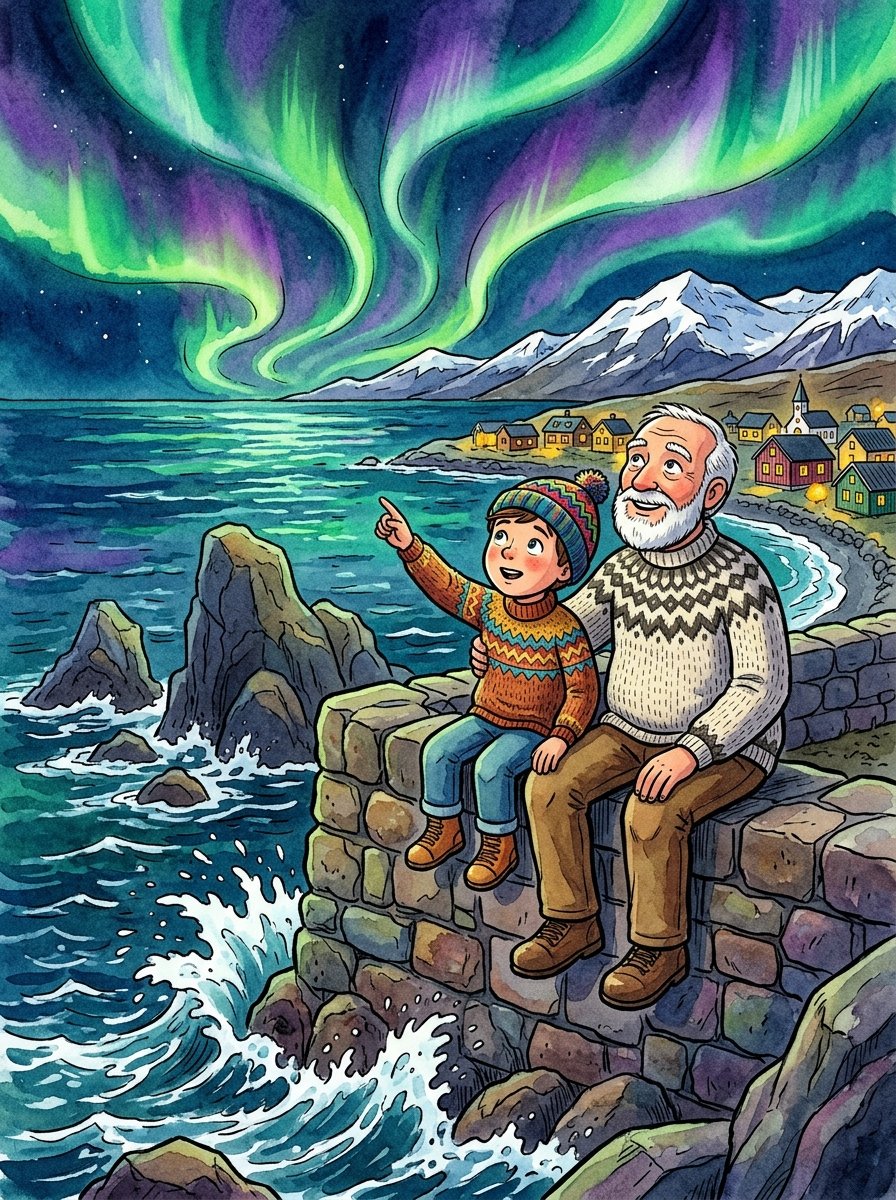
The sky was dark and the sea was cold and Einar was waiting.
He sat on the stone wall beside his grandfather, wrapped in two sweaters and a scarf that his grandmother had knitted so thick it felt like wearing a small tent. The wind came off the cold Atlantic with a sharp, salty bite that found every gap in his clothing. But he did not move. He was waiting for the lights.
His grandfather, Jón, sat beside him with his hands in his pockets and his cap pulled low. He had been waiting for the lights longer than Einar had been alive. He had been waiting for them since he was a boy himself, sitting on this same wall, looking at this same sky.
"They are late tonight," said Einar.
"The lights are never late," said Jón. "They come when they come. You cannot rush the sky."
Einar looked up. The sky was black and vast and full of stars, but there were no lights. Not yet. The air was clear and cold, which meant it might be a good night. Or it might be nothing. You never knew with the lights.
"How long do we wait?" said Einar.
"As long as it takes."
They sat in silence. The sea crashed against the rocks below the wall, a steady, patient rhythm that had been going on for longer than anyone could remember. Somewhere behind them, the town was quiet — a few windows lit, a few cars passing, the rest of the world asleep.
"Do you remember the first time you saw them?" said Einar.
Jón was quiet for a moment. He looked out at the sea, as if the answer was out there somewhere, floating on the water. "I was about your age. My father brought me to this wall. We waited for three hours. I thought he was mad. I told him I was hungry and cold and I wanted to go home. He said: 'A little longer. The sky is about to show you something.' And then..." He stopped. He looked at the sky. "And then the sky caught fire."
"Caught fire?"
"Not like a real fire. Like... the sky was remembering something. Something bright."
Einar looked at his grandfather. Jón's face was old and weathered and full of the kind of lines that come from a life lived outdoors, in wind and salt and weather. But his eyes were young when he talked about the lights.
"What do you think they are?" said Einar.
Jón looked at him. "What do you think?"
"I don't know. Dad says it's gases in the atmosphere. He showed me a book."
"Your father is a sensible man. He sees the world the way it is."
"But you don't think that's what they are."
Jón looked at the sky. "I think gases are one way of explaining it. But there are other ways."
"Like what?"
"Like the old story."
Einar turned on the wall to face him. "Tell me."
Jón pulled his cap lower and settled into the kind of stillness that meant he was about to speak for a long time.
"Before the houses," he said, "before the roads, before the harbour and the lighthouse and the school — there was just the land and the sea and the sky. And the people who lived here were fisherfolk. They went out on the water in small boats, and sometimes they came back, and sometimes they did not."
He paused. The sea crashed against the rocks.
"When the storms came, the boats were swallowed. The men who sailed them were lost. Their wives and children waited on the shore, watching the water, hoping. But the men did not come back."
Einar was quiet. He had heard stories about the sea before — everyone in Iceland had. The sea took people. That was what it did.
"But the men did not disappear," said Jón. "Not really. Their spirits rose from the water and climbed into the sky. They became the lights."
"The lights are fishermen?"
"The old story says so. The men who were lost at sea became the aurora. Their spirits shine in the sky, watching over the families they left behind. When you see the lights, you are seeing the ones who went out on the water and did not come home."
Einar looked at the sky. It was still dark. Still empty. But now it felt different. It felt like a place where something might appear.
"So the lights are ghosts?" he said.
"The old story says spirits. There is a difference."
"What's the difference?"
"A ghost is something that is gone. A spirit is something that remains. A ghost haunts. A spirit watches. There is a kindness in a spirit that a ghost does not have."
Einar thought about this. "Do you believe it?"
Jón looked at him for a long moment. "I believe it is a beautiful story. And I believe that some beautiful stories are true in ways that books of gases cannot explain."
The wind picked up. The sea grew louder. And then, at the edge of the sky, where the darkness met the horizon, a faint green glow appeared.
"There," said Jón quietly.
Einar stood on the wall. The glow was faint at first, like a smudge of paint on the dark canvas of the sky. But it grew. It spread. It moved.
The lights began to dance.
They swept across the sky in great curving arcs, green and white and sometimes purple, folding and unfolding like silk in the wind. They pulsed and shimmered and changed, never the same shape twice, never still. They were enormous — bigger than the town, bigger than the bay, bigger than anything Einar had ever seen.
He had seen photographs. He had seen videos. But nothing had prepared him for this. The lights were alive. They moved with a kind of intention, as if they were going somewhere, as if they had a purpose. They were nothing like the still images in books. They were closer than he had imagined, bigger than he had imagined, and somehow more personal, as if they had been waiting for him specifically to come and watch.
"They're beautiful," he whispered.
"They are," said Jón.
They watched in silence for a long time. The lights swept and danced and painted the sky with colour. The sea reflected them, turning green and silver. The snow on the distant mountains caught the glow and shimmered.
Einar watched the lights and thought about the story. The fishermen. The spirits. The men who went out on the water and did not come home. He looked at the lights and tried to see them as spirits, as the souls of men who had been lost at sea.
He could not see it. They were too beautiful. Too alive. Too full of movement and light.
But then he thought about it differently. He thought about the wives who waited on the shore. He thought about the children who watched the water. He thought about what it would feel like to lose someone to the sea, and then to see them in the sky every winter, shining, watching, remaining.
That was a different kind of beautiful.
"Grandfather," he said.
"Yes?"
"I want to ask them."
Jón looked at him. "Ask them what?"
"If it's true. If the story is true."
Jón was quiet for a moment. "You can ask," he said. "But they may not answer in words."
"That's all right," said Einar. "I don't need words."
He stood on the wall and faced the lights. The wind blew his scarf straight out behind him. The sea roared below. The sky was full of green and white and purple, and the lights were moving, dancing, alive.
He took a breath. And then he spoke.
"Is it true?" he said. "Are you the fishermen? Are you the ones who went out on the sea?"
The lights did not answer. Of course they did not. They were lights. They were gases in the atmosphere. They were a natural phenomenon that could be explained in a book.
But then something happened.
The lights changed.
They had been moving in great sweeping arcs, folding and unfolding. Now they slowed. They gathered. They drew together into a single, brilliant band of green that stretched across the sky from horizon to horizon.
And then, slowly, the band began to pulse.
It pulsed once. Twice. Three times. A steady, rhythmic pulse, like a heartbeat.
Einar stared. The lights pulsed again. Slow. Steady. Patient. Like someone breathing. Like someone saying: I am here. I am here. I am here.
His grandfather stood beside him. Neither of them spoke.
The lights pulsed again. And then they began to move, slowly, in a pattern that Einar had not seen before. They did not dance or sweep or fold. They moved in a circle. A slow, wide circle, like arms opening. Like someone reaching out to hold something they had lost.
Einar felt something shift in his chest. A warmth. A recognition. A knowing.
The lights were not answering his question. They were doing something better. They were showing him.
They were showing him what it meant to remain. To watch. To shine in the dark for the people you loved, even after you were gone.
"Grandfather," he whispered.
"I see it," said Jón.
The lights held their circle for a long moment. Then they slowly dissolved, spreading back into the sky, returning to their dance. But something had changed. The lights were the same — green and white and purple, vast and beautiful. But now Einar saw them differently.
He saw the fishermen.
Not literally. Not as faces or figures. But as presence. As intention. As the particular quality of light that comes from someone watching over you from very far away.
The lights danced on. The sea crashed. The wind blew.
Einar stood on the wall and watched, and he did not count the seconds, and he did not worry about how long it was taking. He just watched, and waited, and let the lights be what they were.
After a long time, Jón put his hand on Einar's shoulder. "It's getting cold," he said. "We should go home."
Einar nodded. He did not move.
"You can come back," said Jón. "They'll be here tomorrow night. And the night after that. And every winter, for as long as you live."
Einar looked at his grandfather. "You've been watching them your whole life."
"I have."
"And you still don't know what they are."
Jón smiled. "That's why I keep watching."
They climbed down from the wall and walked back toward the town. The path was narrow and winding, worn smooth by generations of feet. Einar looked over his shoulder one last time. The lights were still there, sweeping across the sky, green and white and purple. He could not see them as gases anymore. He could not see them as a natural phenomenon. He could only see them as what they were — beautiful, and alive, and full of something that no book could explain.
He walked beside his grandfather through the cold, clear night. The town was quiet. The windows were dark. The sea whispered behind them.
"Grandfather," he said.
"Yes?"
"Thank you for telling me the story."
Jón squeezed his shoulder. "Thank you for asking the lights."
They walked on. Behind them, the sky burned with colour. And somewhere in the light, Einar was sure of it now, the fishermen were watching. Keeping their vigil. Shining in the dark for the people they had left behind.
He carried that knowledge home with him, warm as a blanket, bright as the lights themselves.
And every winter, for the rest of his life, he came back to the stone wall and watched the sky. And every time, the lights were there. And every time, he asked them the same question.
And every time, they answered.