← Story Library
Kinder Yarns

The Balloon That Waited

The Balloon That Waited

The balloon had been tied to the same wooden post for so long that the field had simply grown around it.

Wild flowers pressed against its basket. Beetles had made a home in the rope. Every spring, the farmer mowed around it just as he mowed around the gate and the old stone trough. It was another thing that had always been there and always would be.

Nobody in the village of Kettle Green remembered who put it there, or why. It was a very large balloon, striped red and gold, and it stood in the corner of the field behind the old mill, quietly magnificent, going nowhere at all.

Then Hannah came to the village.

Hannah was eight, newly moved from the city, and she had a habit of noticing things that other people had stopped seeing. She noticed the crack in the post office wall that looked exactly like a running hare. She noticed that the baker always hummed the same three notes. And on her third morning in Kettle Green, pressing her face to the cold iron of the field gate, she noticed the balloon.

She stood there for a long time. "That balloon," she said quietly, to no one in particular, "wants to go up."

Nobody in the village agreed. Mrs. Haversham at the post office said it had always been there. The farmer said the knot was too old to touch. Her mother said she was not, under any circumstances, to go near it.

Hannah went near it the next morning.

The rope was old and stiff, wound twice around the post and knotted in a way that had probably been very secure two decades ago. She worked at it with both hands. The field smelled of warm grass and clover. A bee went past, too busy to notice her. Slowly, stubbornly, the knot began to give.

What Hannah did not notice — because she was entirely focused on the rope — was the sheep.

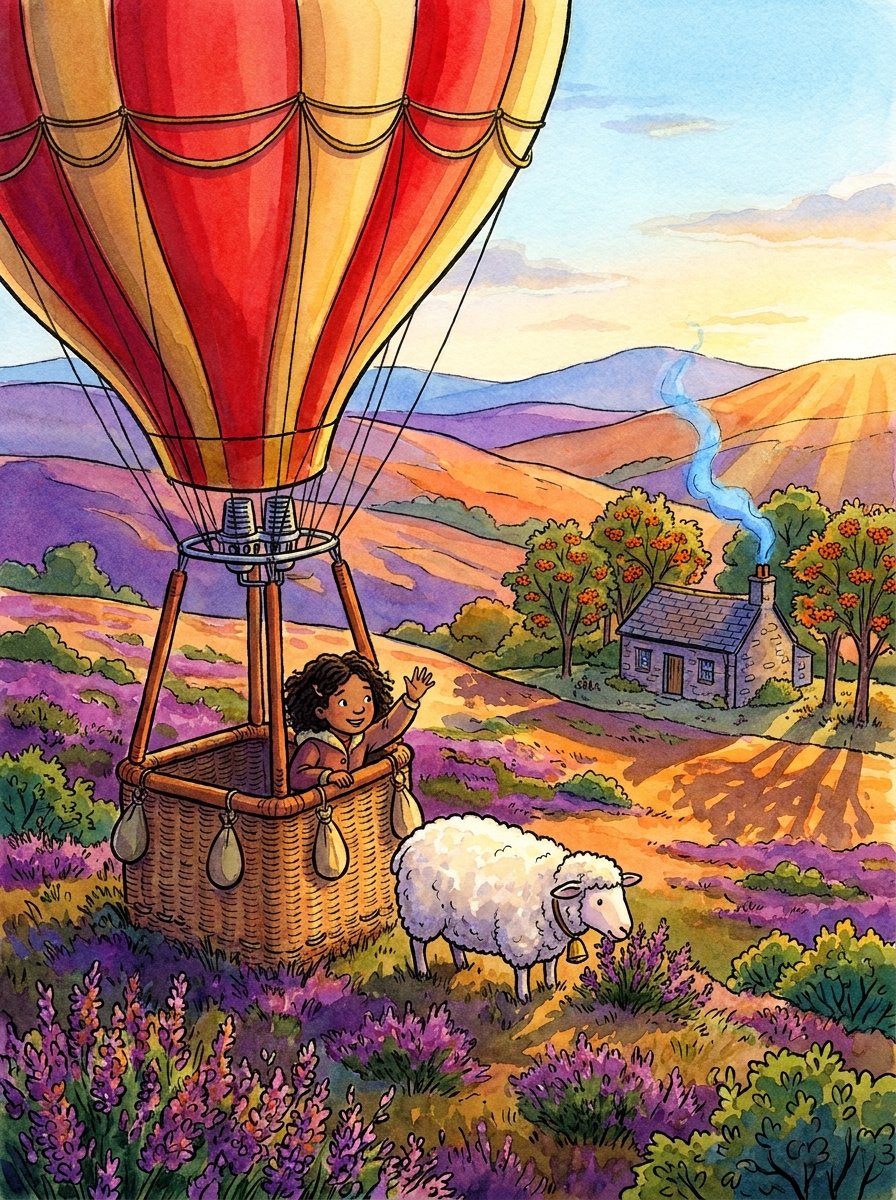
She was a large, broad sheep with wool the colour of old cloud and the thoughtful expression of someone working through a complicated problem. She had found the gap in the basket's side, where a wicker strut had come loose over the years. She climbed in to investigate a smell that turned out to be faint traces of apple. There were no apples to be found. She had settled in the corner anyway, because the basket was sheltered and she had nowhere else to be. The farmer called her Forty-Three. Hannah, once she knew her properly, would call her Agnes.

The last loop of rope slipped free.

The balloon gave a single, tremendous shudder — like something waking up after a very long sleep. Then it rose into the air.

"Oh," said Hannah, who was standing in the basket.

"Mrrh," said Agnes, from somewhere close behind her.

The field dropped away below them. The wooden post shrank to a stick, then to a dot. The wildflowers blurred into colour. Hannah grabbed the edge of the basket with both hands and watched the ground fall and fall and keep falling.

Above them, the red and gold envelope swelled to its full enormous size for the first time in twenty-two years. The old seams held firm. The fabric, which looked faded from below, caught the morning sun from above and glowed. If a balloon could feel anything, this one felt something very close to joy.

Kettle Green spread out beneath them. Hannah could see the post office roof, the baker's chimney trailing white smoke, the mill with its old stopped wheel. She could see her own house — the one she had not yet learned to think of as home — and from up here it looked different. It looked small enough to hold in her hands.

Agnes chewed slowly and steadily. She gazed over the rim of the basket with the calm expression of a sheep who had decided that whatever was currently happening was, on balance, probably fine.

A wind caught them somewhere above the height of the mill's weathervane and pushed them east. The village fell behind them. Below: a patchwork of fields, brown and green and gold, divided by dark hedgerows. A road that looked like a grey thread. Then a band of forest, very dark, and then the hills.

Hannah had seen these hills from her bedroom window every morning since arriving. They were purple with heather this time of year, rolling and enormous, with a silver river running between them. She had wanted to visit them and hadn't yet found the right moment.

She was visiting them now, from above, which was not what she had planned.

It was quieter up here than Hannah had expected. No engine noise, no wind roaring in her ears — just the vast, easy silence of the open air and, occasionally, Agnes shifting her weight in the basket. The river in the valley caught the sun in long bright flashes. A hawk turned in a wide circle somewhere far below, and Hannah realised with a start that she was above the hawk.

She had never been above a hawk before. She wasn't sure anyone in Kettle Green had.

The balloon was losing height. There was a burner above the basket — the kind that heated the air inside the envelope. It wasn't lit and Hannah did not know how to light it. There was also a long rope dangling from a valve at the top. She had a feeling that pulling it would let out air and bring them down faster. She did not pull it. She was not ready to be down yet.

They drifted lower over the heather. She could see the individual colours now — deep purple, pale pink, and here and there a burning yellow gorse. A path wound between two hillsides, and at the end of it, almost hidden by a stand of rowan trees, was a small stone house with smoke from its chimney.

A figure stood in the garden, looking up.

Hannah looked at the valve rope. If she pulled it, they would come down faster. If she did nothing, the wind might carry them right over the house and onto the steeper slope beyond. She reached up, took hold of the rope with both hands, and pulled — just a little. The balloon dipped down sharply. She pulled on it again. They swung toward the softer near hillside rather than the far one. It wasn't particularly elegant, but it was a decision.

The heather rushed up to meet them. Ten feet away, then five.

"Brace yourself," Hannah told Agnes, and the basket touched the hillside with a soft, bouncing thump, dragged sideways through several feet of heather, and stopped.

The red and gold envelope settled down on top of them with a long, slow sigh.

Agnes stepped out, shook her wool thoroughly, and began to eat the heather.

Hannah climbed out after her. Her legs were still trembling from the landing. The hillside smelled extraordinary — of peat and wind and something that had come a very long way to get here. She straightened up and looked around at the vast purple quiet, and felt, all at once, both very small and surprisingly unfrightened.

The figure from the garden was already making her way up the path, climbing quickly for someone who walked with a stick. She was old — properly old — with white hair and sharp, interested eyes and a jacket with more pockets than seemed necessary. She stopped a few feet away and looked at the balloon, and at Agnes, and at Hannah.

"Good heavens," said the old woman.

"I'm very sorry," said Hannah. "I don't know how to land a balloon."

The old woman was quiet for a moment. Then she said: "That balloon is from Kettle Green."

"Yes. It was tied to a post in the field."

"I know," said the old woman. "I tied it there." A short pause. "Twenty-two years ago, I meant to come back for it."

Hannah stared at her. "Why didn't you?"

The old woman looked at the balloon for a long time. She looked at the faded stripes, the weathered basket, Agnes eating heather beside it as if nothing unusual had happened. "I kept meaning to come back," she said. "And then I kept putting it off. And then enough time had passed that I told myself it probably didn't matter any more." She glanced at Hannah. "But here it is."

Her name was Edith. She had owned the balloon since she was thirty years old and had flown it over four countries and two mountain ranges and once, memorably, out over the sea. She made them tea in her small warm kitchen, while Agnes waited outside and inspected the garden with great thoroughness. Then she brought out the logbook from a hidden compartment under the basket's seat. It was full of dates, altitude readings, and small pencil drawings of coastlines and river bends seen from above.

The kitchen walls were covered in maps. Real ones — the large paper kind, soft at the folds — marked all over with pencilled routes and pinned annotations. Hannah counted four before Edith set a mug of tea down in front of her and she lost count.

She turned the logbook pages carefully. One showed a coastline in confident pencil strokes — jagged cliffs, a small harbour, a lighthouse in three lines. "Norway," said Edith, without being asked. "I came down in a fishing village. They fed me smoked fish and asked very few questions, which I appreciated." Another page was dense with numbers — altitude, temperature, wind direction — and at the very bottom, in smaller writing: perfect day. Nothing else was written there.

"How did you learn to fly it?" Hannah asked.

"The same way as everything," said Edith. "Someone showed me the basics and then I made a series of mistakes until I stopped making them."

"You could have it back," Hannah said. "The balloon."

"Or," said Edith, "you could learn to fly it. Then it would have somewhere to go more often."

Before Hannah's mother arrived, Edith walked her back to the balloon. She showed her the burner — how to light it, how long to hold the flame. She showed her how the rising heat filled the envelope and made the whole balloon want to lift. She showed her the valve rope and explained how much to pull and for how long. She showed her the hidden compartment, the spare rope, the small tin of matches kept wrapped in oilcloth so they never got damp. She explained that flying a balloon was mostly a matter of reading the wind and making peace with the fact that the wind had the final say.

Hannah listened to all of it very carefully.

Her mother arrived in the farmer's van forty minutes later, equal parts worried and relieved. She said absolutely not, once firmly and twice more for good measure. Then she looked at Edith's logbook, and at the balloon, and at Hannah's face, and said she would think about it.

On the drive home, the van smelling of Agnes and heather, the hills going gold in the evening light, Hannah pressed her face to the window and watched the sky.

It was everywhere and it was enormous. And most of it, she realised, she hadn't seen yet.

Preview
Share this story
Kinder Yarns

Listen in the app

Engaging, narrated stories for kids aged 4-10.
↓  App Store ↓  Google Play