The first time the bell rang at quarter past three in the morning, everyone in Ashworth Primary assumed it was a mistake.
The caretaker, Mr. Finch, found the bell still vibrating in its iron frame when he arrived to investigate. He checked the clock. He checked the mechanism. He checked the door to the tower, which was locked, just as he had locked it the night before.
"Squirrels," he told the headmistress, Mrs. Calloway, when she arrived at eight.
"Squirrels don't ring bells, Mr. Finch."
"These ones might."
Mrs. Calloway looked at him the way she looked at the school supply budget — with skepticism and a hint of despair.
"Make sure it doesn't happen again," she said.
The second time it happened was a Thursday. The bell rang at half past two in the morning, long and loud, echoing across the playground and into the houses on Chestnut Lane. Mrs. Calloway's neighbour phoned her at half past two to say there was either a burglar or a wedding. Mrs. Calloway told him it was neither. Then she phoned Mr. Finch.
"I've checked the tower," said Mr. Finch, who was breathing hard. "Door's locked. Windows are shut. Bell's cold."
"Bells don't have temperatures, Mr. Finch."
"This one does, and it's room temperature. Nobody's rung it. I would know. I've got the only key."
The third time it happened, a Saturday, three children heard it.
They were the last ones at after-school club on Saturday — a class that had run over. Nora was finishing a painting of the school. Ezra was reading under the table, which was where he read best. Ivy was building something out of pipe cleaners that nobody was quite sure about but that she claimed was a dragon.
The bell rang at quarter past one. Three short rings, one after the other, the way a bell rings when someone is pulling the rope with purpose.
They all stopped.
"Was that the school bell?" said Nora.
"On a Saturday?" said Ezra.
They looked out the window. The playground was empty. The only person in the building was Ms. Gupta, the after-school coordinator, who was on the phone in the office and clearly hadn't heard a thing.
"It came from the tower," said Nora.
"The tower's been locked for years," said Ezra. He had read everything there was to know about the school, including the fire safety reports, which nobody else had ever read. "Mr. Finch has the only key."
"Then how did it ring?" said Ivy.
Ezra didn't have an answer. Ezra always had an answer. This was troubling.
They waited. The bell didn't ring again.
On Monday morning, the bell rang at half past seven. The first children arriving at school heard it clearly — a single bright strike, sharp and sudden, cutting through the sound of the morning traffic and the parents' cars and the general noise of three hundred children trying to get through the gate.
By eight o'clock, every child in the school was talking about it.
"It's haunted," said Liam Chen in Year Five, who had a podcast about things that might be haunted and was always looking for new material.
"It's not haunted," said Mr. Finch, who was standing by the gate, looking tired. "It's old. Old things make noises."
"Bells don't ring by themselves, Mr. Finch."
"They do when the mechanism needs oiling."
"Did you oil it?"
Mr. Finch looked at Liam. "I did."
"Then why did it ring?"
Mr. Finch did not answer this. He looked at the clock tower — the tall brick thing at the north end of the building that had been part of the school since it was built in 1904. The clock face was still there, but the hands had been stuck at eleven fifteen for as long as anyone could remember. The bell inside was bronze, heavy as a small car, and it had not been rung on purpose in thirty years.
"I'll sort it," said Mr. Finch, and he went inside, and the door closed behind him.
On Tuesday, the bell rang at quarter past six in the morning. On Wednesday, it rang twice — once at five and once at midnight. On Thursday, it rang four times between one and two in the morning. Mrs. Calloway called the council. The council sent a man with a clipboard who looked at the tower and said it was fine. The bell rang again that night at half past eleven.
By Friday, Mr. Finch was being blamed.
"The bell only rings when he's locked up," said the Year Four teacher, Mr. Okafor, in the staffroom. "Every single time. After hours. When nobody's there."
"I've spoken to him about it," said Mrs. Calloway. "He insists he's not touching it."
"Then who is?"
Nobody had an answer.
On Friday afternoon, Nora, Ezra, and Ivy were sitting under the big oak tree in the playground when they heard the caretaker talking to the headmistress through the open window of her office.
"I'm telling you, Mrs. Calloway, I haven't touched that bell. I lock up at six, I check the tower door, I go home. There's no one else with a key."
"Then explain to me why it keeps ringing."
"I can't explain it. But I can tell you this — if it keeps happening, they'll shut the tower. They'll bring in some firm to take the bell down, and that bell has been in that tower for one hundred and twenty years. My grandfather used to oil it. His father before him. That bell has been part of this school since before anyone alive was born."
There was a silence.
"I understand, Mr. Finch. But I need a solution, not a history lesson."
Nora looked at Ezra. Ezra looked at Ivy. Ivy looked at both of them and grinned.
"We need to get into that tower," she said.
"The door's locked," said Ezra. "Mr. Finch has the only key."
"So we ask him," said Nora.
They found Mr. Finch in the garden behind the boiler room, where he went when he wanted to be alone. He was sitting on an upturned bucket, eating an apple, and he looked at them the way a fox looks at a rabbit — not hungry, just surprised to see something unexpected.
"What do you want?" he said.
"We want to go into the tower," said Nora.
"You do not."
"We think we can help."
"Help with what?"
"Help find out why the bell's ringing," said Ezra. "We've been keeping a log. Every time it rings, we've recorded the day, the time, and the number of strikes." He held up a notebook covered in neat columns. "There's a pattern."
Mr. Finch looked at the notebook. He put down his apple.
"What kind of pattern?" he said.
"The times aren't random," said Ezra. "They're always at quarter-past, half-past, or quarter-to. But the number of strikes is all wrong. A bell chiming quarters should strike once — one chime per quarter. This one strikes anywhere from one to nine times, no pattern, no reason. Like on Tuesday at quarter past four in the morning, it struck five times. On Saturday it struck three times at quarter past one. A normal bell wouldn't do that."
Mr. Finch was quiet for a moment.
"That's how bells work," he said. "They chime on the quarter-hours. The half-hour. The three-quarter. Then the full hour."
"So the bell's been chiming on the quarters," said Ezra. "But the clock's been stuck at eleven fifteen for thirty years. If the clock's not working, why is the bell still chiming the quarters?"
Mr. Finch looked at the tower. It rose above the rooftops, old brick and darker stone, the clock face bright against the sky. The hands were still at eleven fifteen. They had always been at eleven fifteen.
"My grandfather said there was a second mechanism," he said slowly. "Behind the clock. An older one. He said it was the original bell-ringer, from before the clock was installed. He said the clock was meant to replace it, but they never took the old one out."
"What does the old one do?" said Nora.
"Keeps time," said Mr. Finch. "Its own time. Not the clock's time."
"That doesn't make sense," said Ivy.
"It does if you're a hundred and twenty years old," said Mr. Finch. He looked at them. "I've never gone up there. My grandfather did, when I was a boy. He said there were gears behind the wall, connected to weights. The weights drop slowly, very slowly, over decades. When they reach the bottom, the bell rings."
"So the bell's been winding down?" said Ezra.
"Since 1904," said Mr. Finch. "One hundred and twenty years of weights falling. And now they're at the bottom."
"Which means the bell is about to stop," said Nora.
"Which means it's ringing its last few times," said Mr. Finch. "And when it's done, it'll be silent. The old mechanism will have run out."
They were all quiet for a moment. A bell that had been keeping time for a hundred and twenty years was about to finish.
"Can we see it?" said Nora.
Mr. Finch looked at them. He looked at the tower. He reached into his pocket and pulled out a key.
"If I take you up there," he said, "you don't touch anything. You look. You listen. And if Mrs. Calloway asks, you were helping me fix a leaky pipe in the boiler room. Understood?"
"Understood," they said, all three at once.
The tower door was at the back of the building, past the gym and the old science block that smelled permanently of vinegar. Mr. Finch unlocked the door. It groaned open, and they climbed.
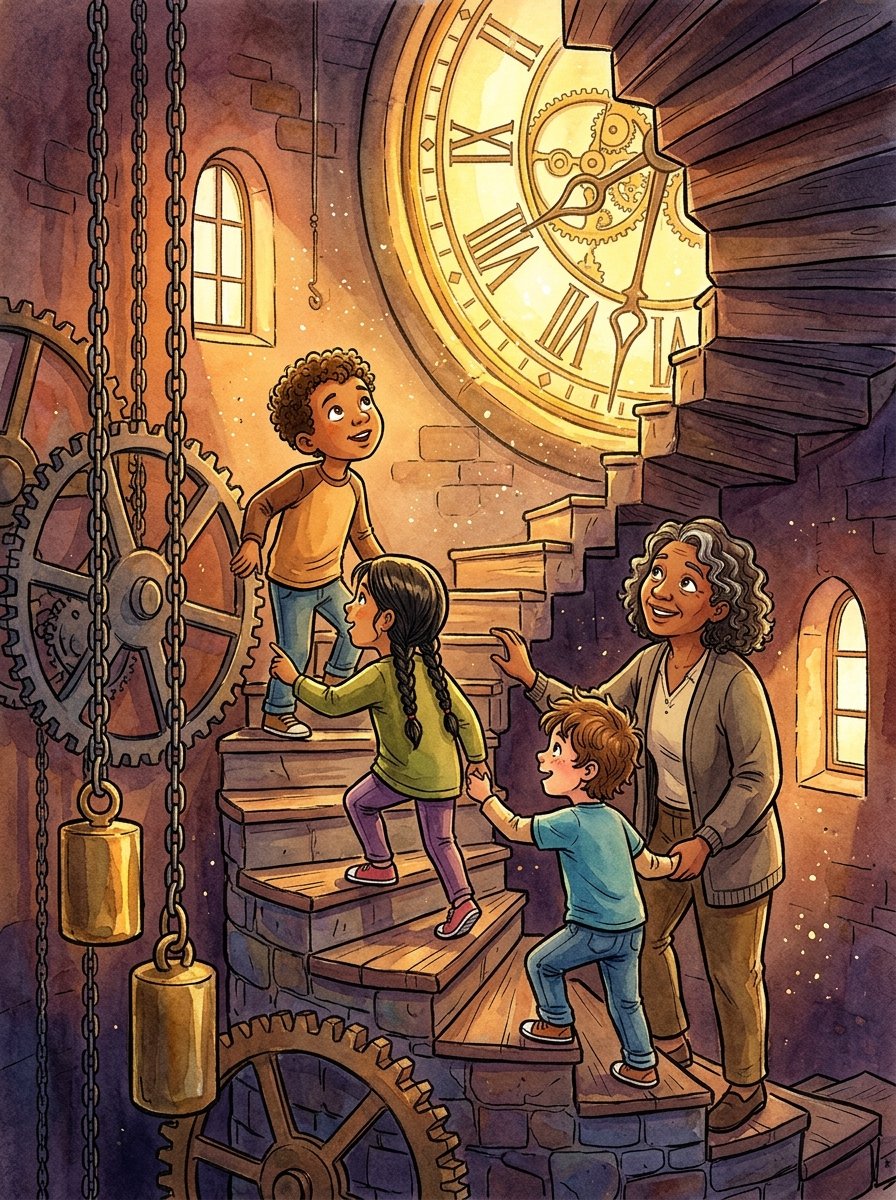
The stairs were narrow and spiral and made of stone, and they curved upward in the dark until the light from the windows above them grew wider and brighter. The air smelled of old iron and dust and something else — something warm, like wood polish, but deeper. The smell of machinery that had been working for a very long time.
They reached the clock room. The great clock face filled the far wall, and through the glass they could see the playground below, the oak tree, the car park, the houses on Chestnut Lane. The clock hands were stuck at eleven fifteen, just as everyone said.
Behind the clock face, set into the wall, was a door.
Mr. Finch opened it.
The room beyond was small and circular, lined with gears. Not the neat, precise gears of a modern machine, but thick, heavy, iron things, the size of dinner plates, with teeth the size of fingers. They were turning — slowly, so slowly that at first it looked like they weren't moving at all. But Ezra put his hand on the wall and felt it — a vibration, deep and constant, like the heartbeat of the building itself.
And in the centre of the room, suspended in a frame of iron, was a set of weights. Three of them, each one the size of a small child, connected by chains to the gears above. They were hanging close to the floor. Very close.
"There," said Mr. Finch. He pointed to a brass plate near the base of the weights. It was engraved with numbers — dates. The first was 1904. The last was 2026.
"That's this year," said Nora.
"The weights were designed to last exactly one hundred and twenty-two years," said Mr. Finch. "My grandfather said the man who built this was very precise. He calculated exactly how long the weights would take to fall."
"And now they've fallen," said Ezra.
"Almost," said Mr. Finch. "They've got a few more strikes left. A few more hours to chime. Then they'll be at the bottom, and the gears will stop."
"Is that why the bell's been ringing so often?" said Ivy. "Because the mechanism is worn out and it's losing time?"
Mr. Finch looked at her. "That's exactly what it is. The old mechanism was perfect for a hundred and twenty years. But now it's winding down, it's ringing whenever it wants, because the weights aren't heavy enough to pull the gears in the right order anymore."
"So the bell is dying," said Nora.
Mr. Finch nodded. "It's winding down. One last time."
They stood in the small circular room and listened. The gears turned. The weights hung. The vibration hummed through the walls and into their hands and their feet and their chests.
"Can we stop it?" said Ezra. "Can we wind it back up?"
"There's no winding mechanism," said Mr. Finch. "It was built to run once. One hundred and twenty-two years. No more. No less."
"That's sad," said Ivy.
"It's not sad," said Mr. Finch. "It did its job. For longer than most people do. My grandfather's father helped build this. My grandfather oiled it. I've guarded it. And now it's time for it to stop." He looked at them. "Some things are not meant to last forever. They're meant to last exactly as long as they're supposed to."
The bell rang.
It was sudden and loud and it filled the room completely, shaking the walls and vibrating through the floor and making their bones hum. It rang once, twice, three times — nine strikes, clear and bright, marking the quarter hour of nine.
Then silence.
The gears slowed. The weights settled. The vibration faded.
"That might have been the last one," said Mr. Finch quietly.
They waited. The clock hands were still at eleven fifteen. The gears were still. The weights hung just above the floor.
They waited for ten minutes. The bell did not ring again.
"Let's go down," said Mr. Finch.
They climbed down the stairs in silence. When they reached the bottom, Mr. Finch locked the door and put the key in his pocket.
"What are you going to tell Mrs. Calloway?" said Nora.
"The truth," said Mr. Finch. "The bell's run its course. It was never anything wrong. It was just finishing."
On Monday morning, Mr. Finch told the headmistress. Mrs. Calloway listened. Then she phoned the council. The council sent a man with a clipboard who climbed the tower and confirmed that the weights had reached the bottom and the mechanism had stopped. The bell would ring no more.
"The school bell has been decommissioned," he told Mrs. Calloway, who wrote it down in her notebook and then crossed it out because she didn't like the way it sounded.
Liam Chen was disappointed. His podcast episode about the haunted bell of Ashworth Primary got four hundred downloads, which was his most ever, but he had to add a correction at the end explaining that the bell was not haunted but merely very old and very tired.
Ezra started a new notebook. This one was about the history of school bells and how they worked and how long they lasted and what happened when they stopped.
Ivy built a pipe-cleaner replica of the tower, complete with tiny gear-shaped pipe cleaners and a small red bell at the top.
And Nora painted a new picture. It was not a picture of the school. It was a picture of the clock tower, with the bell still ringing, and the three of them standing at the base, listening.
She gave it to Mr. Finch. He put it on the wall of his office, next to a photograph of his grandfather, who had oiled the bell, and a photograph of his grandfather's father, who had helped build it.
The tower still stands. The clock still shows eleven fifteen. The bell is silent now, resting in its iron frame, finished with its one hundred and twenty-two years.
But sometimes, on very quiet evenings, when the wind comes from the north and the building settles and the old stones creak, Mr. Finch will stop what he's doing and listen. And if you ask him what he's listening for, he'll look at the tower and say:
"The echo. Old bells don't go quiet all at once. They echo. For years, sometimes. You just have to know how to listen."
Then he'll go back to his work, and the tower will stand there, patient and still, keeping the time it was given, and no more.