The rain stopped.
For three days and three nights it had pounded the earth above Elara's head, filling every tunnel with the drum-drum-drum of a million tiny hammers. She pressed herself against the cool dirt wall and waited. Every worm in the colony knew how to wait through rain. It was the first thing you learned.
But now the drumming stopped. And the earth felt different. Lighter. Softer. Full of a strange new dampness that smelled like the world had been washed clean and offered up for someone to discover.
Elara had never been above ground. Neither had her mother. Neither had her mother's mother. The colony lived deep beneath the old oak's roots, in a labyrinth of tunnels that stretched farther than any worm had ever measured. They knew the taste of limestone and the feel of granite and the sound of underground streams moving through hidden cracks. They did not know the world above.
But today, something called to her.
It was the smell. A fresh, sharp, green smell that came seeping through the soil. She followed it. Up through tunnels she had never explored, past resting worms who watched her with sleepy curiosity. Through layers of earth that grew lighter and looser the higher she climbed.
Her whole body tingled with a feeling she could not name.
The soil above her head was thin now. She could see light — a faint greyish glow filtering through the last layer of dirt. She had never seen light before. She knew about it from the old stories — the ones the eldest worms told when the rain was particularly heavy and the tunnels grew damp and restless.
"Above the earth," they would whisper, "there is a brightness that never ends. And things that move on their own. And a great burning thing in the sky that watches everything."
Elara had always thought they were making it up.
She pushed her head through the last crust of soil.
The world exploded into sensation.
It was enormous. She had known the earth was big — she had traveled through enough of it to understand that — but she had never understood what big really meant. The sky went on forever. It stretched in every direction, blue and endless and overwhelming. She could not find the edges of it. She could not find the end.
She pulled her whole body out onto the wet grass and lay still, trembling.
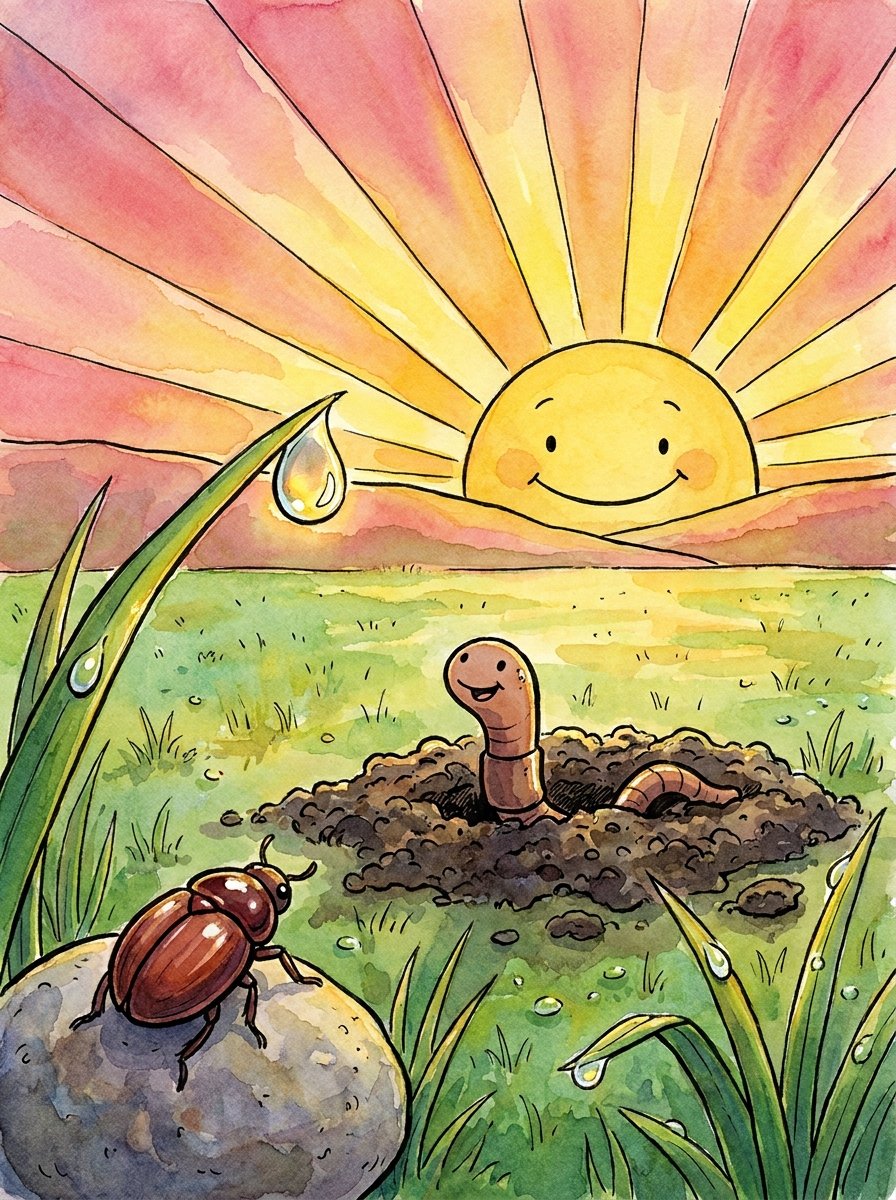
The ground beneath her was soft and cool. The air was thick and wet and full of smells she had no name for — flowers and wet stone and something sweet she would later learn was cut grass. Everything dripped. Everything sparkled. A single drop of water hung from a blade of grass above her head and it contained the entire world inside it, upside down and shimmering.
And then she saw it.
The burning thing.
It was in the sky, which was already too big to understand. It was round and brilliant and it hurt to look at. It sat above the world like a great golden eye, pouring light down onto everything. The grass glowed where the light touched it. The puddles turned into mirrors of fire.
"What is that?" she whispered.
The earth did not answer. But a passing beetle paused and looked up at her. "The sun," it said, and continued on its way.
Sun. The word meant nothing to her.
She watched it for a long time. The longer she looked, the more she noticed. It was moving. Very slowly, but definitely moving, creeping across the sky like a great luminous snail. And the light it gave was warm. Not the damp, still warmth of the deep earth, but a living warmth that reached down and touched her skin. It felt like being held.
She had never felt anything like it.
A shadow fell over her.
Elara froze. Something large and dark had blocked the sun. She looked up and saw a bird standing three feet away, looking at her with one eye and then the other. Its beak was hard and sharp as a stone.
"Hello," said the bird.
"Hello," said Elara.
"I eat worms," said the bird.
"I see," said Elara.
The bird considered her. "You're not afraid."
"I don't know what afraid means," said Elara. "I only came up today."
The bird tilted its head, first one way, then the other. "First time above ground?"
"Yes."
The bird looked at her for another long moment. Then it said, "Eat quickly," and flew away.
Elara did not know what that meant. But she filed it away — birds eat worms, birds can also choose not to — and turned her attention back to the burning thing.
It was lower now.
She watched it sink toward the horizon, turning the sky orange and pink and gold. The world caught fire with colour. The grass turned amber. The puddles turned into pools of honey. Elara had spent her entire life in the dark, and she had not known that dark could end like this — in a blaze of colour so beautiful it made her whole body ache.
"That," she said to no one, "is the most extraordinary thing I have ever seen."
"You haven't seen much," said a voice beside her.
It was another worm. Older. Her skin was darker and scarred, and she moved with the slow confidence of someone who had been alive for a very long time.
"I'm Elara."
"Greta." The older worm settled into the wet grass beside her. "First time up?"
"Yes. Is it always like this?"
"No," said Greta. "Sometimes it rains."
"I know rain. I live underground."
"Then you know nothing yet." Greta's voice was not unkind. "Wait until the sky is empty and the light beats down and the earth bakes hard as stone. That is the sun's true power."
"Is it dangerous?"
"It can be. It dries you out, and a dry worm is a dead worm." Greta looked at her steadily. "That is why we live below. The sun is beautiful, but it does not love us."
Elara thought about this. She watched the burning thing sink lower, turning red and enormous near the edge of the world. "But it's so beautiful."
"Beautiful things can kill you," said Greta. "That is the first lesson of the world above."
They watched the sunset together in silence. When the last sliver of orange disappeared behind the hills, the sky turned purple, then deep blue, and then — slowly — a million tiny lights appeared.
"What are those?" Elara breathed.
"Stars," said Greta.
"They look like tiny suns."
"They are. Very far away. Too far to warm you, but pretty to look at. The old worms say there are as many stars as there are grains of soil in the world. I do not know if that is true. But I like the thought."
Elara stared up at them. She had not known the world above held so many lights. The burning thing. The stars. The strange silver coin in the sky that Greta called the moon. The world above was impossible. It was too big and too bright and too full of things she did not understand.
"I want to understand it all," she said.
Greta laughed — a dry, rustling sound like leaves being moved by wind. "You won't. I have been coming up for forty seasons and I still do not understand it. The sun rises and sets. The rain falls and stops. The birds eat worms and sometimes they do not. There is no understanding. There is only watching."
Elara considered this. "Then I want to watch."
Greta looked at her for a long time. "That is a good answer," she said. And then she disappeared back into the soil.
Elara stayed above ground all night.
She watched the stars wheel slowly across the sky. She learned that some were brighter than others. She learned that the moon changed shape — the beetle under the stone told her it was called a crescent tonight, and that in a few days it would be full.
"What is full?" she asked.
"Round," said the beetle. "Like the sun. But colder."
"That does not make sense," said Elara.
"Very little does," said the beetle, and went back to whatever beetles do under stones at night.
The air grew cool and damp. Strange sounds filled the darkness — the chirping of crickets, the rustle of something small in the grass, the distant hoot of an owl that made her shiver even though she did not know what an owl was.
When the sky began to lighten in the east, her heart beat faster. She recognized the colours from the evening before — pink and gold spreading like water across the dark blue canvas. The burning thing was coming back.
She watched it rise.
First a sliver of gold on the horizon. Then a half-circle, climbing steadily. Then the full enormous disc, rising above the treetops like it owned the world. The light poured over her like a wave. The warmth returned. And Elara felt something she had never felt before.
Joy.
Pure, simple, overwhelming joy.
It did not matter that she did not understand it. It did not matter that the sun could kill her or that birds ate worms or that the sky was too big to fit inside her mind. What mattered was that she was here. She had seen the burning thing rise. She had felt its light on her skin. And she was not afraid.
She stayed above ground until the sun climbed too high and the grass began to dry and the warmth grew sharp instead of gentle. Then she pushed her head back into the soil and descended through the dark layers toward home.
Her mother was waiting in the main tunnel. "Where have you been all night?"
"I saw the sun," said Elara.
Her mother's eyes widened. "What was it like?"
Elara thought about it. The enormity. The warmth. The way the world had caught fire at dusk. The stars. The bird that had chosen not to eat her. The million things she still did not understand.
"It was enormous," she said. "And burning. And I do not know what it is."
"Nobody does," said her mother. "We only know what it does."
"And what does it do?"
Her mother was quiet for a moment. "It makes the world above worth visiting."
Elara smiled — a small worm smile, which is really just a gentle wriggle. "I think I will go up again."
And she did. Every time it rained, Elara surfaced. She watched the sun rise and set in a hundred different ways. She learned the shapes of clouds — the flat grey ones that meant more rain, the tall white ones that meant fair weather. She made a cautious friendship with the beetle, who eventually told her his name was Barnaby. She saw the bird again, and they nodded at each other like old acquaintances who had agreed not to discuss certain things.
She never understood the burning thing. Not really. But she stopped trying to.
Some things, she decided, were not meant to be understood. They were meant to be watched. And wondered at. And felt on your skin on a cool morning after rain, when the whole world was wet and sparkling and the sun was just rising over the edge of everything.
She was a worm who had seen the burning thing. And she knew, with a certainty that ran deeper than any tunnel, that she would keep coming up to watch it for as long as she lived.
That, she decided, was enough.