← Story Library
Kinder Yarns

The Clam's Secret World

The Clam's Secret World

Chester had not opened his shell in eleven years.

Nobody was entirely sure why. The sea anemones had theories, and the starfish had opinions. The old grouper who lived under the rock ledge claimed he had seen it all before and wasn't particularly interested in seeing it again. "Some clams just don't," the grouper said, in his slow and heavy way. "Nothing to be done about it."

The other creatures of the reef had mostly stopped wondering. There were better things to pay attention to — the warm currents that came rolling in from the south, the coral arch slowly building itself near the deep channel. There was also the annual procession of silver fish that moved through every spring like a shining river. Life on the reef was full enough without worrying about one stubborn clam.

Chester sat on his rock and kept his shell shut, and he was not unhappy about it.

The other creatures could not understand this, because they had long ago decided that a closed thing must be a miserable thing. But Chester was full — full in a way that would have astonished anyone who could have seen it. He knew it, and he held that knowledge quietly inside him the same way he held everything else.

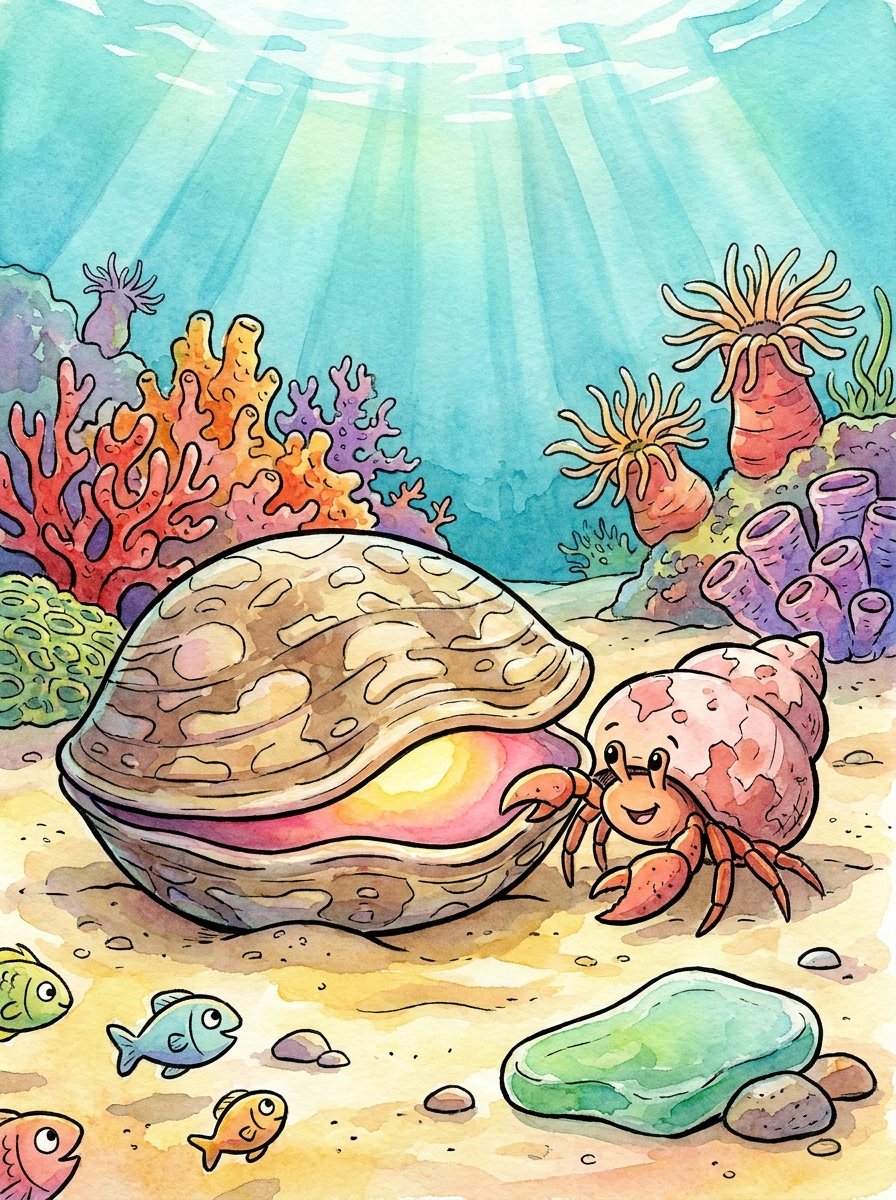
Then one Tuesday — or what would have been a Tuesday, if clams kept track of such things — a hermit crab came and sat down beside him. She had a small pink shell on her back, a little chipped along the left rim. She settled herself in the sand next to Chester with the calm, deliberate air of someone who had arrived exactly where she meant to arrive.

"Good morning," she said cheerfully.

Chester said nothing, because Chester never said anything.

The hermit crab sat there for a while, watching the small fish dart in and out of the coral. Then she picked up a smooth grey pebble, turned it over thoughtfully in her claws, set it back down, and went home.

She came back the next day. And the day after that.

Her name was Pip, and she had made up her mind about Chester the way you sometimes make up your mind about a place. It wasn't because anything remarkable happened there — it was because something about it felt exactly right.

The other creatures noticed eventually.

"You're wasting your time," said the sea anemone, waving her tentacles in what she imagined was a helpful and sympathetic manner. "He never opens and he never speaks, and he has not moved from that rock in eleven years."

"I know," said Pip pleasantly.

"Then what on earth are you doing?"

Pip considered this with the careful attention she gave to most things. "I like it here," she said. "And I think he knows I come. That seems worth doing."

The anemone had no answer to this. She retracted her tentacles slowly and did not bring it up again.

What Pip could not have known — what nobody on the reef knew — was what Chester had been doing inside that shell for eleven years.

He had been building — not with logs and mud, but the way a thought builds, slowly and privately, in the dark. The inside of Chester's shell was the furthest thing from empty. It was the most full thing on the reef.

Years ago, before he had decided to stay closed, Chester had been open like any other clam. He had felt the current wash over him, tasted the salt in the water, watched the shifting light filter down from the surface above. He had been curious about everything. And then, one afternoon, he had begun to collect.

The day he decided to stay closed was not a dramatic day. There had been no danger, no fear, no particular reason. He had simply felt, one ordinary afternoon, that the world outside was very large and very busy and very loud. He had enough inside him already to last a very long time. So he had closed his shell, and the reef had carried on without him, which it was perfectly capable of doing.

The water brought him things through the tiny gaps at the edge of his shell — particles so small they seemed like nothing at all. These were silt and flecks of color from crumbling coral and, once, the faint vibration of a whale song passing somewhere far above. A single grain of something harder and more luminous than sand had found its way in as well. Chester had rolled it very carefully to the exact center of his shell and kept it there for years. Over time, it caught even the faintest light and held it like a promise.

Around the pearl, Chester had arranged the silt into patterns — not by accident, but on purpose. He had arranged it into spirals that echoed the way the current moved above the reef and curves that followed the rhythm of the tides. He had encouraged three varieties of algae to grow along the inside of his left valve, in shades of green from dark forest to pale sea-glass. He tended them carefully with warmth and the slow movement of his own breathing. He had placed fragments of coral along the upper rim of his shell — impossibly small ones, brought in by the current over many seasons. From the inside, they were arranged against the dark like a tiny skyline.

He had done all of this in the dark, working entirely by feel, over eleven years, and it was extraordinary. Chester knew it was extraordinary. He had no one to tell.

He felt Pip arrive on the third morning the same way he felt changes in the current. It was a slight shift in the pressure beside him, a small and particular warmth settling into the sand. She brought a piece of sea glass with her that day, green and frosted smooth, and set it in the sand between them without explanation.

Chester felt something he had not felt in a very long time. He did not have a name for it.

Pip had a particular way of arriving. She always came from the east, where the coral formations grew tallest, and she always paused on the same flat rock before settling into the sand. Chester didn't know how he knew this, since he couldn't see her. He simply felt it, the same way he felt the direction of the current.

She came every day after that. She brought things sometimes — a smooth flat stone, a fragment of white shell, a perfect small spiral of whelk. The whelk had lost its occupant and was now just a beautiful empty shape. She never pressed these things against Chester's shell or asked anything of him. She set them nearby, the way you might leave something pleasant on a friend's doorstep.

She talked to him sometimes, not often and never loudly. She told him what the current felt like each day and whether the long-legged birds were wading in the shallows. She told him what had happened to the small orange fish who lived in the anemone three rocks over. She also told him about the silver fish, which were late this year by her count. And she told him about the coral arch, which had finally closed at the top and was now a proper arch that all the fish swam through.

Chester listened to every word.

Seven months into Pip's visits, a storm moved through the water above the reef.

It was not the worst storm Chester had ever felt, but it was serious and it lasted a long time. The water churned and went cold and dark. Sand lifted from the seafloor in long brown curtains. The anemones pulled all their tentacles in and became smooth grey buttons. The fish scattered for the deep water. The old grouper retreated under his ledge and wedged himself in and did not come out until it was over.

Pip was the only creature who stayed.

She had wedged herself into the sand beside Chester, her claws wrapped around the edge of his rock. She held on through the whole long grinding roar of it. She did not say anything, because there is nothing sensible to say in a storm. She simply stayed where she was and waited.

When the water finally grew still and the sand began to drift back down from wherever the storm had taken it, Pip was still there. She was a little sandy and her shell had a new scratch that hadn't been there before, but she was right where she had always been.

Chester felt something move inside him that was not the current and not the tide.

He had been alone for eleven years, and he had made his peace with it. He had built a whole world in the dark, and it was enough, he had told himself. But Pip had come every day for seven months and then stayed through the storm.

The world inside Chester's shell suddenly felt like it wanted to be seen — but not by everyone. He did not want the grouper or the anemones or the silver fish to see it. He wanted only Pip to see it.

It took him three more days to be ready.

He spent those days listening. He listened to the water settle back into its usual rhythms and to the fish returning from the deep channel. He listened to Pip arriving each morning and sitting beside him in her usual quiet. Each evening when she left, he turned something over in himself the way she turned pebbles over in her claws — slowly, and with great care.

On the fourth morning after the storm, Pip settled into the sand beside him as she always did. While she was quiet, Chester opened his shell. It was just a crack — the thinnest line of space between his two valves, dark at first and then filling with light.

Pip became very still beside him.

The light reached the pearl, and a single beam bounced back out through the crack — gold and blue and a soft warm rose. Pip leaned in closer and the colors deepened and shifted. Inside, barely visible in the dim, were the spirals in the silt and the small green garden along the left wall. And at the center of everything was the pearl, glowing with eleven years of quiet and careful work.

Pip was quiet for a long time.

"Chester," she said at last, very softly. "This is the most beautiful thing I have ever seen."

Chester held the crack open a little while longer. In all the years he had spent building in the dark, he had imagined this moment sometimes — not often, and not clearly. But now that it was here, it was different from anything he had imagined, and it was better. The colors scattered in the water around them, and the silt patterns caught the edges of the light and seemed to breathe. Then he closed his shell.

Pip sat with him until evening, and she didn't say much about it, and she didn't need to.

She came back the next morning. She brought a piece of coral and told him about the birds in the shallows. She also told him that the old grouper had developed a new theory about the tides that nobody on the reef agreed with.

Chester listened, the way he always had. He felt the warmth of her there beside him, as steady and reliable as the current.

He did not open his shell again that day, and he was not unhappy about this. He had never needed to be open all the time. He needed to be open when it meant something, and now he knew what that felt like, and he knew who he would open for.

The closed shell felt different than it had before. It felt less like a wall and more like a door.

Pip came back the next day, and the day after, and the day after that. She brought things and told him about the birds and the fish and the comings and goings of the reef. She told him when the silver fish finally arrived for their annual passage, six days late. She described how they looked from below — like a ceiling of moving silver light, which Chester thought sounded very fine.

He felt the small warmth of her settle beside him each morning, as reliable as the tide.

Once in a while, very quietly, Chester opened his shell just a crack.

And Pip, who never asked for more than he was ready to give, would lean close and watch the colors scatter into the water between them. Then she would sit back, and they would stay together in the easy way of two creatures who know that some things do not need to be said aloud.

Preview
Share this story
Kinder Yarns

Listen in the app

Engaging, narrated stories for kids aged 4-10.
↓  App Store ↓  Google Play