The cookie jar sat on the kitchen counter, round and blue with a silver lid, and every morning it was empty.
This was a problem, because every evening Riley's grandmother filled it. She baked the cookies herself — chocolate chip on Monday, oatmeal raisin on Tuesday, peanut butter on Wednesday. She would stack them inside, click the lid shut, and say, "There. That should last you."
And every morning Riley came downstairs to find the jar empty. Not half-empty. Not with a few crumbs at the bottom. Empty. Clean. As if someone had licked it.
"I am not eating them," said Riley.
"Of course you are not," said his grandmother, smiling the smile of someone who did not believe you.
"I am not!" said Riley. "I go to bed and they are there. I wake up and they are gone. I have never touched that jar at night."
His grandmother patted his head. "Of course you have not."
Riley was being framed.
He decided to solve the case. That night, he did not go to sleep. He lay in bed with his eyes open, listening. The house settled. The floorboards creaked. The refrigerator hummed. And somewhere around midnight, he heard it — a soft thump from the kitchen.
Riley slipped out of bed. He crept down the hallway, past the grandfather clock, past the sleeping cat, and stopped at the kitchen doorway.
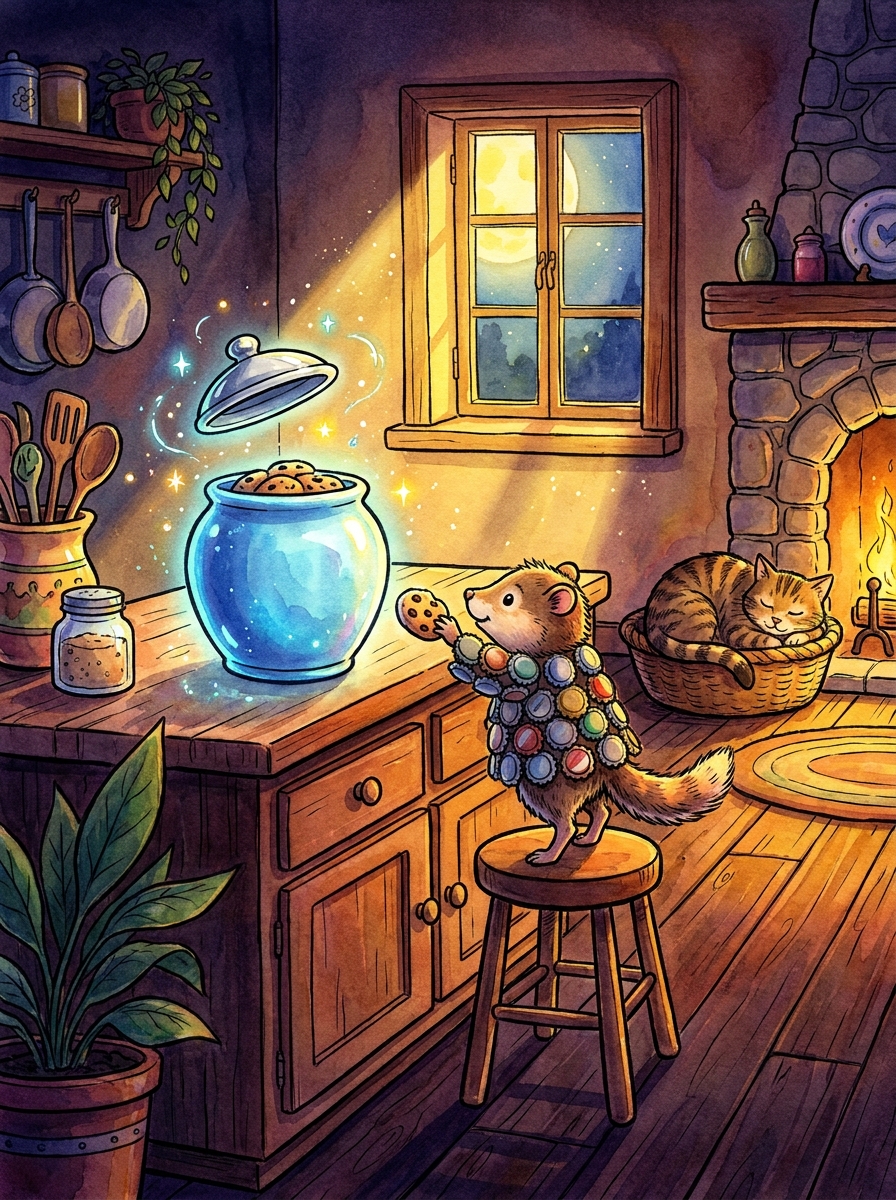
The kitchen was dark. The moonlight came through the window and fell on the counter, where the cookie jar sat, glowing faintly blue. The lid was on. Everything was still.
Then the lid moved.
It lifted. By itself. A tiny crack, then wider, until it hovered in the air like a silver saucer. And out of the jar came a small hand.
It was not a human hand. It was small and round and covered in fur. The hand reached into the cookie jar, pulled out a cookie, and disappeared back inside.
Riley stared.
The hand came out again. Another cookie. Then another. Each cookie vanished into the dark behind the jar, carried by a creature Riley could not see.
He stepped closer. The hand froze. The lid dropped back onto the jar with a clatter.
"Hello?" whispered Riley.
Nothing.
"I saw you," he said. "You are the one taking the cookies."
A tiny voice came from behind the jar. "Are you going to tell?"
Riley walked around the counter. Huddled between the cookie jar and the toaster was the smallest person he had ever seen. She was no bigger than a spoon, dressed in a coat made of bottle caps, with hair like dandelion fluff. In her arms she clutched three chocolate chip cookies, each one larger than her entire head.
"Who are you?" said Riley.
"Nettle," said the tiny person. "I live under your fridge."
"Nettle," said Riley. "Why are you stealing my grandmother's cookies?"
"I am not stealing," said Nettle. "I am relocating them. To my home. Under the fridge. Where they will be safe."
"Safe from what?"
Nettle looked at him like he had asked something very silly. "From the morning," she said. "When they disappear."
"But they do not disappear in the morning," said Riley. "You take them at night."
"I take them so they are not there in the morning," said Nettle. "It is a very important distinction."
Riley sat down on the kitchen floor. This was going to take a while.
"Explain," he said.
Nettle shifted her cookies and sighed. "I cannot give away my secrets. I am a kitchen-dweller. It is in the contract."
"What contract?"
"The one we sign when we move in," said Nettle. "I get warmth from the fridge motor. I get crumbs from the cutting board. And I get one jar of cookies per month, provided I remove all evidence before sunrise."
"One jar per month?" said Riley. "You have been taking one every night."
Nettle looked offended. "Quality control. This is my first week."
Riley had a lot of questions. Where did the cookies go? What else lived under the fridge? Why bottle caps? But one question was more important than the others.
"If I do not stop you," he said, "my grandmother will think I ate them."
"That sounds like a you problem," said Nettle.
"Alternatively," said Riley, "you could stop taking the cookies. And I could leave out crumbs for you instead."
"Crumbs," said Nettle flatly. "You want me to accept crumbs."
"You took three cookies that are bigger than you," said Riley. "What do you even do with them?"
Nettle shifted uncomfortably. "I have a system."
"Show me."
Nettle hesitated. Then she set down the cookies and scurried along the baseboard to the gap beneath the fridge. She lifted a tiny trapdoor made of a bottle cap and disappeared inside. A moment later, a light flickered on.
Riley got down on his stomach and pressed his cheek to the floor.
Under the fridge was a room. It was small and cozy, with walls of cardboard and a ceiling of aluminum foil. A tiny lantern made from a Christmas light bulb glowed in the corner. And stacked against the far wall was a mountain of cookies. Dozens of them. Chocolate chip, oatmeal raisin, peanut butter. A cookie fortress.
"For the winter," said Nettle, emerging from the trapdoor. "Fridge-winters are harsh. The motor stops working sometimes and the cold seeps in. A dweller must be prepared."
Riley looked at the cookie mountain. Then he looked at Nettle, with her bottle-cap coat and her dandelion-fluff hair.
"My grandmother will keep baking," he said. "Every day. All winter. You do not need to take them all at once."
"It is not about need," said Nettle. "It is about the contract."
"Who signed this contract?"
Nettle went quiet. "I do not know. It was here when I moved in. It is the rule."
Riley thought for a moment. "What if I signed a new contract? One that says you get one cookie per night, left out on the counter, and you stop taking them from the jar?"
"You cannot sign a kitchen-dweller contract," said Nettle. "You are a human."
"Then you sign it," said Riley. "And I will witness it."
Nettle considered this. "I would need a fresh bottle cap."
Riley found one in the recycling bin. Nettle scratched a symbol onto it with a pin, then held it up.
"I, Nettle of the Under-Fridge, do hereby agree to accept one cookie per night, placed on the counter after sunset, in exchange for not touching the jar."
"Deal," said Riley.
Nettle handed him the bottle cap. "Keep this under your pillow. It seals the agreement."
Riley put the bottle cap in his pocket. "One more thing," he said. "The cookie mountain. You cannot keep it. It is unsightly."
Nettle looked hurt. "It is architecture."
"It is a health hazard."
Nettle sighed. "Fine. I will relocate it. But I am keeping the oatmeal raisin ones. Those are my favorites."
The next morning, the cookie jar was still full. Riley's grandmother stared at it.
"You did not eat any?" she said.
"I told you," said Riley. "It was not me."
His grandmother looked suspicious but said nothing. She went to make her tea and noticed a single chocolate chip cookie sitting on the counter, on a napkin.
"Hm," she said. "I must have left that out."
She did not notice the tiny footprints in the flour on the counter. But Riley did.
He smiled, took a cookie from the jar, and crunched it loudly.
The case was closed. And under the fridge, a tiny light flickered on as Nettle sat down to enjoy her nightly cookie, surrounded by a fortress of oatmeal raisin.