← Story Library
Kinder Yarns

The Cracked Spectacles

The Cracked Spectacles

Mira found the glasses on a Tuesday, which is an ordinary day for finding extraordinary things.

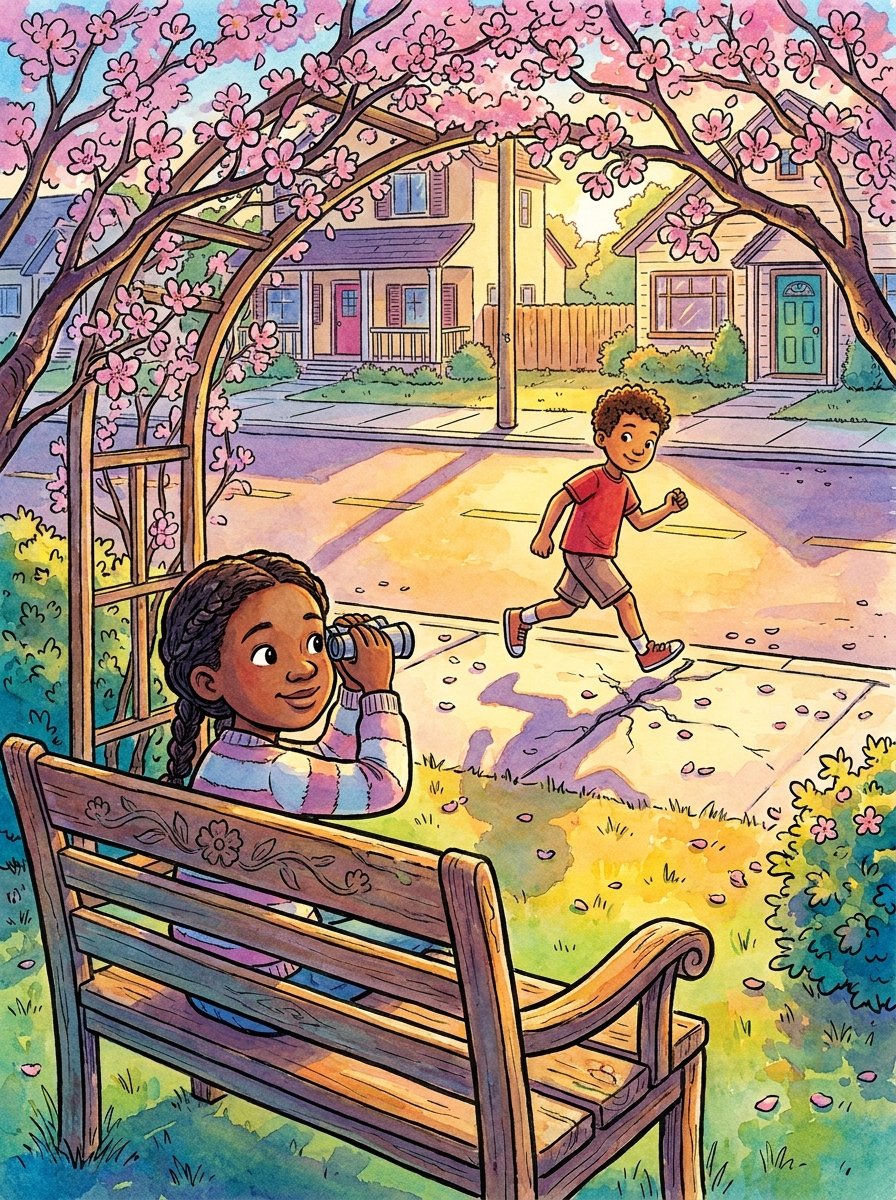
She was walking home from school, taking the long route because she liked the long route. The long route went past the rowan tree with the split trunk, past the stone wall where the moss grew in patterns that looked like maps, past the gutter where someone had dropped an ice cream cone three weeks ago and nobody had bothered to pick it up.

The glasses were sitting on the low wall, right next to a crack in the pavement.

They were strange glasses. The frames were dark and round, with tiny scratches along the arms as if someone had worn them for a very long time. The lenses were not quite clear — they had a faint shimmer, like the surface of a puddle just before it evaporates.

Mira picked them up and put them on.

Everything changed.

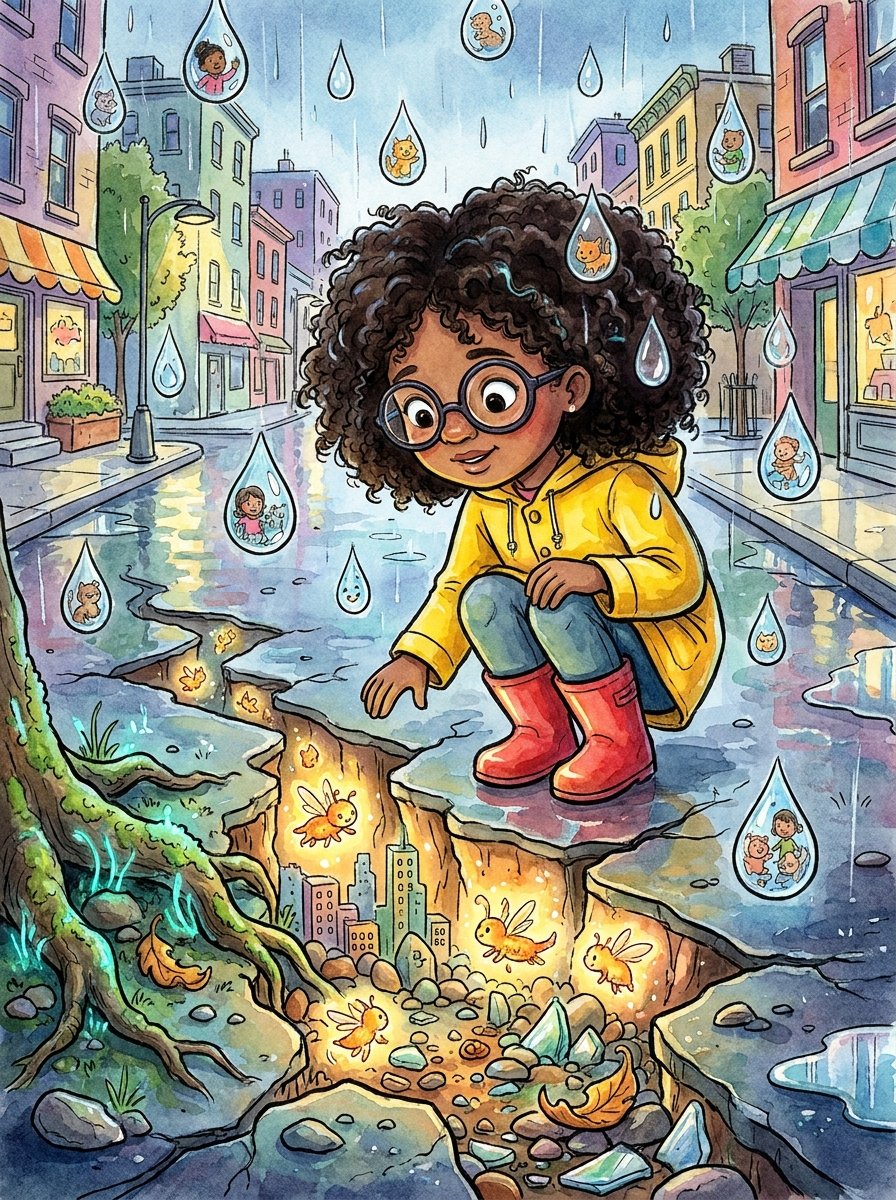
The crack in the pavement was not just a crack anymore. It was a doorway. Inside it, in a space that should not have existed between two slabs of concrete, there was a tiny city. Buildings made of grit and dust. Streets paved with crumbs of stone. And moving through those streets, no bigger than ants, were creatures.

They were not ants.

They had legs, but not the right number. They had eyes, but too many of them. Some were round and fuzzy. Some were long and thin. Some glowed faintly, like embers in a fireplace. They moved with purpose, carrying things — pebbles, fragments of leaf, drops of dew — and they did not seem to notice Mira at all.

Mira crouched down. She stared. Her mouth was open. She could not close it because closing it would mean accepting that what she was seeing was real, and she was not yet ready to accept that.

One of the creatures — a round, orange one with six eyes arranged in a circle — stopped what it was doing and looked up at her.

It had a face. Not a face like a person's face, but a face all the same. It had an expression. The expression said: You can see me?

Mira nodded.

The creature turned to the creature next to it — a tall, thin one that looked like a blade of grass with feet — and made a sound. It was not a sound Mira could hear with her ears. It was a sound she felt in her teeth. A high, chittering vibration that meant something important was happening.

The tall creature looked up at Mira. Then it turned to another creature. And another. Within seconds, every creature in the crack had stopped moving and was staring up at the girl with the strange glasses.

Mira stood up slowly. She took the glasses off.

The crack was just a crack again. Pavement. Concrete. Nothing moving. Nothing alive.

She put the glasses back on.

The little city was still there. The creatures were still there. The round orange one was still looking at her, all six eyes wide.

"Hello," Mira whispered.

The creature chittered. Mira felt it in her teeth again. She did not understand the words, if they were words, but she understood the feeling behind them. The feeling was: astonishment.

Mira took the glasses off and held them in her hands. She looked at them very carefully. They were just glasses. Dark frames. Shimmery lenses. Nothing magical about them. Except that they were obviously completely magical.

She put them back on and kept walking.

Past the gutter where someone had dropped an ice cream cone three weeks ago, Mira stopped again. Through the glasses, the gutter was a river. Not a river of water — a river of creatures. They flowed together, hundreds of them, a current of tiny bodies moving in the same direction, all heading toward the storm drain at the end of the street.

The storm drain looked like a cathedral. Its iron grate was a row of enormous pillars. Behind it, in the darkness, Mira could see light — not the light of lamps, but the light of a thousand tiny bodies glowing as they moved through the tunnel below.

A creature on the edge of the flow — one that had been struggling against the current, swimming upstream like a salmon — paused and looked up at her. It was shaped like a teardrop, translucent, with a single bright eye in its centre.

"The Gathering Place," it said. Its voice was like wind through a straw. "Where we all go when the water moves."

"Where does it lead?"

"Down. Under. Everywhere the water goes." The teardrop creature looked at the current, then back at Mira. "You have the seeing eyes. That means you can choose to look away. Most cannot."

"I don't want to look away," said Mira.

The teardrop creature smiled — or did something that felt like smiling — and rejoined the flow.

Mira watched them go, a river of light pouring into the darkness beneath the street. Then she walked on.

The rowan tree with the split trunk was next. Mira had walked past this tree every day for nine years. She knew its bark, its branches, the way its leaves turned red in autumn and fell in spirals. She knew the knot in the trunk that looked like an eye.

She had never looked at its roots.

The roots of the rowan tree spread out from the base in thick, gnarled fingers that pushed into the earth. Between those fingers, in the soil and the mulch and the darkness, there were creatures.

Different creatures. Bigger than the pavement ones. Some were the size of mice. They had fur — or something like fur — in colours Mira did not have names for. A colour between green and gold. A colour between blue and black. A colour that was not a colour at all but a feeling, the feeling of something growing.

They lived in the roots the way people live in houses. They had rooms carved into the earth. They had furniture made from twigs and pebbles. Mira could see tiny lights — not electric lights, not firefly lights, something else entirely — glowing in the dark spaces between the roots.

One of them noticed her.

It was crouching on a root, holding something that looked like a thimble. It was covered in fur the colour between green and gold, and it had ears that were far too big for its body, like satellite dishes. When it saw Mira looking at it, it dropped the thimble.

"Oh," said Mira.

The creature stared at her. Its enormous ears swiveled forward.

"You can see me," it said.

Mira jumped. She could understand it. Not the sounds — the sounds were clicks and whistles and the rustle of leaves. But the meaning was clear, as if the words had been placed directly into her brain.

"I can see you," she said.

The creature's ears went flat against its head. Then they sprang up again. It turned to the roots and shouted something in its clicking language. Three more creatures appeared, all with oversized ears, all staring at Mira with expressions of total disbelief.

"She can see us," said the first one.

"Impossible," said one of the others.

"The glasses," said another, pointing at Mira's face. "She has the glasses."

Mira touched the frames. "These?"

The creatures went silent. They looked at each other. They looked at Mira. They looked at the glasses. Something passed between them — not a sound, but a feeling. A feeling of recognition. A feeling of something long-lost being found.

"Where did you get those?" asked the first creature, very quietly.

"On the wall," said Mira. "By the pavement. Someone left them there."

The creatures looked at each other again. The first one's enormous ears drooped.

"Those are the Old Seeing Glasses," it said. "They were lost a very long time ago. We thought nobody would ever wear them again."

"What do they do?"

"They let you see us. They let you see everything that lives in the spaces that people forget to look at. The cracks. The roots. The gaps."

Mira looked through the glasses at the rowan tree. She could see the creatures in the roots, but she could also see something else — faint, shimmering lines that connected the tree to the ground, to the air, to the sky. Lines of something that was not quite light and not quite sound. Lines that pulsed, slowly, like breathing.

"What are those?" she asked.

"Connections," said the creature. "Everything is connected. You just need the right eyes to see it."

Mira took a step back. The world through the glasses was enormous. It was not just the pavement creatures and the root creatures. It was everywhere. In every crack, in every gap, in every space that a person had ever overlooked, there was life. Tiny, strange, beautiful life.

A drop of rain began to fall.

Mira looked up. The sky was grey and full of clouds, but she could see something she had never seen before. Between the clouds, in the spaces where the rain was forming, there were creatures. They were made of water — or they were water — or water was made of them. They were the spaces between raindrops, the gaps between falls, the pause between one drop and the next.

They were falling too. They were the rain.

Mira watched them fall. She could see each one individually — not as a blur of grey, but as a cascade of tiny, luminous beings, tumbling through the air in a dance that had been going on for as long as there had been rain.

One of them landed on her glasses.

It was a raindrop creature, and it was looking at her through the lens. It had no eyes, no face, no features at all — but she could feel its curiosity. It was curious about her. It was curious about the glasses. It was curious about a world where someone could see the spaces between raindrops.

"Hello," Mira said again.

The raindrop slid off her glasses and rejoined the rain.

Mira stood in the middle of the street while the rain fell around her, watching creatures she had never known existed tumble through the air and land on the ground and disappear into the cracks and the roots and the spaces between things.

She was crying. She did not know when she had started. The tears were not sad tears or happy tears. They were the tears you cry when you discover that the world is bigger than you ever imagined.

She took the glasses off. The rain was just rain. The street was just a street. The rowan tree was just a tree.

But Mira knew better now.

She stood there for a moment, holding the glasses in her hands. She could put them back on the wall where she had found them. She could leave them for someone else. She could go back to not knowing about the creatures in the cracks and the roots and the rain.

But she did not want to go back.

She put the glasses back on and walked home, stopping at every crack and every root and every gap to say hello to the creatures who lived there. The pavement creatures chittered. The root creatures clicked and offered her tiny thimbles of something that tasted like honey and starlight. The raindrop creatures danced around her glasses and made her laugh.

When she got home, she took the glasses off and put them in her pocket.

Her mother was in the kitchen. "How was school?" she asked.

"Fine," said Mira.

She did not say anything else. She could not say anything else. Not because she was keeping a secret, but because some discoveries are too big for words. They have to be carried quietly, like a glass of water full to the brim, one careful step at a time, until you find the right moment to set it down and share it.

Mira went to her room and looked out the window. The rain had stopped. The street was wet and shining. She put on the glasses.

The world was there, just as she had left it. Creatures in every crack. Life in every gap. Connections humming between everything, a web of shimmer that held the whole world together.

A creature on her windowsill — a tiny thing with wings like tissue paper — landed on the frame and looked at her through the glass. It tapped once, twice, then flew away into the evening air, trailing a streak of gold.

Mira smiled.

She had a lot of helloing to do.

She would go back to the rowan tree tomorrow and ask the root creatures their names. She would find the storm drain again and follow the river of light. She would say hello to every crack, every root, every space between things.

But right now, she was going to sit by her window and watch the rain fall, and she was going to know that the world was full of creatures she had never imagined, and that she was the only person who could see them.

That felt like a very good thing to be.

Preview
Share this story
Kinder Yarns

Listen in the app

Engaging, narrated stories for kids aged 4-10.
↓  App Store ↓  Google Play