← Story Library
Kinder Yarns

The Dog Who Listened

The Dog Who Listened

Bea had a lot to say. Most people who knew her didn't realize this, because most people who knew her were not very good at waiting.

When Bea spoke, the words sometimes got stuck at the beginning, like a door that needed an extra push before it would open. They always came out in the end — they always did — but not always fast, and not always smoothly. And Bea had noticed, over eight years of paying close attention to how people behaved, that most people didn't like to wait. They would lean forward and their eyes would drift toward whatever was behind her. They would sometimes say the word she was reaching for, helpfully, as if finishing her sentence was a kindness rather than the opposite.

So Bea kept most of her words for quieter places.

She kept them in her notebook, where they came out perfectly every time. She kept them in the bath, where she could say absolutely anything at full speed and nobody could hear. And she kept them, lately, for the dog at the end of the street.

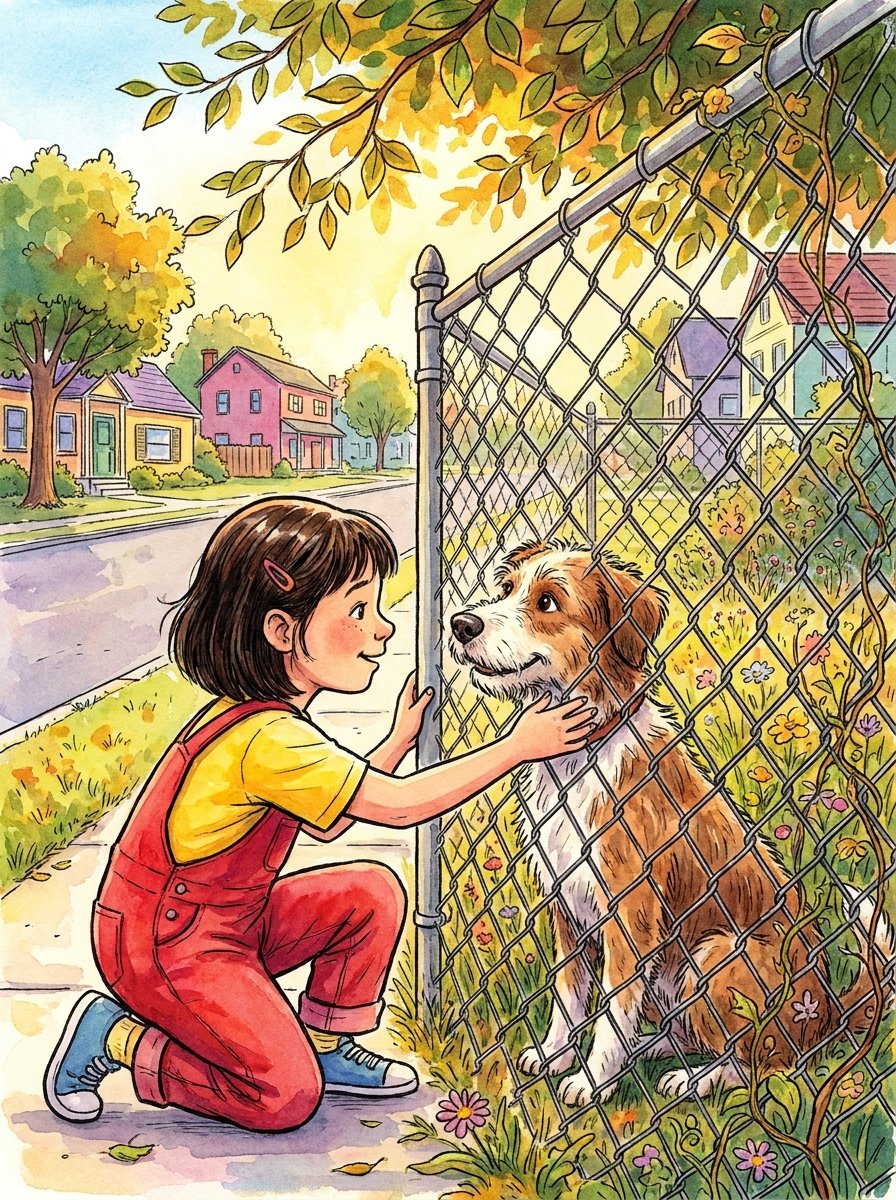
He had appeared three weeks ago, in the scrubby lot behind the chain-link fence at the corner of Maple and Vine. Brown and white, with fur that had grown long and tangled in the way of a dog who had been without a brush for a while. He was not thin, which meant someone had been feeding him. Bea started leaving bread crusts in the mornings before school.

Then, one afternoon, she started talking to him.

The reason was hard to explain, except that the dog had a way of listening with his whole body — ears forward, eyes steady, head perfectly still. He did not look at the clock. He did not lean in with the word she was reaching for. He just waited, in the particular patient way of a dog who understood that waiting was not a hardship but a gift.

She named him Mop, because of the fur.

She told him things she didn't tell most people. She told him about the science volcano that had gone sideways, mostly onto Declan, who had put a fake spider in her bag and thoroughly deserved it. She told him about her book, which was very long and very good. She told him about the summer before, when her family had driven to the coast and found a beach scattered with jellyfish. She had found one the size of a dinner plate, and her little brother had poked it with a stick.

Mop listened to all of it with great seriousness.

She had friends at school, and she liked them, but talking to them was different. She was always aware, with people, of how much time a sentence was taking. She was always counting the seconds, watching for the lean-forward, the wandering eyes. With Mop she didn't count anything. The words simply came on their own.

One afternoon she told him the thing she had never told anyone else: that the worst part wasn't the stuck words themselves. The worst part was when someone jumped in and said the word for her, because then she had to start the whole sentence again from the beginning. By that point, most people had already moved on.

Mop looked at her steadily through the fence.

"That is exactly right," said Bea.

"You're a very good listener," she told him that same afternoon. She realized she had not stuttered once in the whole conversation. That wasn't unusual, exactly — she could speak perfectly well when she wasn't worried about it — but it still felt worth noticing.

Mop wagged his tail once, in a dignified way.

Bea had been watching him carefully since the first day. She noticed that when she said the word "sit," he sat — immediately and cleanly, the way a dog sits who has been properly trained by someone who cared. She noticed the pale ring around his neck where a collar had been, the fur there slightly different from the rest. And she noticed that when she said the word "home," something happened to his face. His ears went up and his gaze shifted south, fixing on something she couldn't see.

Mop belonged somewhere, and he knew exactly where. He just couldn't tell her.

Or — and this thought arrived one Saturday morning while Bea was coming down the street with toast in her pocket — maybe he could.

She got down on her knees at the fence and looked at his neck more carefully. There was a tag there, small and tarnished, half-buried in the ruff of fur. She reached through the fence and held it up. The letters were worn almost completely away, but she turned the tag in the light for a long time. Squinting hard, she made out part of a street name ending in ARLOW, and the first two characters of a house number — either 38 or 83.

She sat back in the grass and looked at Mop.

"Barlow Street," she said, thinking out loud. "Or Harlow, or Marlow." She counted on her fingers. "Number thirty-eight or eighty-three."

Mop put his chin on the lower fence rail and regarded her steadily.

"Let's start with Barlow," Bea said, and stood up.

The first person she tried was Mrs. Okafor, in the yellow house on the corner. Mrs. Okafor had lived on this street for twenty-five years and knew nearly everything that happened on it. Bea knocked and waited, and when the door opened, she took a breath.

She started to speak and felt the familiar catch in her throat, the pause that always felt longer from the inside than it looked from the outside. She pushed through it and kept going. "I am looking for someone who might know about the stray dog on Maple," she said. "The brown and white one with the long fur."

Mrs. Okafor leaned against the doorframe in a relaxed way and did not look at the door. She simply listened, and waited, and when Bea finished, she thought carefully before answering.

Mrs. Okafor didn't know the dog herself, but she had a suggestion. The man at number forty-seven, Mr. Greenfield, had lived in the neighborhood since before Bea's parents were born. He might know more, Mrs. Okafor said. She also gave Bea a biscuit for the walk, which felt like a very good omen.

Mr. Greenfield answered on the second knock. He was very old and moved slowly and looked at Bea over the tops of his glasses with eyes that were sharp and interested.

"Brown and white, long fur?" he said, when Bea had described the dog. "With a ring around his neck where a collar has been? Yes, that sounds like Arthur Benn's dog."

He said the name as if it explained everything, which, as it turned out, it mostly did.

Arthur Benn, Mr. Greenfield told her, lived on Barlow Street — number thirty-eight. He was a quiet man who had walked his dog past here every morning for years, always at exactly the same time. Mr. Greenfield had appreciated this because it gave the morning a reliable shape. Six weeks ago, Arthur Benn had been taken to hospital after a bad fall. A nephew had been looking after the house and after the dog, but the nephew had eventually had to go back to his flat, which didn't allow animals. Nobody had said exactly what happened after that. Mr. Greenfield paused and looked out at the street, as if he was remembering the morning walks, the particular time, the shape they had given his days.

Mr. Greenfield looked at Bea over his glasses for a moment, with the sharp, interested eyes of someone who has been watching the neighborhood for a very long time. "You're trying to take him back, are you?" he said.

"Yes," said Bea, and it came out on the first try, clean and clear.

Mr. Greenfield nodded slowly, with the quiet satisfaction of someone who has been waiting for good news. "Arthur Benn will be very glad to know he's all right," he said.

"Number thirty-eight Barlow," said Bea.

She walked back to the fence first. Mop was at the gate before she even reached it, as if he had known she was coming back with news.

"I think I found it," she said. "Come on, let's go find your home."

The gate was unlatched, and Mop walked out and fell into step beside her knee without being asked, as naturally as if they had been walking together for years.

Barlow Street was eight minutes away. They walked side by side, Mop's claws clicking lightly on the pavement. Bea noticed that she felt different walking with him beside her than she did walking anywhere alone, more solid somehow, more certain of where she was going.

She counted houses along the left side — twenty-two, twenty-four, crossing the junction, thirty-two, thirty-four, thirty-six. Number thirty-eight was a small house with a garden that had gone a bit wild and a pot of orange geraniums on the front step. The soil in the pot was dark and damp. Someone had been watering them recently, which meant someone was keeping the place.

She knocked, and the woman who opened the door was younger than Bea expected. She had paint on her hands and her hair pinned up in a loose clip.

Mop made a sound Bea had not heard from him before — a high, searching sound, urgent and certain all at once. He pressed forward, nosing the woman's hand, and the woman looked down.

Her expression changed completely in an instant.

"Oh," she said, very quietly. "Oh, there you are, Scout."

She knelt and held the dog with both arms, and Mop — Scout — pressed his whole side against her. He made that sound again, the happy one, nothing like a bark.

The woman's name was Alice. Arthur Benn was her grandfather. He was coming home from hospital next week, she told Bea. Everyone had been so afraid to tell him about Scout that no one had mentioned it, but he asked about the dog every single day.

"We will all be so relieved," said Alice, straightening up, her eyes bright. "How did you find him?"

So Bea told her. She told her about the fence and the fur and the tag, about Mrs. Okafor and Mr. Greenfield and thirty-eight Barlow. The story came out in pieces, some parts faster and some parts slower. Alice stood in the doorway and listened to every piece of it without filling in a single gap.

When Bea finished, Alice looked at her for a moment.

"What's your name?" she said.

"Bea," she said, and it came out clean on the first try, the way it sometimes did when something mattered.

Alice shook her hand properly, the way adults do when they really mean it, and asked for her address so that her grandfather could write to thank her.

Bea walked down the front path, and at the gate she turned back. Through the front window she could see Scout — Mop — already settled on the sitting room floor, his chin on his paws, watching Alice move around inside. He looked exactly like a dog who had come home.

Bea walked home the long way, past the corner of Maple and Vine. The gate to the empty lot stood open. She stopped and looked at the space where Mop had always been waiting for her and stayed there for a moment, because some things deserve a proper moment.

She had talked to four people today, not counting Mop. All four of them had listened. Not perfectly — no one listened quite the way Mop listened — but they had been patient. She had gotten through, and the thing she had gone to find had been found.

She thought about Mr. Greenfield and his reliable morning shape, and Mrs. Okafor and her biscuit, and Alice's paint-stained hands. She thought about how people you didn't know could turn out to be exactly the people you needed.

She walked the rest of the way home.

A letter arrived twelve days later, written in the careful handwriting of someone who had never stopped being precise, and it said this:

Dear Bea, Scout is home and I am home and I am very grateful to you for bringing us back together. He sits at my feet exactly where he always sat, which is the best possible arrangement. I think he was waiting for exactly the right person to come along. You were exactly that person. Yours very sincerely, Arthur Benn.

Bea read the letter twice through. Then she folded it carefully and put it in the drawer where she kept things that mattered. She wanted to have it later, when she was older and needed to remember what a good day felt like.

Preview
Share this story
Kinder Yarns

Listen in the app

Engaging, narrated stories for kids aged 4-10.
↓  App Store ↓  Google Play