Henry had been beachcombing for an hour before he found anything worth keeping.
The beach below his grandmother's cottage was good for cuttlefish bones, smooth stones, and very little else. He had two bones already, one large and one small, knocking together in his jacket pocket. The tide had just turned and the wet sand gleamed all the way to the rocks.
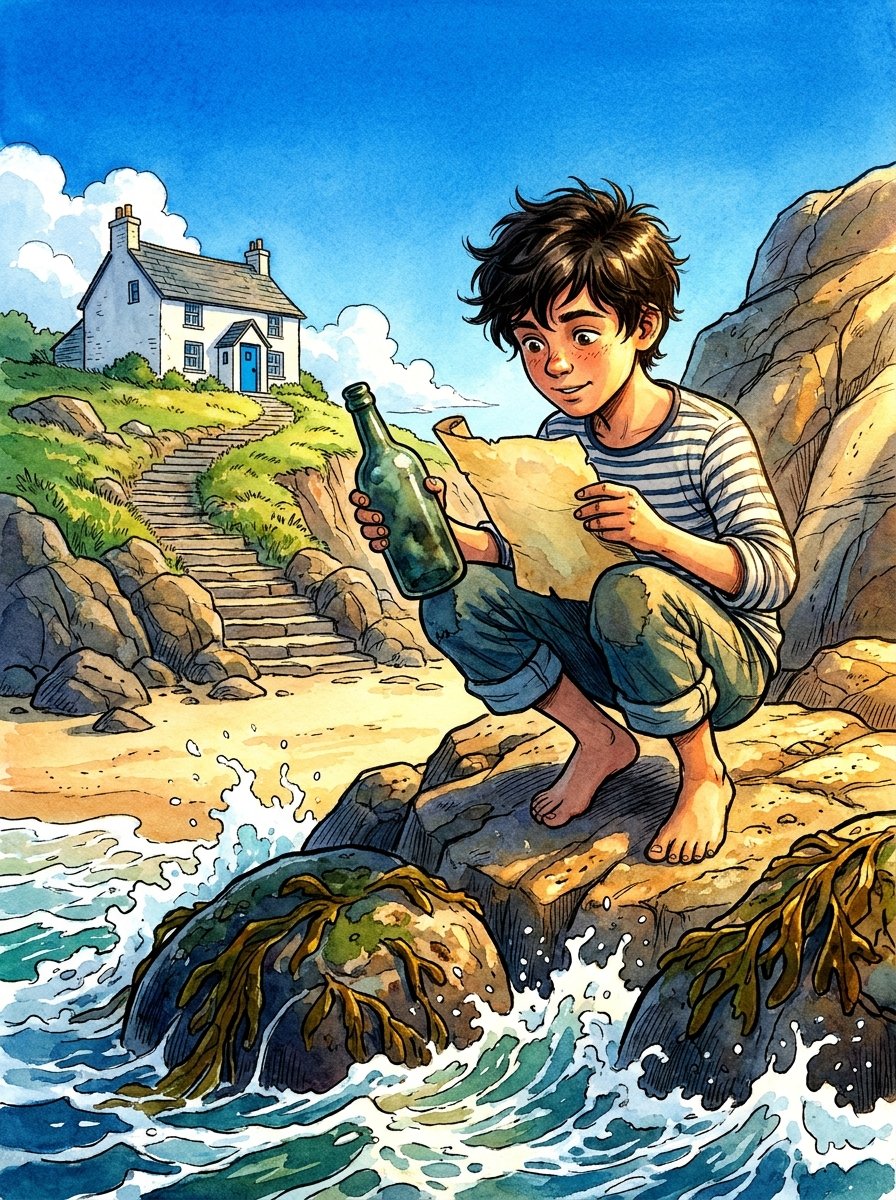
He found it wedged between two grey boulders at the tideline — a glass bottle, dark green, smaller than he expected. The glass was scoured cloudy from years in the sea. A cork sat in the neck, sealed over with old wax that had gone orange with age. Something pale was folded inside.
Henry worked his thumbnail around the wax seal until it crumbled. The cork came free with a soft pop and released a smell like old wood and cold salt. He tipped the contents carefully into his palm.
A roll of paper, tied with a thin strip of faded blue ribbon. He untied the ribbon and unrolled the paper slowly. It was stiff and brown at the edges and felt delicate in a way that made him breathe more carefully, as if a sudden breath might damage it. The writing inside was in blue ink, faded to grey in the older strokes, in the neat and careful handwriting of a child trying very hard to do their best. It began with these words:
Dear finder, my name is Clara Whitmore. I am ten years old. I live in the white cottage at the top of the stone steps, the one with the blue door. I have thrown this bottle from the end of the jetty to see how far it travels and if anybody ever finds it. I used my best fountain pen. If you are reading this, hello. I would very much like to know where you found it and what year it is. Please write back to the cottage. I will be hoping.
Henry read it twice, standing at the tideline with the cold wind pulling at his jacket. He turned the paper over. On the back, in smaller writing: I am hoping this reaches somewhere very far away. But honestly, I would be happy if it reached the next cove.
He looked at the date written in the corner. It was the last week of June, fifty years ago.
He looked up at the stone steps cut into the cliff face. The white cottage at the top had a blue door. He had come through that blue door thirty minutes ago. He stood at the tideline for a moment longer, reading the name one more time to make sure he had it right.
The name was Clara Whitmore. His grandmother's name was Clara.
He tucked the letter carefully into his inside pocket, against his chest, and ran up every one of the forty-three steps without stopping.
His grandmother was at the kitchen table with her crossword and her second cup of tea when he came through the door. She looked up at him over the top of her reading glasses.
"Gran," he said, slightly out of breath. "I found something on the beach."
He took the letter out and laid it on the table in front of her. She looked at it without touching it yet. Something moved in her face — not alarm, not surprise exactly, but something quieter and slower than both.
"Where on the beach?" she said.
"Between the two big grey rocks. Right at the low tideline."
She picked up the letter with both hands and read it. Her lips moved very slightly on the first few words, the way they did when she was reading something she needed to be certain of. She sat without speaking for a long moment after she reached the end.
"I was ten years old," she said at last. "It was the last week of school before the summer holiday. I found the bottle in the shed and washed it out. I wrote the letter at this table and walked down to the jetty to throw it." She set the letter down carefully. "I used my very best pen because I wanted the writing to last. I had no idea how long it would actually need to."
"Where has it been?" Henry said. "For fifty years?"
His grandmother shook her head slowly. "The sea doesn't explain itself."
She stood up and led him into the sitting room. He had been in that room hundreds of times, in the armchairs by the fire with books and beeswax polish in the air. But this time she walked straight to the wall beside the fireplace, where a row of photographs hung in mismatched frames going back many decades.
She stopped in front of one near the middle. It was black-and-white, a little faded. A girl stood on a beach with one arm stretched toward the camera, grinning widely. Behind her, dark and unmistakable, were the two grey rocks at the low tideline.
Henry looked at the photograph, then at his grandmother, then back at the photograph.
"That is me," she said. "That summer — I think my mother took this photograph on the same afternoon."
In the photograph she was exactly his age. She looked, he thought, precisely like someone who would write a letter and throw it into the sea. She had the look of someone who believed things could travel a very long way if you gave them the right start.
"She took the photograph and then I walked to the jetty," his grandmother said. "I threw the bottle and watched it bob past the rocks. Then the current took it and I couldn't see it any more." She was quiet for a moment. "I watched for a reply for years."
"Nobody wrote back?" Henry said.
"Nobody ever found it," she said. "Or not until today."
They went back to the kitchen and sat at the table together with the letter between them. Henry read it once more. This time he paid attention to different things — the way she had described the cottage, the colour of the door, the hope that sat just beneath the careful handwriting.
Outside, the sea was the same colour it always was. Gulls turned in the updraft above the cliff. Henry tried to picture ten-year-old Clara at this same table, using her best pen, and found that he could picture it perfectly.
"What do you want to do with it?"
His grandmother was quiet for a moment, looking at the letter. Then she looked up at him. "I want you to write back," she said.
Henry went upstairs and sat at the small desk in his bedroom. Through the window he could see the sea, very blue in the afternoon light, and the line of the jetty reaching out from the rocks below. He found a piece of paper in the desk drawer. He sat with his pen in his hand for a long time.
He had written letters before, but only thank-you letters, which always started the same way and ended the same way. Writing back to a bottle was different. He was writing to his grandmother at ten years old. She was sitting at the end of the jetty in the only way that still counted — the letter had come from there. He needed to tell her something true. He sat for a long time before he picked up the pen.
He wrote Dear Clara at the top of the page. My name is Henry and I am ten years old. I found your bottle between the two grey rocks at low tide, on a Wednesday afternoon in June. That was fifty years after you threw it from the jetty.
He stopped and looked out at the sea for a long moment. The light on the water was very bright.
You asked the finder to write back and say where they found it. I found it below the cottage. I come here every summer. The cottage looks exactly as you described it. The blue door is still blue. The stone steps are still forty-three steps from the beach — I have counted them many times.
He chewed the end of his pen.
You said you would be happy if it reached the next cove. I don't know exactly where it has been. But it came back.
He stopped again. He wanted to say who he was, but he also did not want to spoil it. He thought about the hoping in her letter, and the years she had spent watching for a reply that never came. He decided the most important thing was to answer what she had actually asked.
You asked what year it is. I am not going to tell you. I think that might be too much to read all at once. But I can tell you that the reply took a long time because the bottle had a long journey. And I can tell you that the cottage is full of people who love you. It always will be.
I think that is what you were really hoping to find out.
He folded the paper and went downstairs.
His grandmother read the letter standing at the kitchen counter, in the same careful way she had read the first one. When she reached the end she did not look up straight away. She stood very still with her back to him and the afternoon light coming through the window.
Henry waited at the doorway. He could hear the gulls outside and the distant sound of the sea pulling back across the stones.
After a while she turned around. Her eyes were bright but she was smiling.
"That is a very good answer," she said. "I think ten-year-old me would have been glad to get it."
She folded Henry's letter along its creases and slid it carefully back inside the bottle with her own. She pushed the cork in firmly and set the bottle on the windowsill above the sink, where the morning light came in low and turned the old green glass warm.
She did not throw it back.
Henry watched the bottle on the windowsill for the rest of that summer. He watched it through sunny mornings and grey ones, through high tides and low ones. Sometimes the morning light came through the kitchen window at just the right angle. The green glass threw a small pale patch of colour across the wall — watery and shifting and always in slightly the wrong place to catch properly.
Every time he saw it, he thought about the jetty, and the current that had taken the bottle out past the grey rocks and into the open water. He thought about fifty years of sea. He thought about the girl standing at the end of the jetty, watching until the bottle disappeared. He thought about her walking back up the forty-three steps, and watching for a reply that never arrived.
He thought the sea had done a pretty good job in the end. It had just taken its time.