← Story Library
Kinder Yarns

The Hundred-Year Soup

The Hundred-Year Soup

Nell had been walking for three hours when she smelled it.

The smell came through the trees on a cold current of air - something warm and deep and layered. It contained whole afternoons and distant kitchens and several things she could not put a name to. Her stomach answered it loudly. She had not eaten since early morning, and the light between the branches had turned the dark gold colour that meant the day was almost finished.

She pushed through the treeline and followed her nose.

The house was small and very old, tucked behind a dense bank of holly with its shutters half-closed and one chimney leaning slightly to one side. It did not look abandoned exactly - more like a house that had decided to stop being noticed. It had done so with considerable success for a very long time. Nobody answered when she knocked, so she tried the latch.

The door swung inward and she stepped inside.

The house smelled of cold stone and old wood and the particular quiet of rooms where nothing had been disturbed in many years. The furniture sat beneath dust that had long since stopped being layers and become something more like additional upholstery. The windows were cobwebbed over and the light barely reached the floor. But the kitchen at the back of the house was warm.

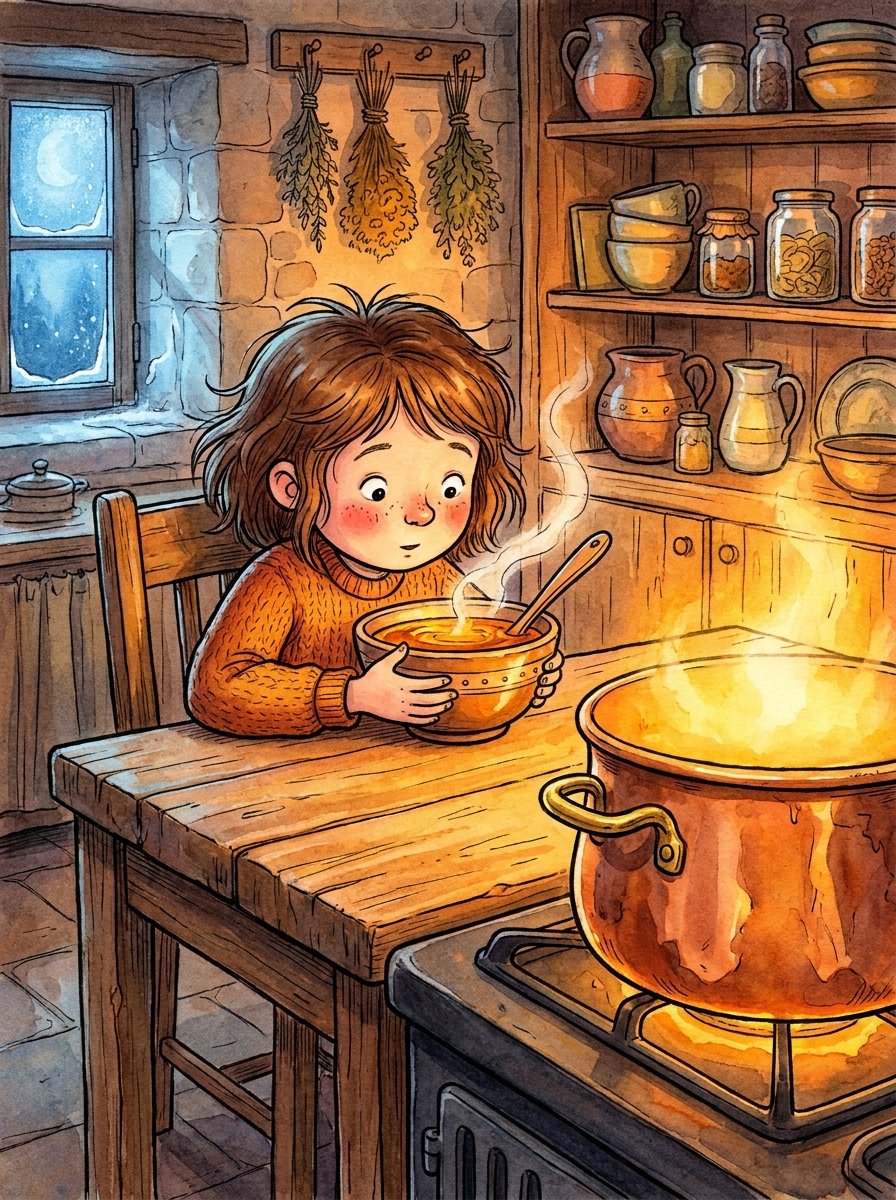
On a black iron stove, a large copper pot was simmering.

The stove showed no sign of being connected to anything that ought to have kept it going. The pot showed no sign of being stirred or tended. And yet both were doing exactly what they were built to do. They kept on patiently, without interruption, as though this arrangement had been in place so long it no longer required anyone's involvement.

Nell found a bowl on the shelf and a ladle hanging on a hook beside the stove. She crossed to the pot, lifted the lid, and leaned in.

The smell that rose from it was extraordinary. She had to put a hand on the counter to steady herself. It was deep and warm and layered in a way that contained several different meals at once - some she almost recognised and some she could not at all. She reached for the ladle.

"I would strongly advise," said the pot, "that you put that down."

Nell put the ladle down carefully and stepped back. She looked at the pot.

The pot looked back at her with the unhurried expression of something that had been waiting to say those exact words for a very long time.

"You just spoke," said Nell.

"I did," said the pot. "I have been simmering for one hundred years. One develops opinions, over that kind of time. Among them: opinions about who should and should not eat me. There is a chair at the table. Please sit in it."

Nell sat in the chair at the kitchen table. It creaked under her in the manner of furniture that had not been sat in for a considerable period. She folded her hands and looked at the pot.

"I should like to know how hungry you are," said the pot. "There is hungry and there is merely peckish, and I do not waste myself on the peckish."

"I have not eaten since early morning," said Nell. "I have been walking for three hours in cold weather. I lost my bread in the mud two hours ago."

"You lost your bread in the mud," said the pot.

"Half of it," said Nell. "The other half I dropped before that."

Something inside the pot made a slow, considering bubble. "That," it said at last, "is properly hungry. Now: do you understand what you are about to eat?"

"That is just soup," said Nell.

A pause followed that lasted rather longer than seemed strictly necessary.

"You are about to eat one hundred years of soup," said the pot, with some feeling. "For one hundred years, every day, water has evaporated and been replaced. Flavours have deepened and concentrated and combined and separated and recombined into something that no other soup in the world currently contains. I am not simply soup. I am one hundred years of attention to a single subject. I am the furthest a soup has ever gone."

Nell considered this carefully. "You are also," she said, "still soup."

"I am also still soup," said the pot. "Just as a very old oak is still a tree. The category is technically accurate. I find it insufficient."

Nell decided not to argue with a copper pot that knew itself better than she did.

"All right," she said at last. "I understand what I'm about to eat."

"Good. Now: will you eat it properly? Not bolted down at the counter. Not carried off somewhere to be consumed while doing something else. You will sit at this table and eat slowly and think about what you are eating for the full duration of the bowl. I require your attention."

"I will sit here and eat every mouthful carefully," said Nell. "I give you my word."

"You may also think about the bread," said the pot, "if there is bread."

"There is no bread," said Nell. "I lost it in the mud."

"Then only the soup," said the pot. "That is perhaps better."

A long quiet settled over the kitchen. The pot simmered on without interruption. The light outside the small window had gone a deep grey-blue. Nell sat with her hands in her lap and waited, because she had the distinct feeling there was more to come.

"There is one final condition," said the pot.

Nell sat up a little straighter.

"You must tell me something true about yourself," said the pot. "Something real, that you have not said aloud before. I have been in this kitchen for one hundred years. I have heard every sound this house makes. I know what dust sounds like when it settles. I know the sound of a door that has not been opened in thirty years. What I do not know is the truth of any person, because in one hundred years, you are the first one to come through that door. That is a long time to wait."

Nell opened her mouth and then closed it again.

She looked at the table. She looked at the pot. She thought about the three hours of walking and the mud and the two paths she had tried before finding this one.

"I got lost," she said, "because I was too proud to ask the farmer at the edge of the wood for directions. He was standing right outside his gate and he would have told me. Instead I thanked him and said I already knew the way, and I did not know it at all."

The pot was quiet. The stove ticked softly beneath it.

"I had been through this wood once before," said Nell. "A long time ago, with my grandmother, who knew every path in it. I thought I remembered the way because she had always known it, and I suppose I believed some of that had stayed with me. But she was the one who knew, not me, and I cannot ask her anymore because she's been gone for two years now."

She stopped there and said no more.

The kitchen was very still. The pot made a slow, quiet sound.

"That is two true things," it said at last. "You did not have to give me both. But I am glad that you did. Very glad indeed."

Something shifted in the kitchen. She could not have described it exactly. It was as though the quality of the silence had changed, the way a room shifts when something held tightly is finally let go.

"Hold out your bowl," said the pot.

Nell held out the bowl with both hands. The ladle rose from its hook by itself, moving slowly and with great care, and filled the bowl to the brim with soup the colour of dark amber. Steam rose from it in a single curling thread. Three slow rings of oil turned on the surface and settled. The ladle returned to its hook without a sound.

Nell sat at the table and she ate.

It was warm in a way that went beyond temperature alone. The warmth reached somewhere deeper than her stomach, into some part of her that had been cold for longer than one afternoon. Each spoonful seemed to taste of something slightly different from the last. Some of the flavours were almost names she knew. Others were entirely their own. She tried to name them and then she stopped trying and simply ate.

She ate slowly, as she had promised. She ate with her full attention. She thought about nothing else at all.

When the bowl was half empty she set her spoon down and looked at the pot.

"Who made you?" she said.

The pot was quiet for a moment before it answered. "A woman," it said quietly. "She made me on a Tuesday morning in October, a very long time ago. She put me on the stove and said she would be back within the hour. She was going to the market. She was going to bring bread."

"She didn't come back," said Nell.

"She did not," said the pot. "I have never been entirely certain why. There are many possible explanations and I have had one hundred years to consider all of them. I do not know which is true. I know only that she meant to return — she would not have started me otherwise. She was not the kind of person to put a pot on the stove and walk away without a reason. She sang while she worked. She hummed quietly when she did not have words for the feeling. The kitchen was never quite quiet when she was in it, and I have not forgotten the sound of it. I am certain of all that."

Nell looked at the pot for a long moment. She thought about her grandmother, who had always known the paths through the forest and who was also not the kind of person to go away without a good reason.

"I'm truly sorry," she said.

"I have been all right," said the pot, after a moment. "I have spent one hundred years becoming something. That is not nothing."

Nell picked up her spoon and finished the bowl slowly, thinking about the woman and the October morning and the bread that was supposed to come. She thought about the stove keeping on without being asked, and the pot deciding, entirely on its own, that it would keep going until there was a reason to stop. There was something she recognised in that, though she could not quite have said what.

When she finished, she set the bowl on the table and sat for a moment without moving. The kitchen was warm around her and she did not feel ready to leave it just yet. Then she looked at the pot.

"That is the best thing I have ever eaten," she said.

"You are the first person who has eaten me," said the pot. "You have nothing to compare it to."

"Some things you know without a comparison," said Nell. "That is one of them."

The pot made a sound she had not heard from it before - a short, quiet sound, not quite a word, not quite a sigh. She thought it might have been the sound of something that had waited a very long time to be told exactly that.

She washed her bowl carefully and put it back on the shelf. She hung the ladle on its hook. She stood in the kitchen doorway and looked back at the copper pot on the stove, simmering steadily, as it always had.

"I'll come back," she said. "Now that I know the way, I'll come back."

"Come back with bread," said the pot. "Rye bread, if you are going to the trouble of bringing any."

"Rye bread," said Nell. "All right."

She went out into the cold evening. The trees were dark shapes against a pale sky. The path through the wood was clear in the moonlight, and she found her way home without any difficulty at all. She did not need to ask anyone for directions.

Behind her, in the small warm kitchen, the pot simmered on. One hundred years and one bowl. It had been waiting a very long time to become what it had become. And it had been waiting for someone hungry enough and honest enough to sit down at that table and eat it properly. That person had known, without needing a comparison, that it was worth it.

The kitchen glowed warmly through the dark. If you looked back through the window as you left, the light was golden and still. It was the kind of light that said something in there was doing exactly what it was supposed to do and had never stopped.

It turned out to be a Tuesday. She thought the woman who had started it on a Tuesday would have appreciated that.

Preview
Share this story
Kinder Yarns

Listen in the app

Engaging, narrated stories for kids aged 4-10.
↓  App Store ↓  Google Play