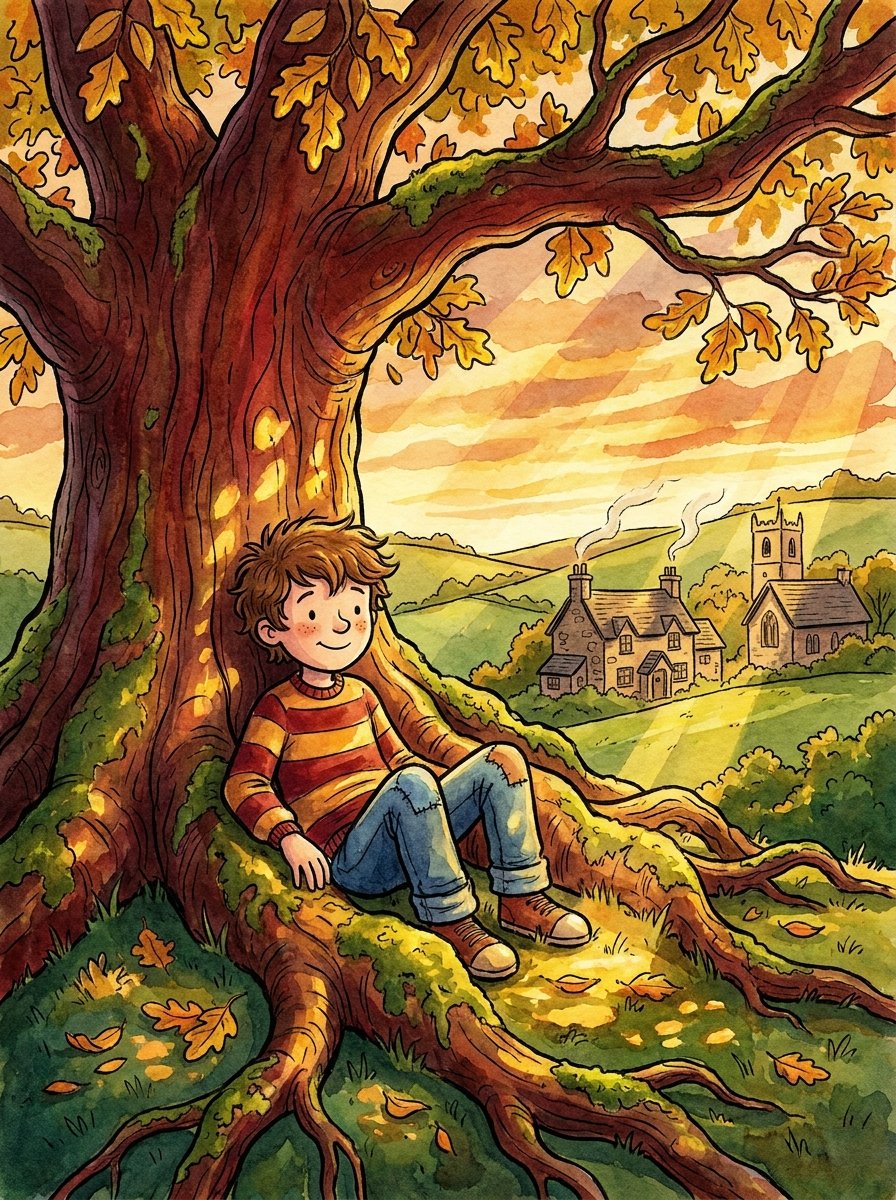
Ben had been sitting under the oak tree for quite a long time without anything interesting happening, which was, frankly, the whole point.
He had a stone that was exactly the right shape for holding. He had a biscuit he was saving for when things got desperate. And he had nothing in particular to think about, which was a rare luxury on a Tuesday afternoon.
The shadow of the oak was very large and very cool. Ben had been intending to stay in it until dinner.
"You're sitting on my root," said the tree.
Ben looked up.
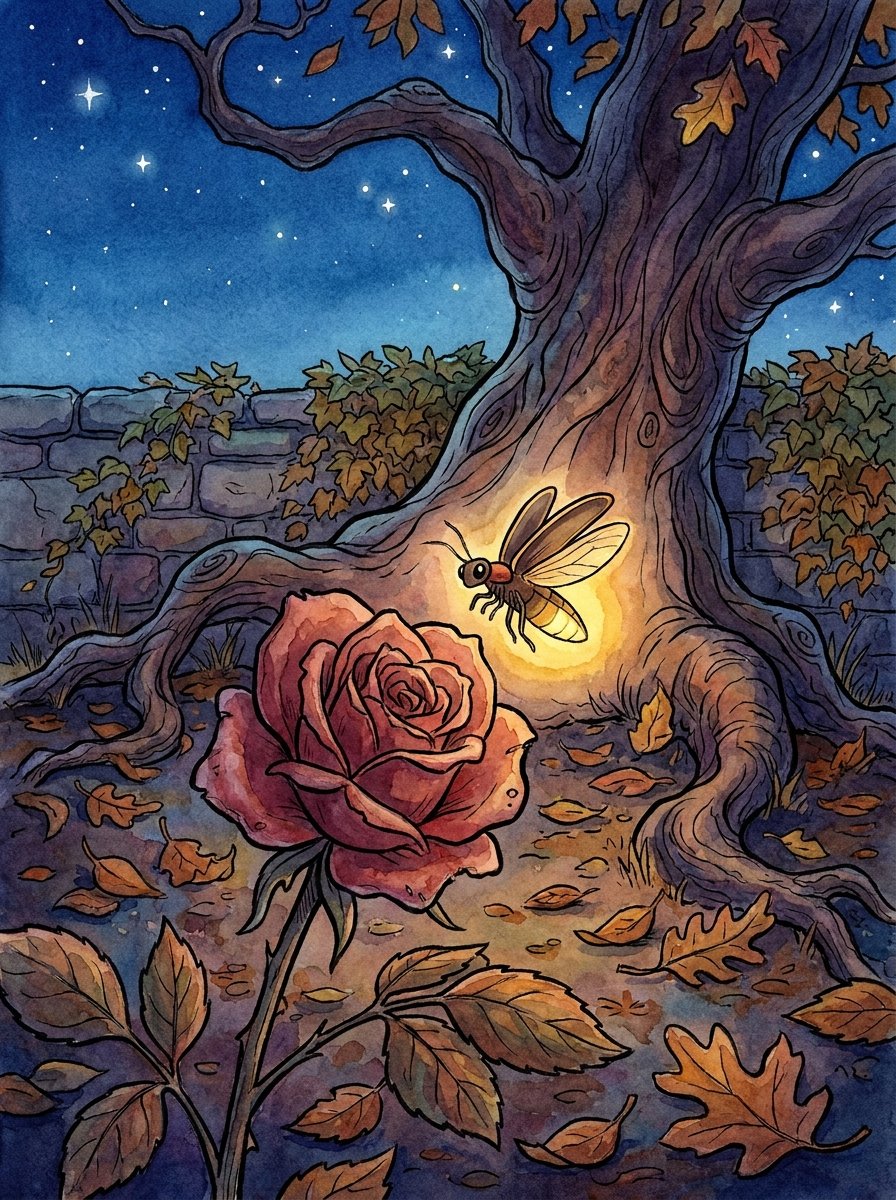
The oak was very old. Its trunk was wider than his bedroom. Its branches went in every direction, as if they had never quite made up their mind. It did not look like the kind of thing that talked.
"I beg your pardon?" said Ben.
"My root. The big one on the left. You've been pressing your elbow into it for forty minutes. It's not painful, exactly. But it's noticeable."
Ben moved his elbow.
"Thank you," said the tree.
There was a long pause.
"How long have you—" Ben began.
"Three hundred and twelve years," said the tree. "Since the winter with the very big snow, in case you want to place it."
Ben looked around. The village was very quiet. A bicycle leaned against a wall. A cat crossed the lane. Nobody seemed to be paying attention to the fact that the oak tree was talking.
"I've been thinking," said the tree, "about whether to tell you something. I've decided I will. But I'm only going to tell you the funny parts."
"The funny parts of what?"
"Of what I've seen. I have watched this village for three hundred years. That is a great deal of watching. Most of it is not funny at all — births, winters, long slow years, things I won't mention on a Tuesday. But the funny parts are very funny. And you look like you could use something funny."
Ben, who had been having what he privately considered a not-great week, found he didn't argue with this.
"Go on, then," he said.
The oak rustled its leaves in a way that might have been a clearing of a throat.
"Seventeen thirty-four. The miller — his name was Crouch, enormous man, very proud of his hat — wore his hat to the harvest festival. It was a very tall hat. He was very attached to it. The wind took it off his head at the exact moment he was standing in front of the entire village to give a speech."
"What happened?"
"He chased it. For one hour and forty minutes. The hat went into the pond. He went into the pond. The hat came out. He came out. The hat went into the Hendersons' vegetable garden. He went into the Hendersons' vegetable garden. The hat blew back across the green and lodged in a hedge. He climbed the hedge."
The tree paused.
"Did he get it back?"
"He did. He put it on his head, very carefully, and walked back to the festival, completely soaked and covered in hedge, and said, 'As I was saying,' and continued his speech. Not one person laughed. Out loud."
Ben grinned.
"Seventeen eighty-one. The new mayor — Mayor Tibbs, small man, very large chain of office — decided to give a ceremonial key to the village to a visiting duke. The key was made specially. It was enormous. It weighed nearly as much as Mayor Tibbs. He carried it out into the square, dropped it on his foot, said a word I will not repeat, and then spent the next twenty minutes trying to pretend that nothing had happened while hopping very slightly on one foot through the rest of the ceremony."
"Could the duke tell?"
"The duke gave him a sympathetic look. Mayor Tibbs gave the duke the key. The duke gave it back and said it was tremendously generous but perhaps impractical to transport. They shook hands very formally for quite a long time while both of them pretended the previous twenty minutes had not occurred."
Ben had put down his stone. The biscuit was forgotten. He was leaning forward against the root — on the far side, away from where the tree had asked him not to be.
"Eighteen sixty-two. A woman named Elsie Barrow, who lived in the cottage by the mill pond, kept chickens. Her chickens were famous. Every year she won the prize at the village show. Every year her neighbour Mr. Finch tried to beat her and couldn't. One year he entered what he claimed was a very impressive hen."
"What happened?"
"It was a duck. He had somehow become convinced it was a hen. Nobody knows how. The judges were very polite about it. Elsie Barrow was less polite. Not loudly — she was very dignified. But she laughed all the way home. I could hear her from here."
The tree was quiet for a moment, in a happy sort of way.
"Do you want to know about the nineteen-fifties?"
"Yes," said Ben.
"A man named Arthur Briggs decided to fix his own roof. He had never fixed a roof. He went up on a Saturday morning. He came down on a Wednesday. Not because of anything dramatic — he simply kept finding more things to fix. His wife passed sandwiches up to him on a broom handle. The whole village knew about the sandwiches. It became a bit of a local story."
"Did he fix it?"
"He fixed it perfectly. It was a very good roof. He was extremely proud of the roof. He talked about the roof for thirty-one years."
Ben laughed properly at this, the kind that comes up from somewhere well below the biscuit.
"Why only the funny parts?" he asked, when he'd settled down. "You said you've seen everything. Why not tell me the rest?"
The oak took a long time to answer. Its branches moved, very slowly, in a breeze Ben couldn't feel.
"Because the rest of it isn't mine to tell. Those parts belong to the people who lived them. The funny parts—" it paused, in the way very old things pause when they are being careful with words. "The funny parts everyone could have. They were the parts people told each other, at the time. They went around the village and made people feel better about their Tuesday afternoons."
Ben looked out at the lane. The cat was sitting in a patch of sun. The bicycle still leaned against the wall.
"Is there a funny part with my family?" he said.
"Yes," said the tree.
Ben waited.
"Your grandfather. Nineteen eighty-three. He was trying to impress your grandmother. He told her he knew how to row a boat."
"Did he?"
"No. They went in circles for an hour. She knew he couldn't row. He knew she knew. They kept going anyway, round and round the pond, because neither of them wanted to say so. They were laughing by the end."
Ben sat with that for a while.
"They rowed in circles," he said.
"Happily," said the tree. "That's the important part."
He picked up his stone. He ate his biscuit. The afternoon light came through the leaves and lay in warm gold patches on the ground around him, dappled and slow.
"Same time next week?" he said.
"I'll be here," said the tree. "I generally am."