Mabel had been digging the same tunnel for two years, three months, and eleven days.
She knew this because she kept count. Every morning she woke in her sleeping chamber, ate seven worms for breakfast, and dug. Every evening she packed the loose earth tight behind her and slept. The tunnel ran east, then curved south, then east again.
She did not know exactly what was at the end of it. A feeling had started her digging - a faint warmth in the soil, a low vibration that seemed to come from deep below rather than from any root or rock. Other moles had asked her why she kept going when there were perfectly good worms and grubs closer to the surface. She had not been able to explain it properly. Moles had always trusted these feelings. They were older than memory, and usually right.
The soil changed as she went deeper. Clay gave way to chalk. Chalk gave way to something drier and finer, almost like powdered stone. Then, on an ordinary Tuesday morning in early spring, her front paws pushed through into nothing at all.
Mabel lost her footing and fell through the gap. It was a short drop - the height of a large book - and she landed hard on something smooth. She lay still for a moment, catching her breath.
Then she opened her eyes.
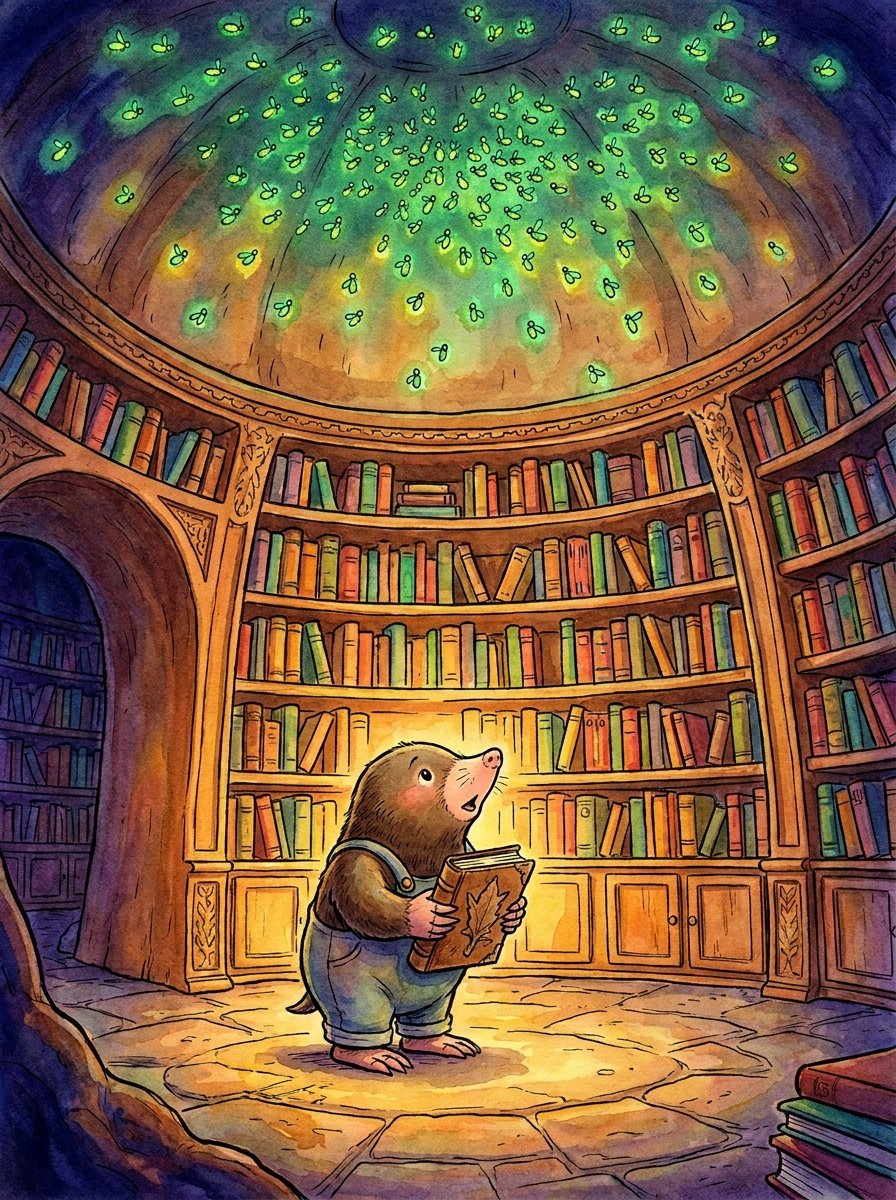
Moles do not see well. Mabel knew her own tunnels by touch and smell rather than by light. But something above her was glowing - many small, cold lights clustered on the ceiling like stars she had never seen before. Each one was a worm, coiled into a pale green curl, giving off just enough light to see by.
She was in a room. It was enormous - far larger than anything she had ever dug. The ceiling rose high above her, its surface thick with glow-worms in long, curving clusters. The walls were lined from floor to ceiling with shelves carved directly from the earth and shored up with smooth timber beams. Each shelf was edged with a thin strip of polished wood to stop the books from sliding. Somebody had made this place with great care.
And on every shelf, running in long and patient rows, were books. Hundreds of them on each shelf, packed tight from end to end. Thousands of them in total.
Mabel stood up slowly and looked around. Her nose told her what her eyes could not. The air held dry paper, old leather, and something like candle wax though no candles burned anywhere. Beneath it all was a deep clean smell - the smell of earth that had been kept undisturbed for a very long time.
She had never smelled anything like it. It was the finest thing her nose had ever found.
She walked to the nearest shelf and pressed her paw flat against the spines of the books. They were cool and dry. Not a trace of damp anywhere. Whatever had built this room had solved every problem that earth and water usually caused, and she did not know how.
She pulled one of the larger books from the shelf and laid it open on the floor. She could not read the words inside, but the pages were full of drawings - detailed pictures of roots, fungi, seed casings, soil creatures. Each drawing had been made with great care and precision. She turned the pages slowly, running a claw along each illustration. Here was an earthworm, shown in cross-section. Here was a beetle larva curled inside its chamber. Here was a root system drawn as if from directly above, spreading like rivers across the page.
She put the book back exactly as she had found it and moved further along the shelf.
The floor was smooth stone, worn to a polish by many feet. Mabel's claws tapped against it as she walked further into the room.
The books were carefully organized. She could not read the writing on their spines - she had never learned to read ink on paper. But she could see they were grouped in some careful order. She walked slowly along the rows, her nose close to the shelves, learning the room one shelf at a time.
Near the middle of the library she stopped. One book stood out as different. It sat pressed between two much larger volumes and was easy to miss entirely. Its cover was not cloth or leather but something she recognized immediately: pressed bark, bound together with dried roots.
She lifted it down carefully with both paws.
The markings inside were pressed rather than drawn — a pattern of ridges and grooves that she read with the tips of her claws. It was the old underground script, the one moles learned from their mothers before they learned to dig. Mabel read slowly, holding the book close to her nose.
The book was a record. It listed every creature that had ever brought knowledge to this library. Earthworms, who carried the history of soil layers going back many centuries. Beetles who had memorized the root maps of entire forests. Dormice who knew the location of every food store within a day's travel of their burrows. Spiders who had catalogued every web pattern known to their kind.
The list also included moles. Several of them, their names pressed in the old scent-mark style, each one different.
Mabel read each mole's name carefully. She did not recognize any of them. Then she reached the last entry on the final page and her claws went still.
The name pressed there was her grandmother's.
Mabel sat down on the cold stone floor with the book in her lap. Her grandmother had died before Mabel was old enough to know her properly. She had been, by all accounts, an exceptional digger - one who dug not only for food and shelter but to discover what lay beyond. She had vanished one autumn without explanation and never returned home.
Everyone had assumed she was lost.
But she had been here. She had found this place and added her name to the record. Perhaps she had sat on this same cold floor and looked up at these same glow-worms. Mabel sat with the book and tried to imagine her grandmother as a young mole. She would have been alone in this room for the first time, holding this same strip of bark and reading the same welcome. The library was quiet around her, and the glow-worms pulsed gently, and she did not try to rush the feeling.
Eventually she set the bark book back on its shelf and kept walking. Near the far wall she found a reading stand - a piece of smooth timber set at a comfortable height for a small creature to read. A large paper book lay open on it. She could not read the words inside.
But pressed between the open pages, used as a bookmark, was a narrow strip of bark. She lifted it out and read it slowly with her claws.
It said: *For the next keeper. This library belongs to no one. It belongs to whoever tends it. The glow-worms need feeding once a week - they eat the grey mould on the east wall. The books are arranged by the age of the knowledge, oldest toward the back. The blank bark sheets and pressing tools are in the small room behind the last shelf. Welcome.*
There was no name at the bottom.
Mabel read the strip twice. Then she folded it carefully and tucked it under her arm.
She walked the whole library two more times before she was satisfied. She counted forty-seven shelves running the full length of the room in both directions. She found a smaller room at the back with a tunnel leading upward that was too narrow to follow. She found the third room the note had mentioned, with a neat stack of blank bark sheets and a full set of pressing tools laid out as if recently cleaned.
She picked up one of the pressing tools and turned it over in her paws. It was exactly the right size for a mole's grip, as if it had been made for one.
By the time she climbed back up through her own tunnel, the morning was completely gone. She sat at the entrance to her sleeping chamber and ate without tasting any of it. Her mind was still below, walking the stone floor between the shelves.
She went back the next morning, and the morning after that.
On the third day she fed the glow-worms - a handful of grey mould scraped carefully from the east wall. She watched them brighten and uncurl, pulsing a little greener and stronger than before. It made a noticeable difference to the light in the room. On the fourth day she began a map of the shelves on a blank bark sheet, pressing the marks in slowly with the tools from the back room. It was careful, slow work, but it suited her completely.
On the seventh day she found a book about tunnelling, written in the old bark script, on a shelf she had not reached yet. It described eighteen different soil types and how to read each one before digging into it. Mabel recognized every type from her own years underground. The book also described three soil types she had never encountered. She read those sections three times each, pressing the descriptions into her memory carefully.
She read the whole book in a single visit, sitting cross-legged on the stone floor with the glow-worms bright above her.
The spring was moving quickly above her. New warmth was pushing down through the earth. Other moles in the fields nearby were starting fresh tunnels, following the thaw toward good roots and soft ground. If she passed them on the surface, they would stop and ask where she had been keeping herself.
Just digging, she would say. The same tunnel as always.
And she would leave it at that, because the library was not something she wanted to share carelessly. It had been kept well for a very long time. Whatever creature had built it and gathered its books and then quietly left - they had trusted the next keeper to treat it with the same care.
Mabel fully intended to do exactly that.
She was already planning her first entry for the record book. It would document something no other contributor had thought to include: the exact feel of soil at each depth. She would press the records in scent-marks that any underground creature could read in the dark, without needing a single glow-worm overhead.
It would take her months to complete. She did not mind that at all.
She thought her grandmother would have approved.