← Story Library
Kinder Yarns

The Lonely Scarecrow

The Lonely Scarecrow

Patch had been standing in the middle of Farmer Grayson's field for three years, and in all that time, not a single crow had come near him.

This was, by any measure, a failure.

A scarecrow's entire purpose — the reason for the straw, the reason for the outstretched arms, the reason for the old hat and the button eyes and the stitched-on smile — was to keep crows away. Patch did that job brilliantly. Too brilliantly. The crows didn't just avoid his field. They avoided the road past his field. They avoided the trees near his field. They flew in long, wide arcs around the whole area, as if Patch were a hole in the sky that they might fall through.

He didn't mean to be so frightening. He was made of burlap and straw and old clothes, with a face painted on by Farmer Grayson's daughter, Lily, when she was seven. The face was supposed to be friendly. Lily had given him a wide smile, two round cheeks, and a pair of eyes that were slightly too big for his head, which she said made him look kind. But somewhere between the painting and the stitching, the kind had become something else. The smile was a little too wide. The eyes were a little too staring. When the wind blew, his arms swung slowly back and forth, and his coat flapped open, and the straw poked out in directions that suggested he was reaching for something.

The crows had taken one look at him on his very first day and decided, unanimously, that he was the most dangerous creature in the county.

Patch didn't know this. He only knew that the sky above his field was always empty.

He watched the other scarecrows in the neighbouring farms. Old Ned up the road had crows sitting on his hat every morning. Old Ned didn't seem to mind. He stood there with his arms outstretched and his painted-on frown, and the crows perched on him like he was a particularly comfortable fence post. They preened their feathers. They argued about things. They fell asleep on his shoulders during the quiet afternoons. The crows flew right past Patch's field to get to Old Ned, wide arcs and all, as if Patch were a hole in the sky they needed to avoid on the way to somewhere better.

Patch would have given anything for that. Not the crows specifically — he didn't know what crows were like up close, only that they were black and clever and they made sounds that seemed like words. He wanted the company. He wanted something alive to be near him, something that wasn't a scarecrow, something that moved and breathed and had opinions.

The field had opinions. Wind had opinions. Even the scarecrow next door, a lopsided thing named Stitch who had lost an arm in a storm, had opinions — mostly about the weather and about how his stuffing was shifting to the left. But none of it was the same as having a visitor.

Patch had tried waving at the crows. This was a mistake. His arms were attached to a crossbeam, and when the wind moved them, they swung in wide, slow arcs that looked, to a crow, exactly like someone trying to grab something out of the air. The crows saw this and flew faster.

He had tried standing very still. This was also a mistake, because standing very still was exactly what a scarecrow was supposed to do, and the crows found it deeply unsettling.

He had tried not having his arms outstretched, but Farmer Grayson had tied them to the crossbeam with wire, and there was no way to undo that without losing the only arms he had.

By the third year, Patch had given up. He stood in his field and watched the empty sky and waited for something to change, the way scarecrows do — slowly, and with a great deal of straw.

Then one afternoon, a crow landed on him.

Not on his hat, or his shoulder, or his outstretched arm. On the ground. Three feet away. A small, dark bird with a sharp eye and a head that tilted to one side like a question mark.

Patch couldn't move, but he could see. The crow looked at him for a long time. Then it looked at the sky. Then it looked back at him.

"You're the one who scares everyone," said the crow.

Patch was so surprised he almost fell over. Almost. He was tied to a crossbeam.

"I'm sorry," he said, though he wasn't sure what he was sorry for.

"Don't be sorry. Be useful." The crow hopped a little closer. "I need to talk to you about something."

Patch had never had a conversation before. He wasn't sure of the rules. "About what?"

"About the deal," said the crow.

"What deal?"

"The deal where you stop scaring us and we stop avoiding you."

Patch thought about this. It was the most interesting thing anyone had said to him in three years. "I don't scare you on purpose."

"I know," said the crow. "That's the problem. You scare us by being you. Which is very inconvenient for everyone."

"I could try being someone else," said Patch.

"You're made of straw. You can't be anyone else. You can only be you, and you are terrifying." The crow tilted its head the other way. "Which is why I have a proposal."

"I'm listening," said Patch, though he couldn't move or lean in or do anything to show he was listening except exist, which was what he had been doing all along.

"My name is Mort," said the crow. "I lead a flock. There are forty-seven of us. We used to eat from this field — the grain, the beetles, the lot. Then you showed up and we couldn't come near it. We've been eating from the dump behind the supermarket for three years. Do you know what the dump behind the supermarket is like?"

"I can imagine," said Patch.

"It is not good," said Mort. "It smells like old chips and regret. My flock is miserable. They blame me for not finding a better place. I need this field back."

"I need company," said Patch.

Mort looked at him. "You're a scarecrow."

"I know what I am."

"And you want company."

"Desperately," said Patch.

Mort was quiet for a moment. He looked at the field. He looked at the sky. He looked at Patch's painted-on smile, which was wide and staring and, to a crow, looked like the smile of something that ate crows for breakfast.

"Here is the deal," said Mort. "My flock comes back to this field. We eat. We sit on the fence. We do our business on Farmer Grayson's tractor. We do all the things crows do. And in exchange, you don't scare us."

"How would I do that?" said Patch. "I'm a scarecrow. Scaring is what I do."

"You do it by not trying," said Mort. "You just stand there. You don't wave your arms. You don't swing at us. You don't do that thing with your coat where it flaps open and the straw sticks out."

"That's the wind," said Patch.

"Then ask the wind to stop."

"I can't ask the wind to stop. I can't ask anything. I'm a scarecrow."

Mort tilted his head. "Then we have a problem."

They were both quiet for a moment. The wind blew. Patch's arms swung. His coat flapped. The straw poked out in directions that looked, to a crow, like someone reaching for something.

Mort watched this with great interest.

"Close your coat," he said.

Patch couldn't close his coat. It was held open by the straw pushing through the gaps in the burlap. But he could shift his weight — slowly, very slowly — and when the wind blew from the right direction, the coat pulled a little tighter across his front.

"Better," said Mort. "Now about the arms."

"I can't do anything about the arms."

"Can you ask Farmer Grayson to lower them?"

"Farmer Grayson doesn't talk to me. Nobody talks to me. Except you."

Mort considered this. "What if I perch on your arm? Will you swing at me?"

"I'll try not to."

"Try harder than that. My life depends on it."

"I promise," said Patch. "I won't swing at you. I won't swing at anyone. I'll stand as still as I can."

Mort looked at him for a long time. Then he hopped forward, very carefully, and landed on Patch's left arm.

The arm didn't move. Patch held it still — not with muscles, because he didn't have any, but with a kind of determined straw, the way scarecrows hold things when they really want to hold them.

Mort settled his feathers. He looked around the field. He looked at the grain, golden and swaying. He looked at the fence, old and wooden and perfect for perching.

"This will work," he said.

And it did.

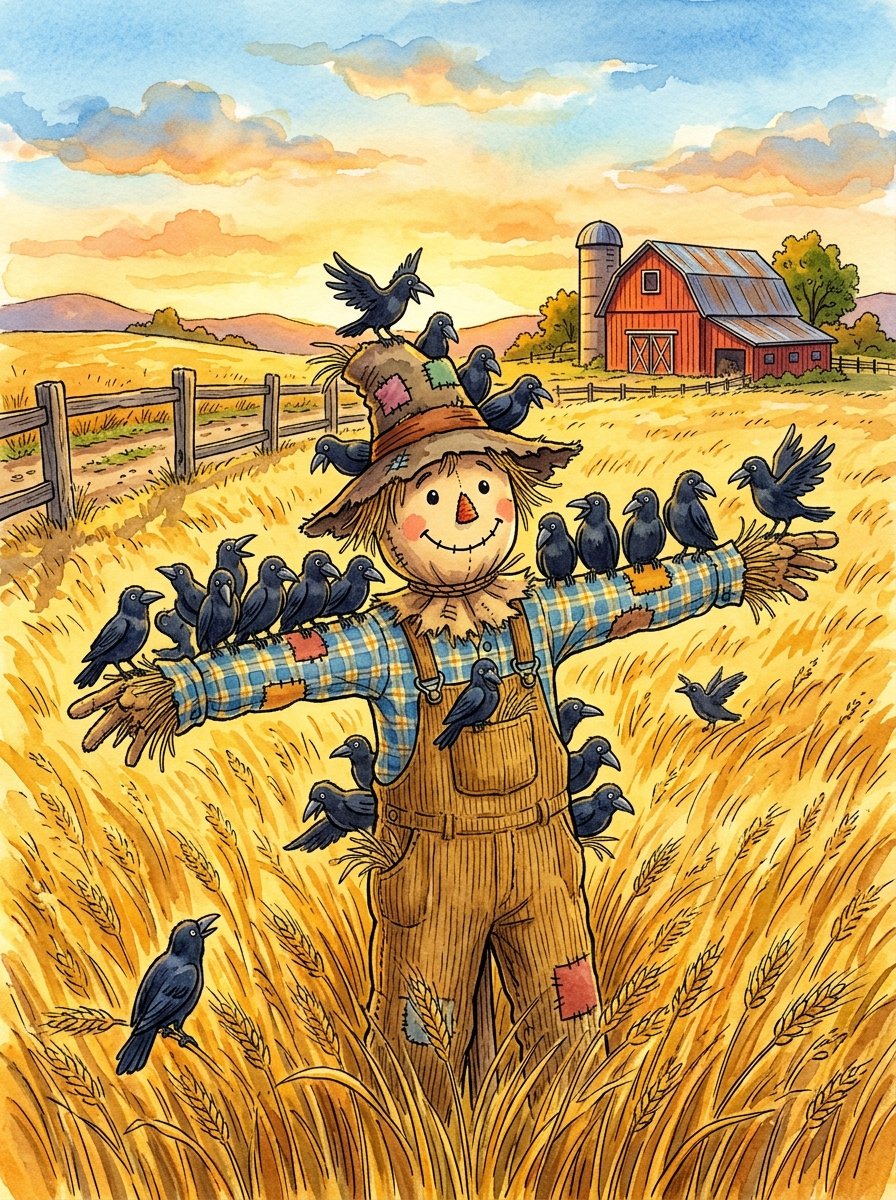
The next morning, forty-seven crows arrived at the field. They came in a great dark wave, circling once, twice, three times, checking that Patch wasn't going to do anything alarming. When he didn't — when he stood there with his arms out and his coat flapping and his painted-on smile doing its best to look kind — they settled.

Some landed on the fence. Some landed on the ground. Some landed on the tractor. A few, the bravest ones, landed on Patch's arms and shoulders and hat. They sat there and looked around and made quiet sounds to each other, the way people do when they're settling into a new place and figuring out where everything is.

Patch had never been so happy. He had birds on him. Living, breathing, opinionated birds. They shifted their weight on his arms, which made his straw creak. They preened their feathers, which made small, comforting sounds. One of them — a young crow with a slightly crooked tail feather — fell asleep on his hat, and Patch could feel the tiny heartbeat through the burlap.

He didn't move. He didn't swing. He stood as still as he had ever stood in his entire life, which was three years and counting, and he let the crows be.

Mort sat on his left arm and kept watch. He was a good leader — patient, observant, and quick to notice when something wasn't right. When a crow landed too close to Patch's face and got spooked by the painted-on eyes, Mort flew over and settled the matter with a few sharp caws.

"You're doing well," Mort told Patch one afternoon.

"I'm trying," said Patch.

"You're not trying. You're just being. That's better than trying."

Patch thought about this. "Is that what friends do?"

"Sometimes," said Mort. "Sometimes friends try very hard. And sometimes they just stand there and let the other ones sit on them."

Patch liked this. He liked it more than anything he had ever liked, which wasn't much, because he had only been alive for three years and most of that had been spent standing in a field with nobody on him.

The days turned into weeks. The weeks turned into months. The crows got used to Patch, and Patch got used to the crows. He learned their names — not all of them, because there were forty-seven and some of them looked very similar — but the ones who came to him most often. There was Mort, of course. There was a crow named Brisk, who was always in a hurry and never sat still for more than ten seconds. There was a crow named Dapple, who had grey feathers mixed in with her black ones and who liked to sit on Patch's hat and watch the horizon. There was a young crow named Click, who had the crooked tail feather and who still fell asleep on Patch's hat every afternoon.

They told him things. About the dump behind the supermarket (still bad). About the other scarecrows (Old Ned was losing his hat, Stitch had lost his other arm). About the weather, and the grain, and the beetles, and the farmer down the road who had started putting up electric fences, which was very rude and unnecessary.

Patch listened to all of it. He couldn't respond — not with gestures, because his arms were tied to a crossbeam. But he could listen, and listening, he discovered, was almost as good as talking. Maybe better. Talking required you to have something to say. Listening just required you to be there.

And Patch was always there.

One evening, as the sun was going down and the crows were settling onto the fence for the night, Mort flew up and landed on Patch's shoulder.

"I need to tell you something," he said.

"Alright," said Patch.

"When we made this deal — you don't scare us, we keep you company — I thought it would be temporary. I thought we'd use the field for a few weeks, get our strength back, and move on."

Patch felt something shift in his straw. Not much. Just a little. "And?"

"And we're not moving on. The flock likes it here. They like the grain and the beetles and the fence. They like the tractor. They especially like you."

Patch was quiet for a moment. The wind blew. His coat flapped. A crow on his hat shifted its weight.

"I like you too," he said.

"I know," said Mort. "That's why I'm telling you. The deal is permanent. We're staying. This is your flock now, and this is our field, and we're going to be here for a very long time."

Patch had never had a flock before. He had never had anything before — no name that anyone used, no purpose that anyone cared about, no reason to stand in a field except that he had been placed there and couldn't move. But now he had Mort and Brisk and Dapple and Click and forty-three other crows who sat on him and talked to him and fell asleep on his hat, and that was more than enough.

"Thank you," he said.

"Don't thank me," said Mort. "You earned it. You stood still when everything in you wanted to swing. You kept your coat closed when the wind wanted it open. You let us sit on you when any other scarecrow would have scared us away." He paused. "You're not a very good scarecrow, Patch."

"I know," said Patch.

"But you're a very good friend."

Patch smiled. His painted-on smile, which had always been wide and staring and terrifying to crows, suddenly didn't feel so wide or so staring. It felt like a smile. A real one. The kind that sits on your face and stays there because something good has happened and you want to remember it.

The sun went down. The crows settled. The field was quiet except for the sound of forty-seven crows breathing and the wind in the grain and the occasional creak of Patch's straw as a crow shifted on his arm.

He stood there, in the middle of the field, with crows on his hat and crows on his shoulders and crows on his outstretched arms, and he thought about what Mort had said. He was not a very good scarecrow. But he was a very good friend.

And for the first time in three years, the sky above his field was full.

Preview
Share this story
Kinder Yarns

Listen in the app

Engaging, narrated stories for kids aged 4-10.
↓  App Store ↓  Google Play