← Story Library
Kinder Yarns

The Long Way Home

The Long Way Home

Bella knew this street. The smell of the old oak tree. The crack in the sidewalk where she used to hop. The blue mailbox at the corner where the mailman always gave her a pat on the head.

But something was wrong.

The house at 42 Maple Lane was not her house anymore. The front door was painted red instead of green. A strange bicycle leaned against the porch. And the flowerpot where Bella used to nap in the afternoon sun — it was gone.

She sat down on the front step and whined softly.

Three years. That was a very long time when you were a dog. Especially when you had walked so far to get back.

The thunderstorm that took her away came out of nowhere. One moment Bella was sniffing a dandelion in the backyard. The next, the sky turned the color of a bruise and the wind screamed through the fence. A branch crashed down beside her. The gate swung open. And Bella ran.

She did not mean to run away. She was just so frightened. The rain stung her eyes and the thunder shook her bones and she ran until her paws ached and her legs gave out beneath her.

When the storm passed, she was lost.

She tried to find her way back. She really did. She followed every road and circled back to every familiar landmark. But the world smelled different after the rain. All the familiar scents had been washed away, and the harder she tried, the more lost she became.

For the first few months, Bella lived in the woods behind the old mill. She caught rabbits and slept under a fallen log and waited for someone to find her. She learned which berries were safe and which made her sick. She learned to listen for thunder and find shelter before the rain came. In the long quiet afternoons, she watched deer pick their way through the trees and wondered if they ever got lost too.

But mostly, she remembered.

She remembered Lily, the little girl who had raised her from a puppy. Lily's hair smelled like strawberries in summer. Her hands were always gentle, even when she was learning to tie knots in Bella's leash. She used to whisper secrets into Bella's floppy ears — secrets about the bird outside her window and the shape of clouds and the way the moon followed her home.

In Bella's dreams, Lily was calling her name.

So Bella started walking.

She did not know where she was going at first. She just walked. Through fields and forests and tiny towns where children threw sticks for her and old ladies left bowls of water on their porches. She followed fence lines and power poles and the bright blur of highway lights at night.

When her paws got sore, she rested. When her belly got empty, she found food. When the loneliness got too heavy, she lifted her nose to the sky and howled.

And then she reached the first city.

It was enormous. Bella had never seen so many people or so many cars or so many buildings that scraped the clouds. The noise was terrifying — horns and sirens and rumbling trucks — but she kept going. She ducked into alleys when the traffic got too loud. She drank from public fountains and the little dishes people left out for stray cats.

She learned the city's rhythm. Morning meant school buses and open gates. Afternoon meant quiet streets and the smell of cooking from open windows. Night meant hiding beneath parked cars, watching for the animal control van that prowled the shadows.

A kind woman in a red coat left meat scraps in a tin dish behind her garage every evening. Bella came back to that dish for two weeks. She never saw the woman's face, but she remembered the sound of her footsteps and the way she always whispered, "There you go, girl," before closing the gate.

It nearly caught her once.

A man in a gray uniform spotted her behind a dumpster. He called out in a friendly voice, but Bella knew better. She bolted through a construction site and under a chain-link fence and did not stop running for seven blocks. After that, she moved at dawn and dusk and stayed in the forgotten corners where nobody looked.

For three months she searched that city. She checked every park and every schoolyard and every neighborhood with front porches and flowerpots. She even crept up to the doors of houses that smelled promising, pressing her nose to the crack beneath and hoping.

She never found the right one.

Bella almost gave up then. She lay in the shadow of a railway bridge and watched the trains go by. Maybe Lily was just a dream. Maybe there was no home to find.

But that night, she dreamed of Lily again. In the dream, Lily was older. Her hair was longer. Her voice was deeper. But her eyes were the same bright blue. And she said: "Bella, I'm still here. Keep looking."

So Bella kept looking.

She followed a highway out of the city. Trucks roared past her day and night, kicking up dust and gravel. Rain soaked her fur until she was nothing but skin and bones and stubbornness. A farmer found her shivering in his barn and gave her a bowl of warm milk. She stayed for three days, eating scraps and sleeping in the hay. He had kind eyes and a quiet voice. He called her "old girl" and scratched behind her ears. Bella almost stayed. It would have been easy. But when she closed her eyes, she saw Lily's face. So she got up and kept walking.

The highway went on forever. Trucks shook the ground when they passed. Rain came and went and came again. Bella's coat grew thick and matted. Her paws grew tough as leather. She drank from ditches and ate berries from the roadside and slept in the hollow beneath a billboard that advertised something she could not read.

And every night, she dreamed of a girl who smelled like strawberries.

Something inside her pulled her forward like a string tied to her heart.

The second city was smaller. Older. The streets were lined with sycamore trees and the houses all had white fences and gardens full of flowers. Bella's tail wagged a little when she saw them. This looked more like home.

She walked every street. She learned the city's map with her nose — the bakery that smelled like cinnamon, the schoolyard where children played tag, the park with the pond where ducks gathered in the afternoon.

And then one Tuesday morning, she caught it.

A smell. Faint at first, like a whisper carried from very far away. But she knew it immediately. Strawberries. And beneath that, the scent of lavender soap and toast and the particular warm smell of the house where she had grown up.

Her heart pounded so hard she thought it might burst.

Bella followed the smell with her nose to the ground. She turned left at a fire hydrant. Right at a garden of yellow roses. Past a barking terrier behind a screen door. Through a gap in a hedge. Across a street where a mailman nearly tripped over her.

And there it was. A small white house at the end of a quiet street. A red front door. A wooden swing on the porch. A garden full of daisies. And a flowerpot — the very same flowerpot where Bella used to nap in the afternoon sun.

She walked up the path on legs like jelly. Her tail was between her legs, not from fear, but from hope so big it felt scary. What if they did not remember her? What if they had a new dog? What if three years was too long?

She sat down on the front step and whined.

The door swung open.

A girl stood in the doorway. She was tall — much taller than the girl in Bella's dreams. Her hair was long and brown. Her face was older. But her eyes were the same bright blue, and they got very wide, and her hand flew to her mouth.

"Bella?" Lily whispered.

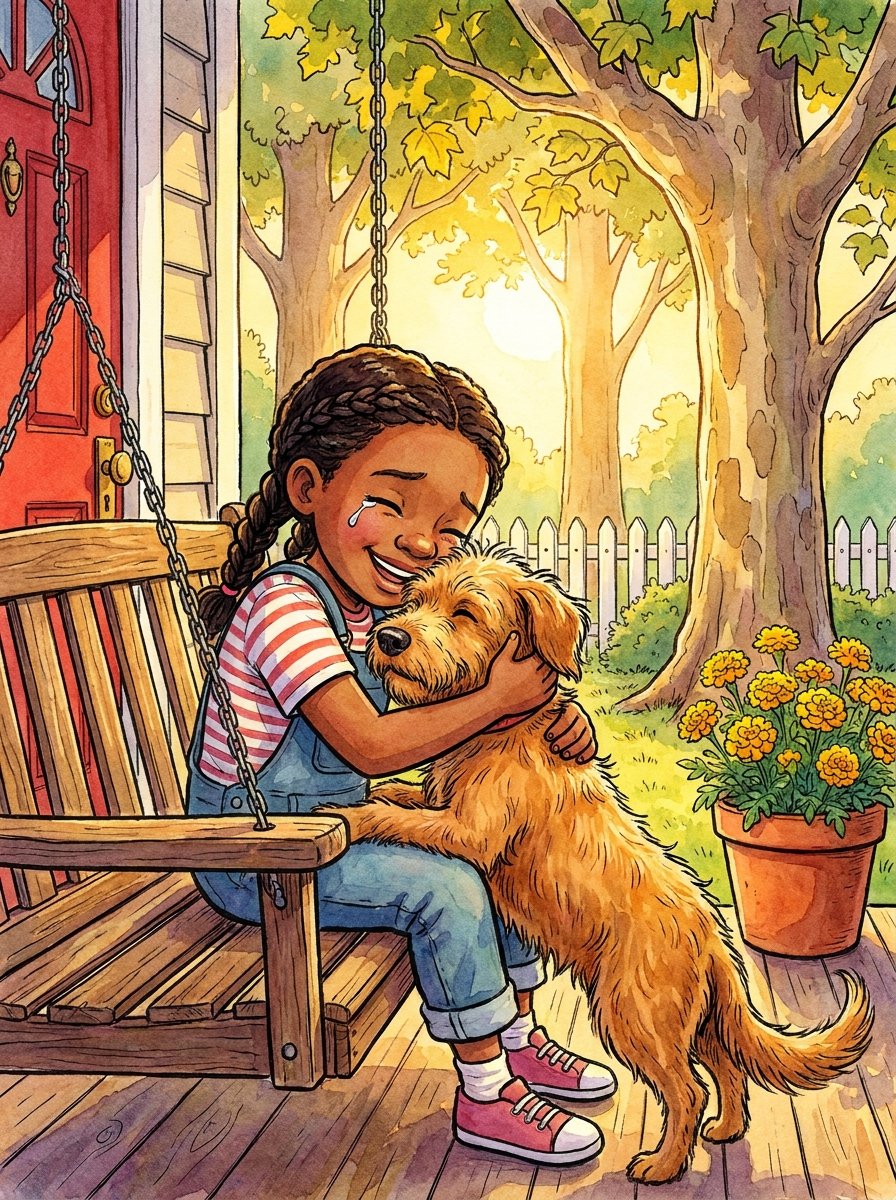
Bella's tail exploded into wags. Her whole body wiggled so hard she could barely stand. She barked once — a loud, joyful bark from somewhere deep in her chest — and launched herself forward.

Lily caught her on the porch swing. They tumbled together, girl and dog, laughing and crying and holding on like neither one would ever let go. Bella licked Lily's face until her own tongue was tired. And Lily kept saying "Bella, Bella, Bella" over and over, like the word was the most beautiful sound she had ever made.

Lily's mom came running out of the kitchen. Then Lily's dad. They all gathered on the porch, kneeling around Bella, touching her fur and crying and laughing all at once.

"We moved twice," Lily said, her voice wobbly. "First to a different neighborhood. Then here, clear across the city. And you still found us. How did you find us, Bella?"

Bella pressed her nose into Lily's hand and wagged her tail and let out a happy little grumble. Because that was the thing about a dog's heart. It did not care about miles or years or the way cities changed and streets shifted. Home was not a house. Home was not an address. Home was the smell of strawberries and a girl's gentle hands and a voice that said your name like a song.

The neighbor across the street brought a bowl of water. The mailman came back with a treat from his pocket. By the end of the afternoon, the whole street had heard about the dog who had been lost for three years and found her family through two cities.

"That dog walked a hundred miles," said Lily's dad, shaking his head.

"More," said Lily's mom. She was already on the phone, canceling the missing pet alert she had never quite been able to delete.

That night, Bella slept on Lily's bed for the first time in three years. She stretched out across the blankets with her head on the pillow and her paws in the air, and she snored so loudly that Lily's dad could hear it from two rooms away.

Nobody complained.

In the morning, Lily made Bella a pancake. No syrup, because dogs should not have syrup, but a pancake all the same, cut into little pieces on a blue plate. Bella ate it in two bites and rested her chin on Lily's knee.

"What do you want to do today?" Lily asked.

Bella's tail thumped against the floor.

That afternoon, they walked to the park together. Lily threw a stick, and Bella chased it. She was slower than she used to be. Her legs were older now, and she had walked so very far. But she brought the stick back every time, tail wagging. Because that was what you did when you were home.

And if you looked closely, you could see it in her eyes — a quiet, knowing look. The look of a dog who had done something impossible. She had crossed two cities. She had walked more than a hundred miles. She had never, not once, stopped believing.

And in the end, that was enough.

Preview
Share this story
Kinder Yarns

Listen in the app

Engaging, narrated stories for kids aged 4-10.
↓  App Store ↓  Google Play