Pip woke up.
This was unusual, because Pip was a seed, and seeds were not supposed to wake up until they were ready. But the rain had been falling for days and days, soaking through the soil with a steady, determined patience, and something inside her had finally stirred.
She stretched. It was a very small stretch — seeds do not have arms or legs — but she pushed outward with everything she had, and the hard shell around her cracked, just a little, and the first pale root slipped free.
"Good morning," said the earth.
Pip said nothing, because she did not know how to talk yet. She was still figuring out what she was.
This was the thing about being a seed. You did not know what kind of plant you would become. It was not written on your shell or stamped on your root. You just had to grow and find out. The other seeds in the packet had their own ideas — the sunflower seeds were quite sure they would be tall and bright, and the marigold seeds smelled like everything important — but Pip had been at the bottom of the packet, small and quiet, and nobody had told her what she was.
That was fine. She would find out when she grew.
But something was wrong.
The soil felt different. Pip had memories — fuzzy, half-formed memories, the kind seeds have before they properly wake up. She remembered the packet. She remembered being held by warm hands. She remembered being pressed into dark, rich earth that smelled like compost and care. She remembered the garden she was planted in — the one with the stone wall and the blue birdbath and the row of lavender that hummed with bees.
This was not that garden.
The soil here was lighter. Drier. It did not smell like compost. It smelled like rain and something sharp, like lemon. And the light — the light that filtered down through the soil above her — was brighter. Stronger. As if the sun here had less patience and more urgency.
Pip pushed upward. She had to see.
The soil broke apart above her head, and she emerged into a world she did not recognize.
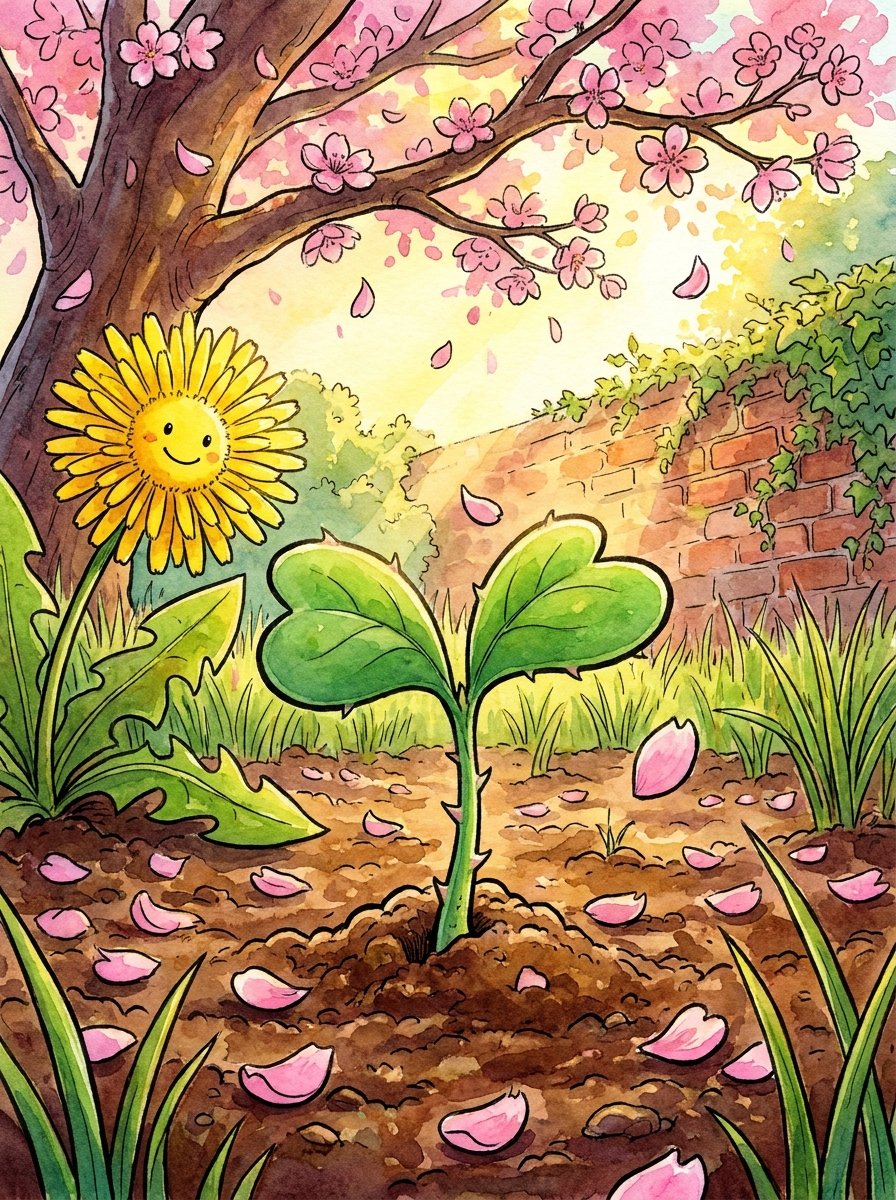
It was a garden, yes. But not the one she remembered. The one she remembered had neat rows and a stone wall and everything in its proper place. This garden was wild. Beautiful, but wild. Flowers grew wherever they pleased. Vines climbed over everything. A tree with pink blossoms stood in the center, dropping petals like confetti in a slow, endless celebration.
"What," said Pip, "is this place?"
"Morning," said a voice to her left. "You're new."
It was a dandelion. A very large dandelion, with a bright yellow head and leaves that spread out like arms. It was looking at her with what Pip could only describe as cheerful suspicion.
"I'm Pip," she said. "I think."
"You think?"
"I'm a seed. I just woke up. I don't know what I am yet."
The dandelion considered this. "Fair enough. I'm Dandy. I've been here three seasons. Welcome to the other garden."
"The other garden?"
"That's what we call it. The one on the other side of the wall." Dandy nodded toward a low brick wall that ran along the back of the garden, half-hidden by ivy. "You came from the other side, I'm guessing. The neat one. The one with the blue birdbath."
Pip's root twitched. "Yes. That one."
"That one's boring," said Dandy. "This one's better. Messier, but better. Come on. I'll show you around."
Pip did not have much choice. She was tiny — barely a green nub above the soil — and the world was enormous and strange. She followed Dandy as best she could, which mostly meant growing in the direction Dandy pointed.
The garden was full of life. Bees buzzed from flower to flower, heavy with pollen. A ladybug crawled along a leaf, examining everything with great seriousness. Two sparrows chased each other through the branches of the pink tree, chattering and scolding and laughing all at once.
"Everything is so loud," said Pip.
"That's spring," said Dandy. "Wait until summer. Then it gets really loud."
They passed a row of tulips, standing tall and proud in reds and yellows and purples. They did not look at Pip. They did not look at anyone. Tulips were like that.
"Don't mind them," said Dandy. "They think they're important."
"Are they?"
"They're tulips. That's enough for them."
Further on, Pip met a patch of clover that hummed with contentment. She met a rose bush that was covered in thorns and opinions. She met a moss that grew so quietly she almost missed it entirely, a soft green carpet spread over a stone that had been there longer than anyone could remember.
"Who lives under the stone?" Pip asked.
"Nobody," said the moss. "That's what I like about it."
Pip liked the moss. She liked its quiet certainty, the way it did not need to be anything other than what it was.
By afternoon, Pip had learned several things. She had learned that the garden was bordered on three sides by fences and on the fourth by the brick wall. She had learned that the pink tree was called a cherry blossom and that it only bloomed for two weeks before the petals fell. She had learned that the garden had a name — Mrs. Chen called it her "little jungle" — and that Mrs. Chen was the woman who lived in the house at the back, the one with the yellow door and the cat that slept on the windowsill.
She had also learned that she had no idea what she was.
"Dandy," she said, as the sun began to sink and the light turned gold. "How do you find out what kind of plant you are?"
"You grow," said Dandy.
"And then?"
"And then you look at yourself and say, 'Oh. I'm that.'" Dandy shrugged — or did the dandelion equivalent, which was a slight leaning of the stem. "It's not complicated."
"But what if I don't like what I am?"
Dandy looked at her for a long moment. "Then you grow anyway. Because that's what seeds do."
Pip thought about this. She thought about the garden she was supposed to be in — the neat one, the one with the stone wall and the lavender. She thought about the hands that had planted her, the ones that smelled like soil and hope. She wondered if they were looking for her. She wondered if they missed her.
But she was here now. In this wild, loud, beautiful garden where flowers grew wherever they pleased and the moss liked being alone and the dandelions called it home.
That night, something remarkable happened.
The cherry blossom tree began to drop its petals. Pip watched from the ground as thousands of pink petals drifted down through the air, catching the last light of the sun. They fell slowly, spinning and turning, covering the ground in a soft, pink carpet. It was like snow, but warmer. Like rain, but gentler.
"It's beautiful," Pip whispered.
"It does that every year," said Dandy. "Two weeks of blooming, then the petals fall, and the tree just stands there, green and quiet, all summer. It doesn't seem to mind."
Pip watched the petals fall. She watched them settle on the ground and on the leaves and on her own tiny green stem. One petal landed right on top of her, and for a moment she was wearing a pink hat that was bigger than she was.
She laughed. It was a very small laugh — seeds do not have big laughs — but it was real.
"Welcome home, Pip," said Dandy.
The next morning, Pip woke up and felt something new. A warmth inside her, deep in her root, like a question waiting to be answered. She was growing. She could feel it — the slow, steady push of stem upward and root downward. She was becoming something.
She looked down at herself. Her stem was thin and green. She had two small leaves, one on each side, shaped like tiny hands. She had thorns.
"Thorns," she said.
"Oh," said Dandy. And then, more quietly: "Oh."
"What? What does that mean?"
Dandy was quiet for a moment. Then he said, "You're a rose."
Pip looked at her leaves. She looked at her thorns. She looked at the rose bush she had met yesterday — the one covered in thorns and opinions — and then back at herself.
"I'm a rose," she repeated.
"A small one," said Dandy. "But you'll grow."
Pip sat with this for a while. A rose. She was going to be a rose. She thought about the rose bush and its thorns and its refusal to be anything other than what it was. She thought about the petals that would eventually come — red, or pink, or maybe white, she did not know yet.
She thought about the garden she was supposed to be in. The neat one. The one with the lavender and the blue birdbath. She wondered if there was room for a rose there. There probably was. Roses fit nicely in neat gardens.
But she was here. In the wild garden, with the cherry blossom and the dandelions and the moss that liked being alone. She was here, and she was a rose, and she was growing.
"I think," she said slowly, "that I like it here."
"Good," said Dandy. "Because you're not going anywhere."
Pip smiled. She was a seed who had been lost and found. A seed who had been planted in one place and grown in another. A seed who did not know what she was until she was already something.
And the garden — this wild, loud, beautiful garden — was home.
That afternoon, a breeze came through the garden, carrying the last of the cherry blossom petals. They swirled around Pip's small stem, pink and gold in the sunlight, and for a moment she was surrounded by a whirlwind of colour.
When the petals settled, Pip noticed something she had not seen before. A tiny seed, caught in the ivy on the brick wall. It was small and brown and looked very lost.
"Hello," said Pip.
The seed said nothing.
"I know how you feel," said Pip. "I was lost too. I woke up in the wrong garden. But it turned out to be the right one."
The seed was quiet for a moment. Then, very softly: "How did you know?"
"You grow," said Pip. "And then you look at yourself and say, 'Oh. I'm that.' And then you decide if you like it."
The seed was quiet for a long time. Then it said, "I think I'm a morning glory."
"That's wonderful," said Pip.
"Is it?"
"It will be."
And somewhere in the garden, the cherry blossom tree stood green and quiet, its petals all fallen, its branches reaching toward the summer. It did not seem to mind that its beautiful display was over. It had bloomed. It had dropped its petals. And now it would grow.
Just like Pip.
Just like every seed that ever woke up in the wrong place and decided to stay.