← Story Library
Kinder Yarns

The Painted Door

The Painted Door

Lena had painted the same door fourteen times before she started to wonder where it came from.

It showed up in every picture without being invited. She would sit down to paint a forest, and the door would appear between two trees. She would paint a harbour, and the door would be set into the harbour wall. She painted a sky full of clouds once and the door appeared in the middle of them, which made no sense at all and which she liked very much.

The door was always the same. Round-topped, made of dark wood with iron hinges. A brass handle shaped like a wing. Old stone on either side of it, with moss growing thick along the base.

She never decided to paint it. It just came out of the brush.

Her art teacher noticed after the eighth or ninth picture. She stood behind Lena for a while and then said: "You keep painting that door."

"I know," Lena said, without looking up.

"Have you seen it somewhere? A place you visit?"

"I don't think so," said Lena. But she was not entirely certain.

That evening she laid out the pictures she had kept, side by side across her bedroom floor. The door in the jungle. The door underwater with fish drifting past. The door in the snow with icicles on the hinges. The door at the edge of a cliff with the sea far below. In every picture it was exactly the same — the same arch, the same dark wood, the same brass handle. She had never once chosen to paint it. It simply appeared, and she let it, because stopping it would have felt wrong.

She began to look for it.

She started with the streets she knew best — the route to school, the path along the river, the roads around the library. She looked at every wall she passed. Brick walls, stone walls, garden walls covered in old climbing plants. She looked carefully and slowly, the way she looked at a blank page before starting a painting. She paid attention to arches and doorways she had walked past for years without seeing.

She found nothing at all.

She widened her search area. She took a different route to school every day for two weeks. She walked down streets she had never tried before. She made a map and crossed off each road once she had checked it. She stood on the corner of a road she had driven along many times but never walked. She studied every wall and doorway on both sides from one end to the other.

There was nothing to find.

She began to think she might have invented it — that the door lived only inside her head, in some room she could not find or describe. She painted it again one afternoon, paying very close attention this time, watching her own hand to understand where the feeling came from. The brush moved before she had decided to move it. The round top appeared first, then the hinges, then the handle, then the stone surround with the moss along the base.

It felt like drawing something she remembered, even though she had never seen it.

Her grandmother came to stay that weekend. She found Lena with all the door pictures spread on the kitchen table. Without being asked she picked one up — the door in the snow — and held it out at arm's length.

"You keep painting this," her grandmother said.

"I know that," said Lena. "I'm trying to find it."

Her grandmother looked at the pictures one at a time. She set down the snow picture and picked up the jungle one, then the harbour one. She did not say anything for a while.

"The stone around the door," she said at last. "Do you see how it's worn? How the edges have gone soft? That kind of stone takes a long time to look like that. This is not a new door."

Lena looked closely. Her grandmother was right about this. She had painted that weathering without thinking about it.

"Where do you think it is?" Lena asked.

Her grandmother set the picture down and looked at her. "I think you'll know when you find it," she said. "Some things work that way."

That was not a useful answer. But Lena noticed that her grandmother had not said it doesn't exist.

Three days later Lena was late for school. She had spent too long on a wall near the post office that turned out to be solid blank. Now she was taking a shortcut through a narrow lane she almost never used. It ran between the backs of two rows of old buildings, dark and a little damp, with high walls on both sides. She had walked it once before, maybe twice.

She was halfway down it, thinking about how late she was, when she stopped.

The door was in the wall on her left.

Not a door that resembled it. The exact door she had painted fourteen times — the round top, the iron hinges, the brass handle shaped like a wing. The old stone surround with the weathered edges her grandmother had pointed to. The moss along the base, green and dense, exactly where she always painted it. She stood in the lane and looked at it for a long time without moving, without thinking anything in particular.

She walked toward it slowly, the way you approach something you are afraid of startling. The moss along the base was exactly the right shade of green. The iron hinges were exactly the right size. She reached out and touched the brass handle. It was cold and slightly rough, and exactly the weight she had somehow expected.

She pressed the handle down. The door swung open without resistance, as if the hinges had been oiled very recently, as if someone had known she was coming and left it ready for her.

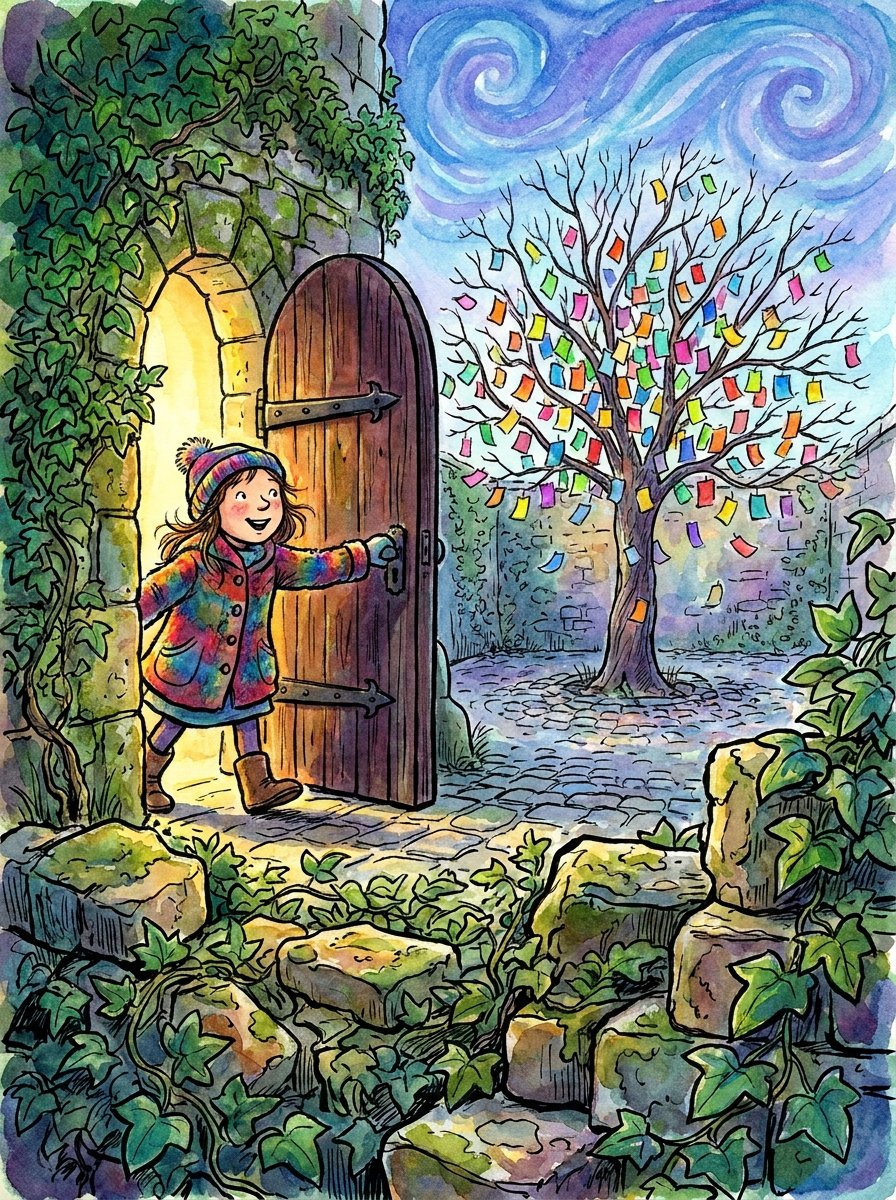
On the other side was a courtyard. It was small — no larger than a big room — enclosed on all four sides by the high backs of the surrounding buildings. Pale winter light fell through the gap of sky above. The air in here was still and slightly warmer than the lane. It smelled faintly of paper and something else she could not name, something old and dry and not unpleasant.

In the centre of the courtyard was a single tree, bare-branched in the cold, and from every branch hung pieces of paper on lengths of string.

She stepped inside and looked more closely. Each piece of paper held a painting. She took the nearest one and turned it to the light. It showed a door — round-topped, dark wood, iron hinges, a brass handle shaped like a wing. She checked the next one. Another painting of the same door, in a different style, on different paper. She went along the branches one by one. Every single piece of paper showed the same door — in a forest, in the snow, at the bottom of the sea, in the middle of the clouds. They were all different sizes, painted in different styles, on paper of different ages. Some of the pieces were yellowed and soft at the edges. Some of the paper looked quite fresh.

She looked at them for a long time. A few of them felt familiar in a way she could not explain. She recognised the particular blue someone had used for a winter sky. She recognised the way another hand had painted the moss along the base — careful, deliberate strokes, the same ones she always used.

At the base of the tree, between two thick roots, was a tin box. She knelt and opened it. Inside was a small notebook, and inside the notebook was a letter, handwritten on a folded sheet of paper.

It was addressed to no one in particular.

You found the door, it said. That means you were meant to find it. Everyone who has come to this courtyard spent years painting the door before they found it. None of us has ever been able to explain why. We only know that certain people are called to it, and that they all find each other here eventually. It takes as long as it takes. That is all we know.

There are paintings on this tree from sixty years ago and paintings from last month. Every person painted the same door they had never consciously seen. Every person found this courtyard in the end.

Bring one of your own paintings and hang it on a branch. Sign your name in the notebook. Come back whenever you like. The door will always open for you now.

Lena sat down on the ground with her back against the tree. She read the letter twice. The courtyard was very quiet. Above her, the paper paintings shifted gently in the thin current of air that moved through the space.

She lifted the notebook and opened it. There were dozens of names inside, some with dates, some with short notes. The oldest entry was sixty-three years ago: a name she did not know, and below it the words found it on a rainy Thursday. have been painting it since I was seven. glad to finally understand. Someone else had written: came back for the third time today. added another painting to the high branch. A woman had written her name and then: I painted this door every day for twenty years. I had almost stopped believing it was real. A boy had written: found it on the way to the bus stop. only painted it twice but I knew it straight away.

She read every entry carefully and slowly. She read about a person who had moved away and come back years later just to find the door. She read about a girl who had brought her mother, who could not see the door at all and thought she was pointing at a plain wall. She read about someone who had sat in this courtyard for an entire afternoon. They had gone home feeling that something had been settled — something that had been quietly unsettled for a very long time.

She read every name in the notebook. She read every note that people had left, even the short ones that only said the date and nothing else. She tried to count the entries and lost track somewhere after forty.

Then she took the pen from her jacket pocket — she always carried one — and found the next blank page. She wrote her name at the top. Below that she wrote today's date. She thought for a moment, and then wrote: fourteen paintings. I started looking three weeks ago. I should have looked in this lane first — I always felt something when I walked past the end of it. I am glad I finally did.

She closed the notebook and put it back in the tin.

She looked up at the tree. She already knew which painting she would bring. The door in the clouds was the one she liked best — the one that made the least logical sense and felt the most right. She would hang it on one of the upper branches where the light was better.

She got up, brushed the dirt from her knees, and went back through the door into the lane.

She was very late for school. She walked quickly, not particularly worried about it. The day felt large enough to absorb being late. When she reached the school gate she looked back the way she had come. From here the lane was just a gap between two buildings, easy to miss, easy to walk past.

She realised she had been walking past it for years. She had never once gone down it by choice.

She also realised, now that she thought about it, that she had always known it was there.

She thought about the fourteen paintings lined up across her bedroom floor. She would bring one of them here next week — the door in the clouds — and add it to the tree. And then she would come back as often as she wanted. She would sit among all those painted doors — the ones people had carried inside them for years before finding their way to this lane.

She already could not wait. She started planning which branch she would choose for the door-in-the-clouds painting before she had even reached the end of the street.

Preview
Share this story
Kinder Yarns

Listen in the app

Engaging, narrated stories for kids aged 4-10.

↓  App Store ↓  Google Play