← Story Library
Kinder Yarns

The Planet at the Edge

The Planet at the Edge

The planet had been waiting for a very long time.

She did not know exactly how long. Time moved differently at the edge of the solar system. The sun was so small from here — just a bright star, the brightest of all the stars, but still just a star. She had watched it for so many years that she had stopped counting.

The other planets were far away. She knew their names. She knew their shapes. But she had never met them, not really. She was the last one, the smallest, the furthest out. Everything else was closer to everything else.

She had not always minded.

But there is a difference between not minding and not noticing. And lately — in the last thousand years or so — she had begun to notice.

The quietness was very large.

Then one morning — or what passed for morning at the edge of the solar system, which was really just a slightly different shade of dark — something appeared.

It was very small.

It came from the direction of the sun, moving in a straight line with great patience and purpose. The planet watched it for a long time before she understood what it was.

A probe.

She had heard about probes. The other planets had mentioned them, once, a very long time ago, in the way you mention something interesting you've read about. The rocky inner planets had seen them up close. Even the gas giants had been visited. But no probe had ever come this far.

Until now.

It arrived slowly. It did not land, exactly — it was too small and cautious for landing. It circled her once, then twice, with its little camera pointed at her surface, making quiet clicking sounds she could barely feel.

The planet did not know what to do.

She thought about saying hello. But she did not know how to say hello to something that small. She thought about making something happen — a gust of her thin atmosphere, a shift in her ice. But she didn't want to startle it.

So she waited. And the probe circled. And they looked at each other, if you could call it that.

Then the probe did something unexpected.

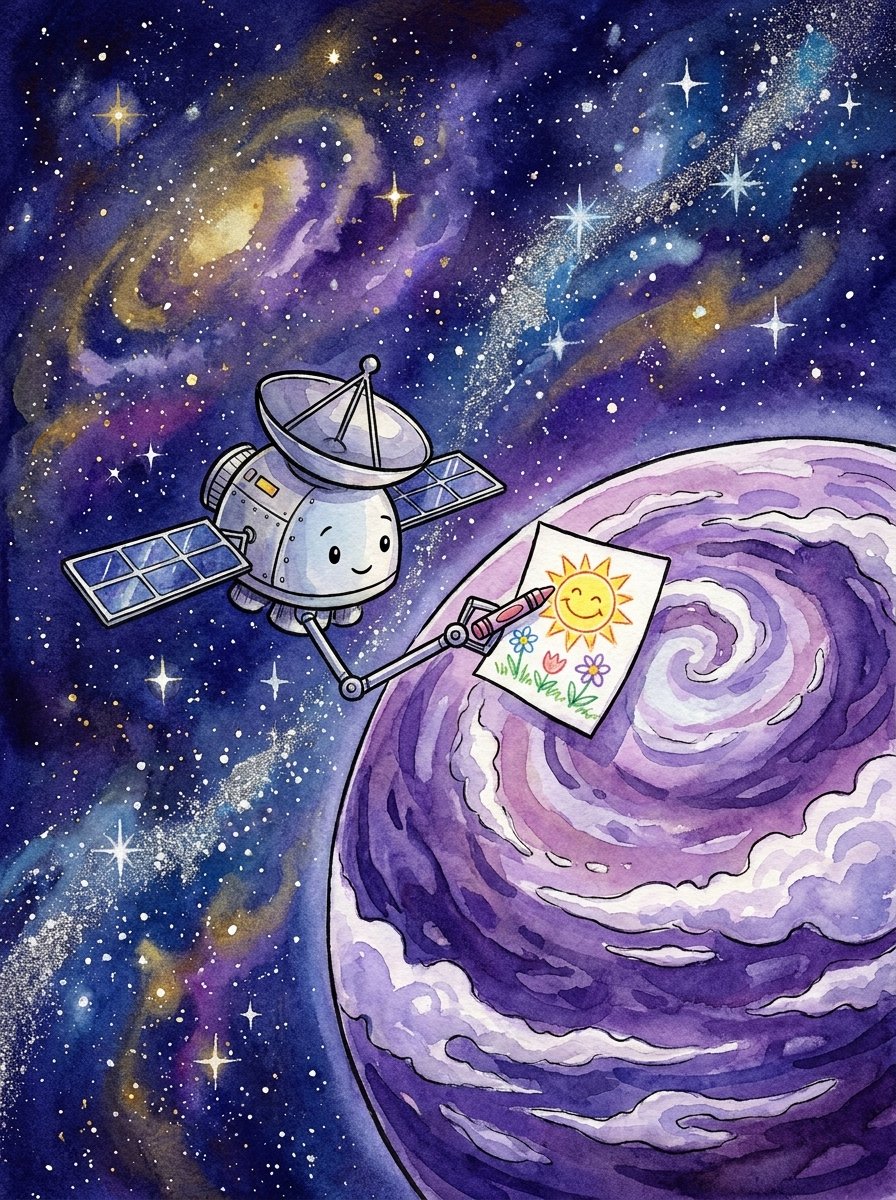
It extended a small arm, very carefully, and opened a panel in its side. Inside was a flat, protected case. And inside that case was a piece of paper.

The planet had never seen a piece of paper before, except in descriptions. It was very thin. It was covered in coloured marks. She looked at it for a long time, shifting her gaze very slowly to make out the shapes.

There was a yellow circle with lines coming out of it. That was the sun.

There were planets — eight of them, in a line, each a different colour.

And at the end, small but clearly drawn with extra care, was another planet. Purple, with a white surface and a tiny crescent of shadow. The planet stared at this for a long time.

That was her.

At the very bottom of the drawing, in large wobbly letters: HELLO. I DREW YOU. I HOPE YOU ARE OK. And then a name, spelled very carefully in letters that got smaller toward the end, because they had run out of space.

The planet was quiet for a very long time.

She did not know what to do with this. She had been prepared for many things — for ice, for cold, for dark, for the slow drift of rocks. She had not been prepared for a drawing. She had not been prepared for someone wondering whether she was okay.

She ran through her options. She had some gas in her thin atmosphere. She could move it. She had ice on her surface. She could reflect light differently. She had, very deep inside, a small amount of warmth left over from the beginning of everything.

She tried saying hello back. She thought it very loudly in all directions.

Nothing happened, as far as she could tell.

She tried rearranging her surface ice into a shape. But her ice moved very slowly, and she wasn't sure the probe would wait.

She thought about the name at the bottom of the drawing. The letters that got smaller because the child had run out of space.

That, she thought, was the most interesting thing. The child had tried so hard to fit the whole name in. They had kept going even when it got tight.

The planet understood something about not giving up on a message.

She looked at the probe. The probe looked at her. Its little camera made a very soft sound.

And the planet made a decision.

She couldn't send a drawing back. She had no paper and no coloured marks and no small arm to extend. But she had something else.

She had been sitting in the same place for a very long time. She had collected, over the years, a small cloud of dust and ice around her — not quite a ring, not quite nothing. Just a shimmer, barely visible, that caught what little light reached her.

She moved it.

Slowly, carefully, the way you move something very delicate that you've been holding a long time, she pushed her shimmer of dust and ice into a shape.

It took several hours. The probe waited.

When she was done, the shape wasn't perfect. She wasn't a child with a pencil. She was a planet, working with ice and light and gravity. But it was readable.

A circle — the sun.

Eight small clusters — the other planets.

And at the end, larger than the rest, a shape that was trying its best to be a waving hand.

The probe's camera turned very slowly. Made a sound. Turned back.

Then it beeped.

It was a very small beep. One short note, sent back in the direction of the sun. She had no idea what it meant. She thought it might mean: received.

She hoped it might mean: received.

The probe stayed for three more days, circling carefully, pointing its camera at various parts of her surface, making its small clicking sounds. The planet watched it the whole time. She didn't want to miss anything.

Then, with great patience and no fuss, it turned and began the long journey back.

The planet watched it go until she couldn't see it anymore, which took quite a long time.

The quietness returned. It was the same quietness it had always been.

But it was different now, in a way she couldn't quite explain. Like a room that has had someone in it is different from a room that has never had anyone in it, even after they've left.

She thought about the drawing. She thought about the name that got smaller at the end.

She thought: somewhere, very far away, travelling very fast, are pictures of my waving hand.

She settled back into the dark, into the cold, into the old familiar quiet at the edge of everything.

And she waited, very happily, to see what would happen next.

Preview
Share this story
Kinder Yarns

Listen in the app

Engaging, narrated stories for kids aged 4-10.
↓  App Store ↓  Google Play