← Story Library
Kinder Yarns

The Shoe Dispute

The Shoe Dispute

Every morning at exactly seven fifteen, before the toast popped and before the kettle whistled, James had the same problem.

His shoes were fighting again.

It started the usual way. James's left shoe — a sensible blue sneaker with white laces and a perfectly flat sole — would clear its throat and say something perfectly reasonable about the day ahead.

"Today is Tuesday," said the left shoe, in a calm, measured voice. "Tuesdays are library days. The library has carpet. The library is quiet. The library has exactly the right amount of everything."

Then the right shoe — a slightly scuffed blue sneaker with one lace always coming untied — would say something that ruined everything entirely.

"The library?" said the right shoe, in a voice that sounded like it was grinning. "Again? James, we could go to the creek. The creek has mud. Real mud. The kind that squelches between your toes and makes a sound like a happy elephant."

James stood in the hallway, one shoe in each hand, and sighed.

The left shoe stiffened. "We are not going to the creek. Last time we went to the creek, I spent three days drying on the radiator. Three days. Do you know what it's like to be warm and dry on a radiator for three days? It's terrible. It smells like wet wool and regret."

"That smell is called adventure," said the right shoe.

"That smell is called mildew," said the left shoe.

James tried to intervene. "What if we just go to school? School has a playground. It has a field. It has a—"

"The playground," interrupted the right shoe, "has a puddle near the swings. A really good puddle. Deep. Wide. The kind of puddle you can jump in with both—"

"We are not jumping in puddles," said the left shoe firmly. "Puddles are just rain that made bad decisions."

James put the shoes on the floor and stood back, the way a referee stands back before a boxing match. The shoes faced each other. They did not have eyes, or faces, or fists, but somehow they still managed to look like they were about to start something.

"I have been to the creek seventeen times this month," said the left shoe. "Seventeen. I have the mud stains to prove it. My sole is practically a topographical map of that creek bed."

"Exactly," said the right shoe. "You're experienced. You're seasoned. You're a veteran of creek exploration."

"I don't want to be a veteran of creek exploration. I want to be a veteran of staying clean and dry and having a reasonable day."

James sat down on the stairs. This could take a while.

His mother walked past, carrying a basket of laundry, and didn't even glance at the shoes. She had learned long ago that getting involved only made things worse. Once, she had tried to mediate by suggesting they take turns — the left shoe could have Tuesdays and Thursdays, and the right shoe could have Mondays and Wednesdays. Both shoes had looked at her with what could only be described as horror.

"We are not taking turns," the left shoe had said. "We are a pair. We go together. That is the entire point of being shoes."

"Then stop arguing about where to go," his mother had said, which was, in retrospect, the least helpful thing anyone had ever said to a pair of shoes.

The argument had escalated that day. The right shoe had refused to go to the park unless the left shoe agreed to visit the creek afterward. The left shoe had refused to go anywhere unless the right shoe promised to stay away from puddles, mud, wet grass, and "any body of water larger than a drinking glass." The right shoe had called the left shoe "a boring piece of rubber with laces." The left shoe had called the right shoe "a reckless piece of rubber with one good lace and one bad one." James had missed the school bus entirely.

Today, James decided to try a new approach. He picked up the left shoe and held it close to his face.

"What if," he said carefully, "we go to the library first?"

The left shoe brightened. Not literally — it was still blue — but something about its posture perked up.

"The library," it said. "Yes. That is a sensible beginning to any day."

"And then," said James, turning to the right shoe, "on the way home, we walk past the creek. Just past it. We don't go in. We just walk past."

The right shoe considered this. "How close to the creek are we talking?"

"Close enough to see it."

"Can we wave at it?"

"You can wave at it."

"Can I wave at the puddle near the swings on the way to the library?"

The left shoe made a sound like a small air leak. "Absolutely not."

"Then what's the point of waving at the creek if I can't even wave at a puddle?" said the right shoe. "It's discrimination. Puddle discrimination."

James rubbed his temples. He was eight years old, and he already had the headaches of a much older person.

His father walked through the hallway, keys in hand, and paused. "Are they still going?"

"They're still going," said James.

His father nodded and left for work. He had stopped asking questions about the shoe situation years ago. The shoes had been arguing for as long as anyone could remember. They had argued about the walk to preschool. They had argued about the trip to the beach. They had argued so loudly during a family picnic that a nearby squirrel had climbed a tree in distress.

The shoes did not argue about important things, like whether James should eat breakfast or brush his teeth. They agreed on those completely. The only thing they ever disagreed about was where their feet should take them, and they disagreed about it with a passion that would have been impressive if it weren't so inconvenient.

James tried again. "What if we go to the park? The big park, with the pond?"

"The pond!" said the right shoe excitedly. "Yes! The pond has ducks. And mud around the edges. And—"

"The pond has a bridge," interrupted the left shoe. "I like the bridge. The bridge is solid. The bridge has a clear purpose. You walk across it. You don't jump off it. You don't splash in it. You simply cross it and arrive somewhere else."

"You want to go to the park just to walk across a bridge?" said the right shoe.

"It's a very nice bridge."

"It's a bridge. That's like going to a candy store just to look at the ceiling."

"The ceiling in that candy store is probably well-maintained," said the left shoe.

James stood up. He had an idea. It was not a good idea, but it was an idea, and at this point, any idea was better than standing in the hallway while his shoes debated the structural merits of bridges.

He put the left shoe on. The left shoe settled onto his foot with a contented sigh, like someone sinking into a warm bath.

Then he put the right shoe on. The right shoe bounced slightly, like a dog that had just heard the word "walk."

"Now," said James, "we are going outside."

"Where are we going?" both shoes asked at the same time.

James walked out the front door and turned left. The left shoe hummed happily. The right shoe said nothing, but James could feel it thinking.

They passed the library. The left shoe sighed with longing. The right shoe said nothing.

They kept walking. They passed the school. The left shoe perked up slightly. The right shoe said nothing.

They kept walking. The left shoe began to look uncertain.

They reached the creek.

The right shoe exploded with joy. "The creek! James! You brought us to the creek! I knew it! I knew you had it in you! Look at it! Look at the water! Look at the mud! Look at the—"

The left shoe was having a crisis. "We are at the creek," it said, in a very small voice. "We are actually at the creek. This is really happening."

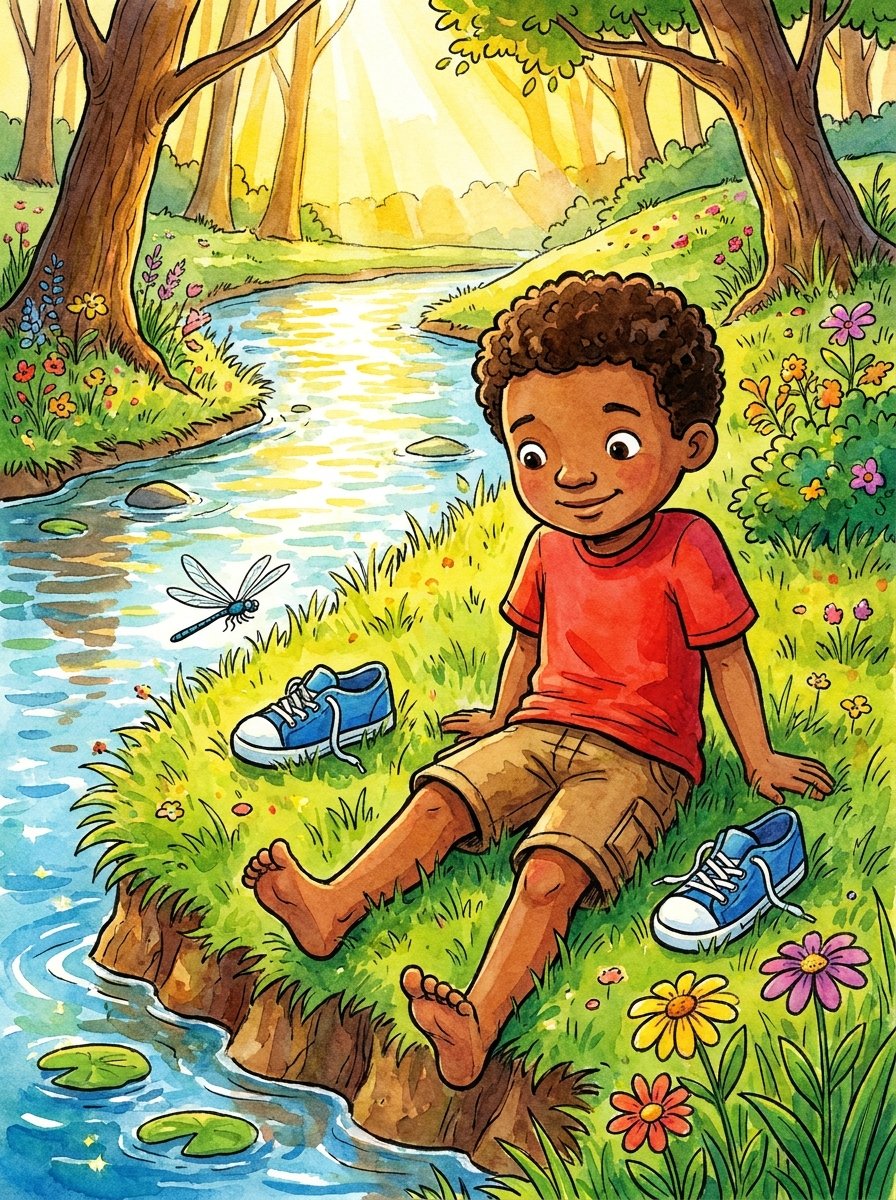
James sat down on the bank and took off both shoes. He placed them side by side on the grass, facing the creek.

"You two need to work this out," he said. "Right now. I'm not moving until you do."

The shoes were silent for a moment. The creek gurgled. A bird sang somewhere in a tree.

"Fine," said the left shoe. "I'll admit it. The creek is... not terrible."

The right shoe nearly fell over. "Did you just say something nice about the creek?"

"Don't make a big deal out of it."

"No, no, I want to make a big deal out of it. Say it again. Say the creek is nice."

"I said it's not terrible. That's not the same thing. Don't twist my words."

"The creek is not terrible!" repeated the right shoe, addressing an imaginary audience. "You all heard it! The creek is not terrible!"

"Quiet," hissed the left shoe. "You'll scare the fish."

"There aren't any fish in the creek," said the right shoe. "It's too shallow."

"How do you know? Have you looked?"

"Every single time we come here, I look. I look with great enthusiasm."

The left shoe paused. "You look for fish?"

"Of course I look for fish. What kind of shoe do you think I am? I go to the creek to explore. I look at everything. The rocks. The bugs. The fish that aren't there. I look because looking is interesting."

The left shoe was quiet for a moment. "I go to the library to read," it said finally.

"Read what?"

"The labels on the spines of books. The titles. The authors. Sometimes I read the little cards inside that tell you when the book was last checked out."

"You read library cards?"

"They tell stories of their own. Did you know a book called 'The Very Hungry Caterpillar' was checked out forty-three times last year? Forty-three. That's a popular caterpillar."

The right shoe was quiet for a moment. "That is interesting," it admitted.

James said nothing. He watched the creek flow.

"I suppose," said the left shoe slowly, "that the library and the creek are not so different. They both have things to discover. You just have to look for them."

"And I suppose," said the right shoe, "that sometimes you want to discover things quietly, and sometimes you want to discover things with mud."

"Yes," said the left shoe. "Something like that."

Another silence. A dragonfly landed on the left shoe's toe, then flew away.

"What if," said the right shoe, "we go to the library first, and I try reading library cards?"

The left shoe brightened again. "You'd do that?"

"I'd do that. But only if, afterward, we come to the creek, and you try looking for fish."

The left shoe considered this. "I'm not getting wet."

"I'm not asking you to get wet. I'm asking you to look. There's a difference."

"Fine," said the left shoe. "I'll look. But if I see a single drop of water on my sole, I'm going straight to the radiator."

"Deal," said the right shoe.

James put the shoes back on and stood up. He felt something strange, like a warm feeling in his chest that had nothing to do with the sun.

They walked to the library. The left shoe was delighted. The right shoe read library cards with great interest and discovered that a book about trucks had been checked out sixty-seven times, which it found genuinely impressive.

Then they walked to the creek. The right shoe was delighted. The left shoe looked for fish with great determination and found a small, smooth stone that it decided to keep forever, because the stone was dry and sensible and had clearly made good decisions in its life.

James walked home, one shoe talking about library statistics and the other talking about the shape of the stone, and he realized something that had taken him a long time to understand.

His shoes were never going to stop arguing. That was not the point. The point was that they argued, and then they worked it out, and then they went somewhere together, and the somewhere they went was always better because they had both had a say in choosing it.

The library was better because the right shoe made it more interesting. The creek was better because the left shoe made it more thoughtful. And James was better because he had a pair of shoes that cared enough about where they were going to fight about it every single morning.

When he got home, his mother was in the kitchen.

"How was the library?" she asked.

"Good," said James.

"How was the creek?"

"Also good."

His mother smiled. "Did they fight?"

"Of course they fought," said James. "But they worked it out."

His mother poured him a glass of juice and didn't ask any more questions, because some things are better left to settle on their own, the way streams find the sea, or the way two shoes find the same path, one careful step at a time.

Preview
Share this story
Kinder Yarns

Listen in the app

Engaging, narrated stories for kids aged 4-10.
↓  App Store ↓  Google Play