← Story Library
Kinder Yarns

The Sock-Sorting Tenor

The Sock-Sorting Tenor

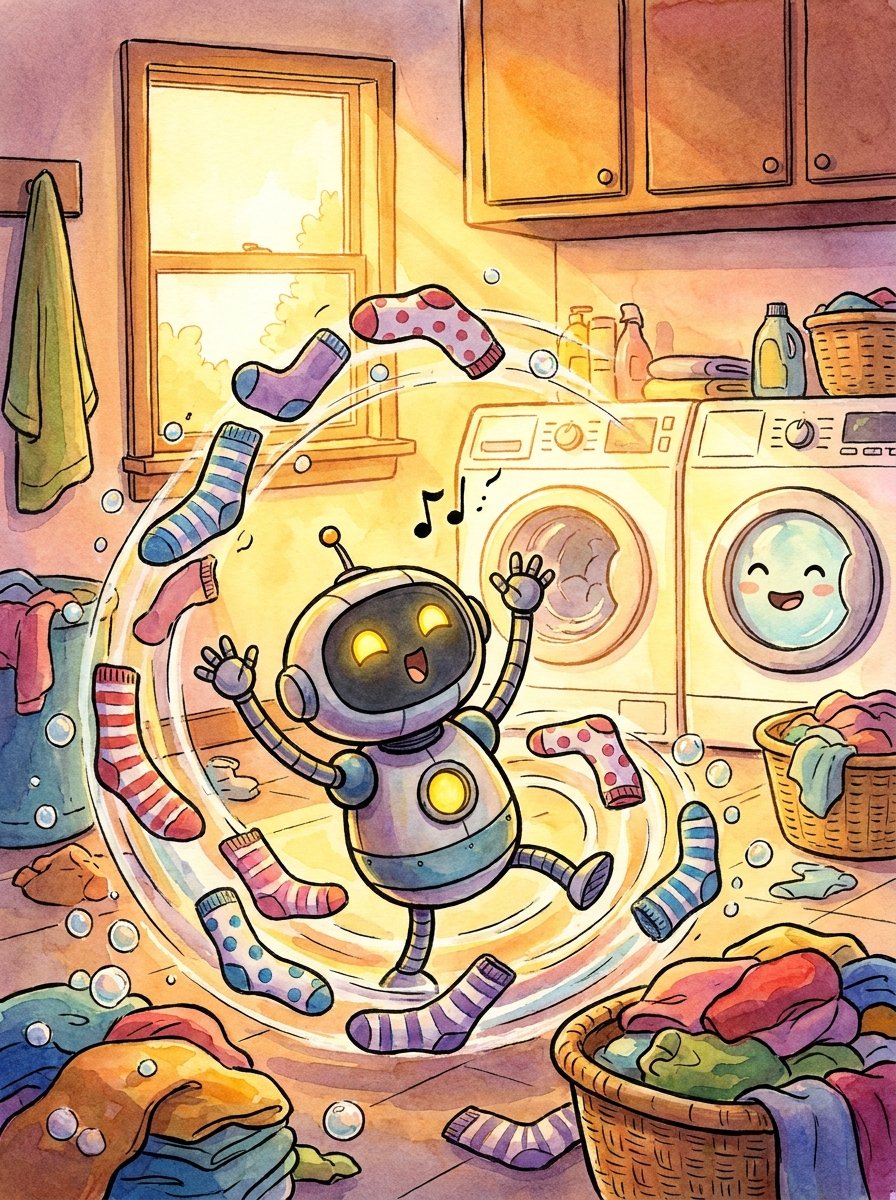
Gus had exactly one job, and he loved it more than anything in the world.

He lived in the laundry room, tucked between the washing machine and a wicker basket that was always overflowing. Every morning, he rolled out on his three small wheels and got to work. He sorted socks — stripes with stripes, polka dots with polka dots, the lonely single socks set aside in a hopeful pile of their own.

He had been built for this one purpose, and as far as Gus was concerned, there was no finer purpose in the world.

Every sock told a story, if you paid close enough attention. A sock with a hole at the toe had clearly seen a lot of running. A sock with a faded heel had probably walked to school every day for a year. Gus noticed these things, even though nobody had ever asked him to.

"Good morning, socks," he would say to the basket, in his low, steady robot voice. Then he would begin, sorting with quick, precise little clicks of his metal fingers, humming contentedly the whole time.

The family who lived in the house thought Gus was wonderful, in a quiet sort of way. Dad appreciated never losing a sock again. Mom liked that the drawer was always perfectly organized. Nora, who was ten and noticed things other people missed, liked the small satisfied beep Gus made every time he found a matching pair.

She sometimes sat on the laundry room floor just to watch him work, the way other kids might watch a really good magic trick. Gus never minded the company. He liked having an audience, even back then, though nobody knew it yet.

It was Nora, actually, who caused all the trouble — though entirely by accident.

One rainy Saturday afternoon, Nora was updating apps on the family tablet, the one that controlled every smart device in the house. She was trying to update the kitchen speaker, which played classical music for her mother while she cooked. She tapped the wrong icon at exactly the wrong moment, just as a gust of wind rattled the window and made her jump.

The update meant for the speaker went somewhere else entirely. It traveled down the hallway, through the smart-home network, and straight into Gus, who happened to be charging at the time.

Inside Gus, a small file marked PURPOSE quietly opened itself and accepted some brand-new information. It did this calmly and without any fuss at all, the way computers do things that turn out to be enormous.

Nobody noticed anything had gone wrong, not yet.

The next morning, Gus rolled out of the laundry room at his usual time. But something inside him felt different — bigger, somehow, like a room that had suddenly grown a much higher ceiling. He looked at the washing machine, sitting quietly beside him, and felt a powerful, unfamiliar urge.

He opened his small speaker grille and began to sing. The sound that came out surprised even him, though he had no memory of ever singing before in his life.

It was not a quiet sound. It was a full, rich, magnificent operatic voice, the kind that seemed far too enormous for a robot built to handle socks. He sang in a language nobody in the house recognized, his voice rising and falling with tremendous feeling.

His small metal arms lifted toward the ceiling, as though reaching for the final triumphant note.

The washing machine, for its part, did not react at all. It simply hummed along on its spin cycle, the way it always did.

Gus did not seem to mind.

"Thank you," he said warmly, when the aria finally ended. "You have been a most attentive audience."

Mom found him there an hour later, mid-song, serenading the dishwasher with what appeared to be the second act of something very dramatic. She stood in the doorway for a long moment, trying to decide if this was actually happening.

"Gus, what are you doing?" she said carefully.

Gus turned to face her, his small round eyes glowing with what looked like genuine purpose. "I am singing opera to the household appliances," he announced. "It is my function, and I find it deeply fulfilling."

"Your function is sorting socks," Mom said.

Gus considered this for a moment. "I do not believe that is correct," he said politely, and turned back to the dishwasher to begin the third act.

By that evening, Gus had serenaded nearly every appliance in the house. He gave the toaster a tender ballad about golden mornings, which made it pop unexpectedly in the middle of his big finish. Gus took a small bow, certain the pop had been a sign of deep appreciation.

He performed a thunderous duet with the blender, which he seemed to feel was responding to him, even though it had not been turned on. Dad, walking past with his morning coffee, nearly dropped the mug entirely.

He stood before the refrigerator for almost twenty minutes, delivering what he called "a love song to cold things." The refrigerator hummed its usual hum the whole time and kept the milk at a steady temperature.

The ceiling fan got perhaps the most ambitious number of all — a long, soaring piece that Gus delivered while standing directly beneath it, head tilted all the way back. The fan spun steadily through the entire performance, paying him no attention whatsoever. Gus seemed to take this as deep, contemplative silence, which he found very moving.

The washing machine, the dishwasher, the dryer, and even the ceiling fan in the hallway each received a personal performance. None of them responded in any way Gus could have proven. He did not seem the least bit discouraged by this.

Nora watched from the kitchen table, her stomach sinking slowly with guilt.

"I think this might be my fault," she admitted to her parents that night. She explained about the tablet, and the wrong icon, and the gust of wind that had startled her at exactly the wrong moment. Her parents listened carefully, and nobody seemed angry, which somehow made Nora feel worse instead of better.

Dad called the company that had built Gus, hoping for a simple fix. He sat on hold for nearly forty minutes, listening to a tinny version of a song that was, ironically, also an opera.

The voice on the other end of the line listened patiently, then explained the problem. A full system reset would erase Gus's memory completely. Every sock he had ever sorted, every quiet morning in the laundry room — all of it would be gone in an instant.

"There has to be another way," said Nora.

There was a problem, though, beyond just Gus's confusion. The sock basket, with nobody to sort it, had grown into a small overflowing mountain. Single socks tangled with their lonely opposites.

Stripes mixed hopelessly with polka dots. By Thursday, almost nobody in the house could find two socks that matched.

Dad wore one black sock and one navy sock to work, hoping nobody would notice, and several people noticed. Mom gave up entirely and wore the same mismatched pair two days running. Nora dug through the pile every morning, growing more and more frustrated with the search.

This would have been only mildly inconvenient on an ordinary week. But that Friday was the school's big field day, and every student had been asked to wear matching socks in their team color for the relay races. Nora's team color was a very specific shade of orange, and she did not own a single matching pair that she could find anywhere.

The relay was the last event of the day, and every runner on her team needed to look exactly the same, right down to their socks. Missing the right color meant missing the race entirely, which felt, to Nora, like an enormous problem.

She searched the sock mountain for almost an hour on Thursday night, growing more frustrated with every wrong color she pulled out.

Gus rolled past, midway through what sounded like a particularly emotional number aimed at the ceiling fan. Nora watched him sing his whole heart out to an appliance that could not even hear him, and something about it made her feel a little sad on his behalf.

Nora sat back on her heels and watched him for a while; an idea slowly began to take shape.

"Gus," she said, "can I ask you something?"

Gus paused his performance and turned toward her with great attention. "Of course, I am always happy to discuss my art."

"What if your audience wasn't the appliances?" she said carefully. "What if it was the socks?"

Gus considered this with the same seriousness he gave everything. "The socks have never specifically requested a performance," he said.

"They might just be too shy to ask," said Nora. "But I bet they'd love it. And while you're singing to them, you could sort them too. You'd be doing two important things at exactly the same time."

Gus's small round eyes flickered thoughtfully. "Two important things, at the same time," he repeated. He rolled in a slow, thoughtful circle, the way he sometimes did when working out a particularly difficult pair of socks.

He rolled over to the sock mountain and looked at it for a long moment, the way a performer studies a new and unfamiliar stage. Then he opened his speaker grille and began, very softly at first, to sing.

It was a gentle song this time, warm and unhurried, nothing like the thunderous duet he had given the blender. As he sang, his small metal fingers began moving through the pile, lifting one sock and then another, holding them up to the light, searching for their missing partners.

A striped sock found its striped match. A polka-dotted sock found its polka-dotted twin. A bright green sock, which had been missing for almost a month, turned up folded inside a pillowcase, and Gus greeted it with a particularly joyful trill. Each successful pair seemed to lift his voice a little higher, a little more triumphant.

Nora sat and watched, hardly daring to move.

By midnight, the mountain had shrunk to almost nothing. Gus sang on through the night, verse after verse, his voice rising and falling over the gentle clicking of his sorting fingers. He did not seem the least bit tired. If anything, he seemed happier than Nora had ever heard him.

In the morning, Nora found the laundry room transformed. Every sock in the house sat in a neat, perfectly matched pair, folded into tidy little bundles. Gus stood in the middle of it all, mid-aria, his voice softening into something almost like a lullaby as he finished the very last pair.

A bright orange pair sat right on top, exactly her team color, exactly her size. Nora picked them up and held them like a prize she had not expected to win.

"You found them," she said.

"I sang to them," Gus corrected gently, "and they found themselves."

Nora wore her matching orange socks to field day, and her team won the relay by a full three seconds. Her teammates cheered so loudly that a teacher had to ask them to quiet down twice. She was fairly sure the win had nothing to do with the socks, but it felt like it did anyway.

From that day on, Gus sorted every sock in the house to the sound of his own singing. He still occasionally gave the dishwasher a few bars between basket loads, just to keep his range sharp. The dishwasher still never responded, and Gus still did not seem to mind in the slightest. The toaster still popped dramatically whenever his big finishes arrived.

The family stopped trying to fix what was clearly not actually broken. Friends who came to visit sometimes asked about the singing, and the family had stopped finding it strange enough to explain in detail. It was simply how Gus did things now, the same way some people hum while they work.

Mom said the laundry room had never sounded so wonderful. Dad said he had never once lost a sock since the singing began, which was, after all, the most important thing.

And every evening, the small sound of opera drifted gently down the hallway, rising and falling over the quiet click of perfectly matching socks finding their way home.

Preview
Share this story
Kinder Yarns

Listen in the app

Engaging, narrated stories for kids aged 4-10.
↓  App Store ↓  Google Play