Finn was the fastest seahorse in Coral Bay. This was not a matter of opinion. It was a fact, verified by every creature in the water, from the smallest shrimp to the oldest turtle, and even the crabs on the seafloor who didn't care about much but did care about being right.
Finn was fast. Unreasonably fast. When he swam, the water parted around him like a curtain being pulled aside, and the fish he passed didn't even see him — they just felt a sudden whoosh and a swirl, and by the time they turned around, he was gone.
There was only one problem.
Finn could not swim in a straight line.
He had never been able to. From the very first day he was born, when he popped out of his father's pouch and shot forward in a perfect, gleaming spiral, everyone in the bay knew he was different. His father had watched him spin away, a tiny golden comma curling through the water, and said to his mother, "Well, that's not normal."
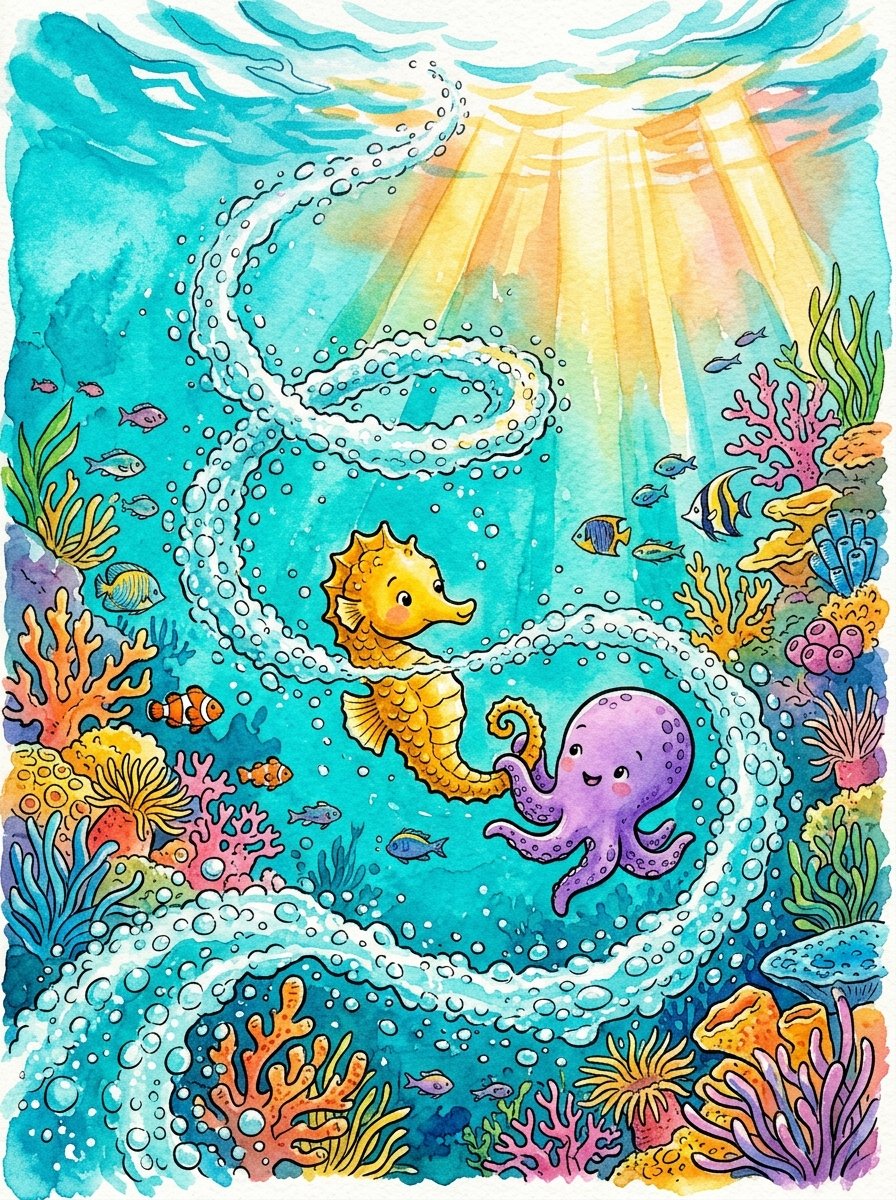
It wasn't. Seahorses were supposed to swim in straight lines — slow, dignified, upright lines, the way seahorses had been swimming for millions of years. Finn swam in spirals. Tight spirals, wide spirals, spirals that corkscrewed downward and spirals that corkscrewed up. He couldn't help it. His body turned when he moved. The faster he went, the tighter the spiral.
This made getting anywhere very complicated.
Take delivering a message, for example. Coral Bay was not a big place — you could cross it in five minutes if you swam straight. Finn could cross it in two. But crossing it in a spiral meant he covered three times the distance, and by the time he arrived at his destination, he was usually facing the wrong direction and slightly dizzy.
"Meet me at the big coral," his friend Coral would say. Coral was a sea anemone who never moved, which made her very easy to meet. But even finding her took Finn several attempts. He would swim toward the coral, spiral past it, spiral back, spiral past it again, and eventually land on it by accident, spinning.
"Sorry," he would say, every time.
"You're always sorry," Coral would say, every time. "And always late."
"I'm not late. I'm early. I just can't stop."
This was true. Finn's spirals didn't have brakes. Once he started spinning, he kept spinning until he hit something or the water slowed him down. He had left trail marks on every rock, every piece of coral, and every slow-moving fish in the bay. The older fish had learned to move out of the way. The younger fish hadn't learned yet, and several of them had been knocked sideways by a spinning seahorse who was trying very hard to stop.
Finn didn't mean to cause trouble. He just wanted to get places. But getting places in a spiral was like trying to walk to the door by bouncing off the walls — you eventually arrived, but you left a mess behind you.
The other seahorses didn't understand him. They swam in straight lines. They were slow and careful and dignified, and they looked at Finn the way people look at a car that's driving too fast on a narrow road — with a mixture of admiration and fear.
"Why can't you just swim normally?" asked his cousin Perch, who was the most normal seahorse in the bay and very proud of it.
"I don't know," said Finn. "I try. But my body doesn't listen."
"Your body is broken," said Perch.
"My body is fast," said Finn.
"Fast and broken," said Perch, and swam away in a straight line, which was the most Perch thing anyone had ever done.
Finn tried to fix himself. He spent whole mornings swimming in straight lines — or trying to. He would fix his eyes on a piece of coral and tell his body, very firmly, to go straight. His body would agree, for about half a second, and then it would start to turn. Just a little at first. Then more. Then he was spinning again, faster and faster, until he spiraled right past the coral and crashed into a sea fan on the other side.
"I'm sorry," he said to the sea fan.
The sea fan didn't respond, because it was a sea fan.
Finn tried swimming slowly. If he swam slowly enough, the spirals were gentler — more like wide loops than tight corkscrews. But swimming slowly made him miserable. He was built for speed. Swimming slowly was like being a racehorse forced to walk everywhere. It technically worked, but it felt wrong.
He tried swimming with one eye closed. He tried swimming upside down. He tried swimming with his tail curled straight, which lasted for three seconds before his body remembered it was a seahorse and started spinning again.
Nothing worked. Finn was a spiral swimmer, and that was that.
Then one afternoon, everything changed.
A baby octopus named Tilly got caught in the rip current.
The rip current was a narrow, fast-moving channel of water that pulled from the bay toward the open ocean. Most creatures knew to avoid it. The current was invisible — the water looked calm on the surface — but underneath, it was a river within the bay, dragging everything toward the deep.
Tilly didn't know about the current. She was only three days old, which was very young for an octopus, and she had been exploring the rocks near the edge of the bay when the current grabbed her. One moment she was sitting on a stone, looking at a crab. The next moment she was moving — fast — toward the open water, her eight arms flailing, her body spinning.
"Tilly!" screamed her mother, who was on the other side of the bay. She started swimming, but she was slow. Octopuses are not fast swimmers. They are clever swimmers, and patient swimmers, but not fast ones.
The other creatures started swimming too. Coral couldn't move — she was an anemone. But the fish swam, and the crabs scuttled, and the turtles paddled. They all swam toward Tilly. But the current was fast, and they were slower, and Tilly was getting smaller and smaller in the distance, a tiny purple dot against the blue.
Finn saw it from across the bay. He saw Tilly spinning in the current. He saw the other creatures swimming after her, too slow. He saw the open ocean ahead of her, vast and dark and full of things that octopuses should not meet.
He didn't think. He just moved.
He swam.
And for the first time in his life, the spiral didn't matter.
Finn's spiral cut through the water like a drill. He didn't fight it — he let it carry him, spinning faster and faster, the water parting around him in a perfect corkscrew. He didn't need to swim straight. He needed to swim fast. And fast was exactly what he was.
He overtook the fish in seconds. He passed the turtles before they even saw him. He blew past the current itself, the water rushing around his spiral, and within moments he was beside Tilly, spinning alongside her in the current.
"Grab on!" he shouted.
Tilly grabbed his tail with two of her arms. Finn kept spinning. The current pulled them both toward the open ocean, but Finn was faster. He spiraled against the current, fighting it, his tiny body cutting through the water with a force that no straight-swimming seahorse could have matched.
The current fought back. It was strong — stronger than anything Finn had ever swum against. But Finn was stronger. He spiraled harder, faster, tighter, and slowly — so slowly — he began to pull Tilly out of the current's grip.
The other creatures watched from a distance. They saw the tiny golden seahorse spinning in the blue, pulling the baby octopus out of the current's teeth. They saw the water churn around them. They saw Finn's spiral tighten until it was almost a blur, and then loosen as he broke free of the current and shot back toward the bay.
He spiraled all the way back. He couldn't stop — he never could — and he spiraled right past the rocks, past the coral, past Coral and the sea fan and the crabs on the seafloor. But Tilly was safe on his tail, and she was laughing — a tiny, bubbly laugh that sounded like water over pebbles — because she had never been on a ride that fast before.
Finn finally stopped when he hit the seaweed at the edge of the bay. He untangled himself, very carefully, and set Tilly down on a rock.
"Are you alright?" he asked.
Tilly looked at him with her eight arms spread wide and her eyes like two black buttons. "That," she said, "was the best thing that has ever happened to me."
Finn blinked. "You were almost swept out to sea."
"I know. But the ride was amazing." She looked at him. "You're the spiral seahorse, aren't you?"
"I'm Finn."
"I'm Tilly. And I owe you my life." She paused. "Can you do that again sometime?"
Finn stared at her. Nobody had ever asked him to do his spiral again. Nobody had ever wanted to see it twice.
Tilly's mother arrived, out of breath and trembling. She wrapped three arms around Tilly and one around Finn, which was a lot of arms for one seahorse to deal with, but Finn didn't mind.
"Thank you," she said. "Thank you, thank you, thank you."
"He's very fast," said Tilly.
"He's very brave," said her mother.
"He's very spinny," said Tilly.
After that, everything changed.
The creatures of Coral Bay looked at Finn differently. They didn't see a broken seahorse anymore. They saw the fastest creature in the bay — the one who could get anywhere, not in a straight line, but in a spiral, which was sometimes better.
When a fishing net drifted into the bay, Finn spiraled through it and tangled it up before it could trap any fish.
When a storm stirred up the water and stirred up the sand and made everything dark and cloudy, Finn spiraled through the murk and found the way back to the safe water, and the other creatures followed his golden trail.
When Perch got his tail caught in a shell and couldn't get out, Finn spiraled around the shell until the pressure popped it open, and Perch was free, and he never called Finn broken again.
Finn still couldn't swim in a straight line. He still spiraled past things and crashed into things and left trail marks on every rock in the bay. But now, when he arrived at his destination — spinning, dizzy, and facing the wrong direction — someone was usually there to meet him.
"Sorry I'm late," he would say.
"You're not late," they would say. "You're exactly on time. You're just facing the wrong way."
Finn would smile and turn around, and everything would be fine.
One evening, as the sun went down and the water turned gold and orange, Finn sat on his favourite rock and watched the bay. Coral was beside him, swaying gently in the current. Tilly was nearby, practicing her ink-spraying on a confused crab.
"Do you ever wish you could swim straight?" Coral asked.
Finn thought about it. He thought about the straight lines Perch swam, slow and careful and boring. He thought about the spiral that had carried him through the current, fast and wild and unstoppable. He thought about Tilly laughing on his tail, and her mother wrapping arms around him, and the whole bay looking at him like he was something special.
"No," he said. "I don't think I do."
"Good," said Coral. "Because straight lines are overrated."
Finn smiled. The sun went down. The water turned dark. And somewhere in the bay, a tiny golden seahorse slept on his rock, dreaming of spirals.