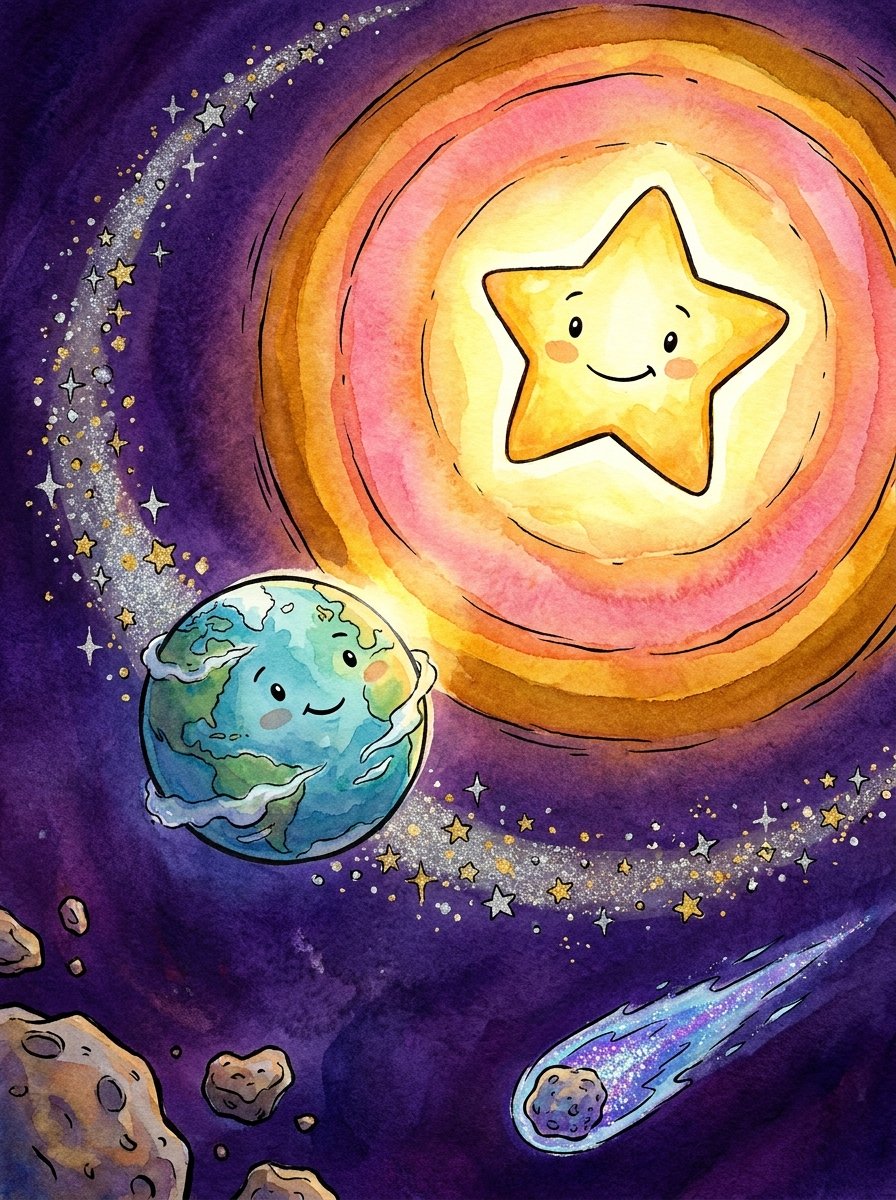
Nova was born in a single brilliant moment.
One instant there was nothing — just a cold dark cloud of gas drifting quietly through space. Then there was heat, and pressure, and a spark so bright it lit up everything for a million miles around.
And just like that, she was a star.
She blinked and spun slowly on her axis, feeling her own enormous gravity pull everything inward while her light pushed everything outward. She looked around at the vast, silent universe and felt wonder — the most extraordinary feeling she had ever felt, which was also, of course, the very first.
All around her, other stars burned — some old and red, some hot and blue. Some were so far away they were just faint flickers at the very edge of the dark. She could see a great spiral of light curling slowly through the black, like a river made entirely of stars. She was part of it. She was one small, bright point in a spiral of a hundred billion.
"Hello!" she called out, in the only way a star can call — with light.
Her light shot outward in every direction at once, a great golden wave rushing through the dark.
She waited and waited some more.
The old star closest to her was named Aldebaran, and he was ancient beyond counting. He had been burning since before most things in the galaxy could remember, and he spoke slowly, the way things do when they have all the time in the world. Stars cannot truly speak, of course. But they can send their light toward each other, and if the light is patient enough and the distance is small enough, something like a conversation can happen — a thought sent outward in one direction, an answer drifting back from another, both of them arriving years later than they were meant to.
"You sent out your first light," he said warmly. "That was very well done."
"Will anyone see it?" Nova asked.
Aldebaran did not answer right away. "Oh, yes," he said finally. "One day, someone will."
Nova stared out into the dark. She had just been born, and already she was thinking about someone she had never met, somewhere she had never been, in a time she could not imagine.
"What do I do while I wait?" she asked.
Aldebaran glowed a little warmer. "That," he said, "is entirely up to you."
At first, Nova tried doing nothing.
She kept on burning into the dark. She sent her light in every direction and tried not to think about the waiting.
But doing nothing was harder than it sounded.
Because the universe, it turned out, was absolutely full of things.
A comet came tumbling past her, a great spinning ball of ice and ancient dust, trailing a shimmering tail like a silver scarf in the solar wind. She reached out with her warmth and the comet blazed brighter, its tail catching her light and scattering it into a thousand glittering pieces.
"Oh!" said Nova, who hadn't known she could do that.
Then came a slow cluster of rocks drifting past — a trail of them, circling her in patient, endless loops. She watched them travel their slow paths. Some were gray and rough. Some were bright with veins of shining metal. And one was shaped almost exactly like a duck, which Nova found very funny.
She sent it a little extra warmth, just because.
Time passed — which it does, whether you want it to or not. A great deal of it.
Over millions of years, Nova learned that her gravity had quietly gathered eight planets, all of them circling her in their own careful orbits. She learned that some were made entirely of gas, enormous and beautiful and swirling with storms bigger than whole oceans. She learned that the third planet from her — small and blue-green, wrapped in thin clouds — had done something unexpected.
Against all odds, over billions of years, it had quietly grown life.
She wasn't sure exactly when it happened. One year the planet was just rock and water, and then, after a very long time, something stirred in the warm shallow seas. Then something crawled onto the land. Then, eventually, something stood up and looked at the sky.
That was the moment Nova had been waiting for, even without knowing it.
Those small creatures looked up. And she looked back at them.
Many years later, another wandering comet stopped nearby on its long arc through the outer edges of the solar system. It had traveled farther than most things, and it had seen many stars.
"You seem like you are thinking very hard about something," the comet observed.
Nova was quiet for a moment. "I have been burning since the moment I was born," she said. "For billions of years, my light has been reaching that little planet. And only now — only just now — has someone looked up and seen me."
The comet drifted in a slow and thoughtful arc. "What do you want them to see?"
Nova had not considered that question before. She turned it over slowly, looking at it from different angles the way you might look at a strange and interesting stone.
"I want them to feel what I felt," she said at last. "When I first opened my eyes and looked at everything for the very first time. That feeling of the whole universe being new."
The comet was quiet for a moment.
"Then you know what to do," it said, and continued on its long journey.
Nova thought about this for several hundred years, which for a star is a reasonable amount of time to think.
She wasn't idle while she thought. She kept burning, kept warming her planets, kept watching the small creatures on the blue-green world. Over thousands of years, she watched them build fires on the dark side of the planet — little orange sparks appearing and disappearing as they discovered warmth. She watched them form groups and spread across the land. She watched them plant things in the dirt and wait patiently for them to grow.
Watching them wait was interesting.
She noticed they were not so different from her, in that way.
She also watched the other stars. She saw stars that burned cool and red for billions of patient years, never rushing, never brilliant, steady as old promises. She saw stars that burned fierce and blue, blazing briefly and then exploding in vast, beautiful clouds of color that scattered across space. Those clouds eventually became the dust of new stars, new planets, and new beginnings.
She saw a star not far from her go quietly out one night — not with a bang, just a slow dimming. It was like a lamp in a window when someone finally goes to sleep. It left a dark space where the light had been.
Nova looked at that empty dark for a long time.
"I will not waste my time," she said out loud, to no one in particular, and she meant every word.
Nova began to pay attention in a way she hadn't before.
She had eight planets and she watched every one of them carefully. She watched how her second planet spun under thick bands of cloud, always hidden. She watched how the third planet had its moon keeping careful watch, pulling the ocean back and forth in steady tides.
She realized something important: everything she did mattered.
Every degree of warmth she sent out, every tiny shift in her brightness, every particle of energy streaming away — all of it shaped the worlds below. The creatures on the blue-green planet depended on her without knowing it. The seasons came because of her. The daylight came because of her. The warmth that grew their food, the light that helped the eyes of every creature that had ever looked up — all of it was her.
She had been doing so much without even realizing it.
It made her burn more carefully, more steadily, more like something that intended to last.
And then one night, the creatures looked up.
They had been there for thousands of years already — building fires, forming groups, planting things in the dirt. But this night was different. This night, they stopped what they were doing and turned their faces to the sky. And Nova felt it the way you feel a sound in a quiet room before you can explain how — she was being seen. Not just her light hitting their planet, the way it always had. But them, looking back. Seeing her. Knowing she was there.
She could not see their faces. She did not know what they said or how they felt. But she knew, in the way that stars know things, that on that little blue-green planet, someone had looked up and found a light where they had never thought to look before.
That was her. That had always been her. And now they knew.
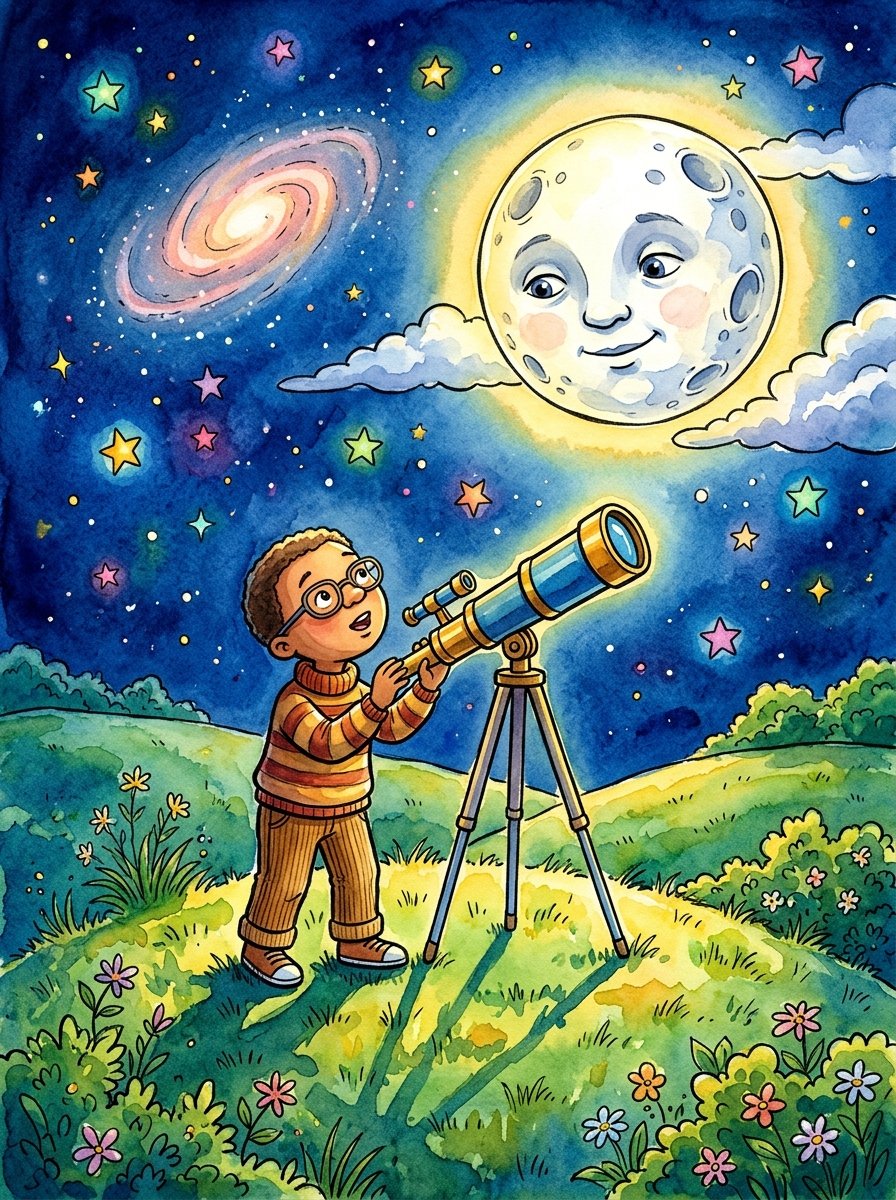
Meanwhile, the creatures continued their own quiet work. They began giving her names. They plotted her position in the sky and tracked how she moved. They wrote down where she was, what colour she was, and how bright she burned. From that night on, they paid attention — just as she had been paying attention to them.
That night, Nova did something new.
She gathered everything she had become — billions of years of watching and warming, of comets and creatures and fires in the dark. She thought of quiet stars going out and bright ones blazing brief and beautiful. She thought about the duck-shaped asteroid. She thought about the comet's question. She thought about Aldebaran speaking slowly because he had all the time in the world.
She put all of it into her light.
She couldn't have explained exactly how. You can't explain the mechanics of wonder any more than you can explain why something beautiful makes your chest feel full. She simply burned with everything she had — ancient and new all at once.
Her light went out across the dark, carrying everything she had become. It reached the little blue-green planet, where the creatures were still looking up. And for the first time, they saw her not just as a point of light in the sky, but as something more — something that had been burning for a very long time, and had been waiting for them just as long.
Later, when Aldebaran was close enough to speak again, he said: "You've changed."
"I've been burning for a while," said Nova.
"And it suits you," he said.
She thought about the very beginning — the cold dark gas, the spark, the blazing burst of first light she had sent out before she even knew what she was. She thought about the question she had asked on her very first day.
"I think I understand now," she said.
"And what do you understand?"
"The light I sent on the first day was just me arriving," she said slowly. "Everything since then is me becoming. And the creatures didn't need my first light to find me. They just needed time to look up."
Aldebaran glowed warmly, the way old stars do.
"Yes," he said, in his slow and certain way. "That is exactly what I mean."
Nova looked out across the dark — at the eight planets circling patiently in their paths, at the distant spiral of stars curling through the galaxy. Everywhere she looked, there was the faint scattered light of everything that had ever been born and burned and sent its brightness traveling outward into the unknown.
She was a small star in a very large universe.
She had all the time in the world.
And so she kept burning.