← Story Library
Kinder Yarns

The Three-Minute Shadow

The Three-Minute Shadow

Every afternoon, Idris's shadow got home before he did.

He hadn't noticed at first. It was his mother who pointed it out, one Tuesday in October, when Idris was still two blocks away and she was already calling from the front step that his shadow had beaten him home again.

"It's been happening all week," she said. "Your shadow comes through the gate, slides up the front door, and waits. Then three minutes later, you show up."

Idris looked at the ground. His shadow was gone. He looked at the front door. A dark shape, exactly his size and shape, was pressed against the wood like a patient guest.

"That's very strange," he said.

"It is," agreed his mother.

That evening Idris lay on his bed and thought about it. A shadow is supposed to follow you. That is the entire purpose of being a shadow. It has no business going anywhere without you.

Unless it had somewhere to go.

The next day Idris walked home from school the way he always did. Same street, same turn, same pace. But today he stopped at the lamppost. He stood still and looked down.

His shadow was already gone.

He had felt it leave — a lightness on the back of his neck, as if someone had stepped away. He turned around. The street was empty. The shadow was already around the corner.

Idris started walking. Not his usual pace. Faster. He wanted to catch it.

He rounded the corner and ran. He ran past the trees and the parked car and the woman with the dog, and when he reached his front gate he stopped, breathing hard.

His shadow was there. It had been there for at least a minute, pressed against the front door, perfectly still.

"You're fast," said Idris.

The shadow did not respond. But Idris had the feeling it had heard him, and that it was pleased with itself.

He stood there for a moment. Then he did something he had never done before. He spoke to his shadow directly.

"Where do you go?"

The shadow remained still. But the edges of it had sharpened — the outline of his head, his arms, his legs, crisp and precise, the way shadows look at noon when the sun is directly overhead.

"That means something," he said to himself, though he wasn't sure what.

That night he asked his mother about shadows.

"Can they go places on their own?"

"Shadows go where the light tells them to," she said. "That's all."

The next day Idris left school ten minutes early. He walked slowly, watching the ground. He was on Elm Street when it happened — that lightness on his neck, that sense of something stepping away. He looked down. His shadow was gone.

He looked around. Shadows stretched from every surface — shop fronts, bin posts, the bakery awning. His shadow could have been anywhere.

But Idris had an idea. Near his feet, at the edge of the pavement, he saw something. A faint dark mark — not a shadow exactly, but a trail. As if his shadow had left a smudge on the ground when it departed, pointing in a specific direction.

He followed it.

The smudge led him down Elm Street, past the park where he played football, past the fish and chip shop and the old bookshop with the yellow door. It led him to the canal.

The canal was narrow here, no more than ten steps across. The water was dark and slow. On the far side, a path led to the industrial estate — a place Idris had never been.

The smudge crossed the narrow bridge. He followed it.

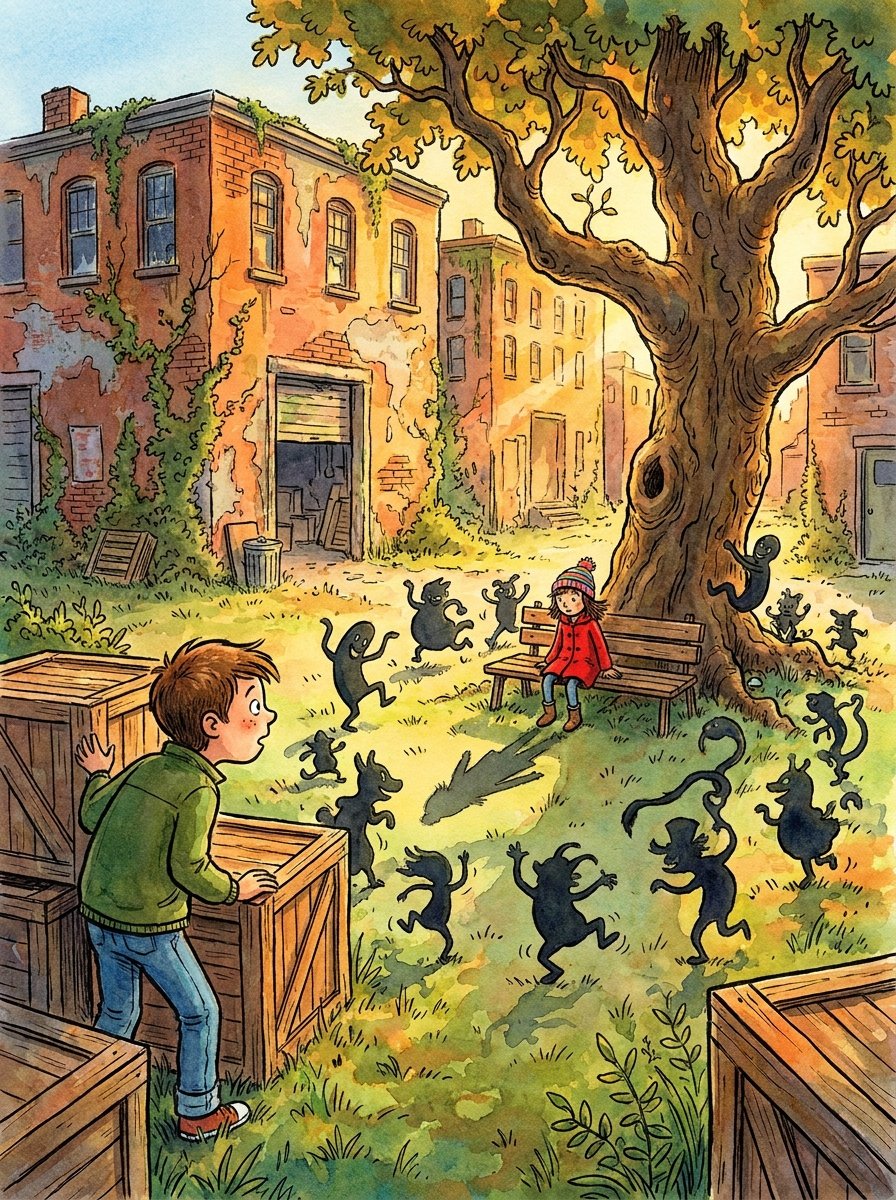
The smudge led him through a gap in a fence, along a gravel path, and into a small clearing hidden behind the warehouses. A patch of grass, a single bench, and a tree that had no business being this close to concrete but had grown anyway, reaching its branches toward the sky.

And there, in the clearing, he saw something extraordinary.

His shadow was not alone.

Dozens of shadows were gathered in a loose circle around the tree. Some were large, some small. Some were the shapes of adults, some of children, some of dogs. And they were doing something Idris had never seen a shadow do.

They were moving on their own, independently, without any light source driving them. Some stretched upward toward the branches. Some contracted, pulling inward. Some swayed gently, the way trees sway in a breeze that isn't there.

In the centre of the circle, standing on the bench with her shadow stretched out behind her, was a girl Idris had never seen before. She was about his age, with dark hair and a red coat, watching the shadows with quiet concentration.

Idris stepped into the clearing.

The girl looked at him. The shadows stopped moving. Every one of them turned — if shadows can be said to turn — and faced him.

"You're early," said the girl.

"I'm what?"

"Early. You're usually three minutes behind your shadow. Today you're only two." She looked at him. "You followed it."

"I did," said Idris. "I wanted to know where it went."

"They all come here," said the girl. "Every afternoon. They rest."

"Rest?"

"They spend all day following people. Being pulled and stretched and flattened. It's exhausting." She looked at the shadows. "This is where they come to be themselves for a few minutes."

Idris looked at his shadow. It had joined the circle, lying beside the shadow of a large dog. Its edges had softened. It looked relaxed, the way Idris felt on a Friday afternoon when school was over.

"You can see them too?" he said.

"Obviously," said the girl. "I'm Maren. I've been doing this since I was six."

"Doing what?"

"Managing the clearing. Making sure the shadows are okay." She looked at him. "You should have your shadow back by now."

As if on cue, Idris felt a pull at his feet. His shadow was moving toward him, sliding across the grass, returning to its proper position beneath him. It settled into place, dark and faithful.

"There," said Maren. "Right on time."

"How long have you known about this?" said Idris.

"My whole life. My shadow started doing it when I was five. My grandmother told me about it." She looked at the clearing. "I keep this place up. Make sure nobody builds over it."

Idris looked at the clearing — the grass, the bench, the stubborn tree. He looked at the shadows, who had resumed their quiet movements. He looked at Maren, standing on the bench in her red coat.

"Can I come back?" he said.

"Tomorrow," said Maren. "Same time."

He went back the next day, and the day after that. After a week he knew the clearing well — the grass thicker on the south side, the tree's branches creaking in wind, the way shadows moved differently on cloudy days compared to bright ones.

He learned that shadows were particular about their resting places. Tall shadows preferred the edge of the circle. Small shadows liked the centre, near the bench. Dog shadows lay together in a loose pile, dark on dark, completely at ease.

He learned that shadows had different shapes depending on how their person had spent the day. Active shadows were thinner and sharper. Still shadows were broader and softer. Sad shadows were a deeper black, as if sadness had a colour and it was the darkest one.

"Why do you do it?" he asked her one afternoon. They were sitting on the bench while the shadows moved around them.

"Because somebody has to," she said. "And I noticed first."

"That's not a reason."

"It's the only reason I have." She looked at the shadows. "They can't talk. They can't explain themselves. But if nobody watches, nobody makes sure they come back."

"Has a shadow ever not come back?"

"Once," said Maren. "A shadow got lost. Its person spent three days looking very flat and strange." She looked at Idris. "That's why your shadow goes ahead of you. It's not being rebellious. It's making sure the clearing is safe before you arrive."

Idris looked at his shadow. It was lying near the base of the tree, its edges perfectly still, its outline crisp. It looked like something that had been tired for a long time and had finally found a place to rest.

"Thank you," he said to it.

The shadow did not respond. But its edges softened, just slightly.

He went to the clearing every afternoon for the rest of the autumn. He brought his homework sometimes and sat on the bench while the shadows moved around him.

On the first day of winter, when the sun sat low and the shadows were long and thin, Maren told him something.

"The shadows will change with the light. In winter they'll need more time in the clearing. In summer they'll come back faster."

"So the three minutes might become four," said Idris. "Or five."

"Or two. It depends on the light."

"Will I always be able to see them? The way you do?"

Maren looked at him. "You followed your shadow here. You came back every day. I think you've always been able to see them. You just didn't know what you were looking at."

That afternoon Idris walked home with his shadow at his heels. The sun was low and golden, and the shadow stretched long behind him. But it was not hurried. It walked at his pace, matching him step for step, and when he reached his front gate his shadow was right where it should be.

His mother was at the door.

"You and your shadow got home together today," she said.

"We did," said Idris.

"Did something change?"

Idris looked at his shadow, pressed flat against the pavement. "I know where it goes," he said.

She waited.

"It goes to a clearing behind the canal, where all the shadows come to rest. There's a girl who looks after them. She makes sure they come home."

His mother looked at him for a long moment. Then she looked at the shadow.

"Your grandmother used to say something about that," she said slowly. "She said shadows need a place of their own." She looked at Idris. "I thought she was being poetic."

"She wasn't," said Idris.

"No," said his mother. "I don't think she was."

That night Idris lay on his bed and listened to the house settle. The shadows on his walls were long and still, cast by the lamp on his desk. He watched them the way he watched everything now — with attention, with care, with the understanding that they were not just shapes but presences.

He thought about Maren on her bench. He thought about the clearing behind the canal, hidden and quiet and necessary. He thought about his shadow, resting there every afternoon, gathering its strength for the walk home.

He turned off the lamp. The room went dark. His shadow vanished into the black, and he knew it was already on its way to the clearing, where it would rest, and where Maren would be waiting.

He fell asleep knowing it would be home in the morning, right on time.

Preview
Share this story
Kinder Yarns

Listen in the app

Engaging, narrated stories for kids aged 4-10.

↓  App Store ↓  Google Play