← Story Library
Kinder Yarns

The Tooth That Would Not Go

The Tooth That Would Not Go

Felix had wiggled that tooth for six weeks. He had wiggled it at breakfast. He had wiggled it during maths. He had wiggled it while watching television, which his mother said was rude but which Felix considered efficient.

And on a Wednesday morning, just as he was biting into an apple, it came loose.

It did not fall out with a dramatic pop or a splash of blood or any of the things Felix had been promised by his older brother, Jack, who was a liar. It simply tilted to one side, like a small white door that had been left open, and then it was in his hand. Tiny. Smooth. A bit damp.

Felix stared at it.

"IT'S OUT!" he shouted.

His mother came running. Jack came running. The cat came running, because whenever anyone shouted in the house, the cat assumed food was involved and showed up to investigate.

"Under the pillow," said his mother. "Tonight. The tooth fairy will come."

Felix had heard about the tooth fairy. He had heard from Jack, who had heard from a boy at school named Owen, who may or may not have been reliable. The deal was simple: you put the tooth under your pillow, and in the morning there is money. Not a lot of money. But money.

Felix put the tooth in a small glass of water on his bedside table, because his mother said teeth should stay clean, and went to school.

He thought about the tooth all day. Not about the money. About the fairy. What did she look like? Was she big or small? Did she fly? Did she have wings? Did she have a special outfit for collecting teeth, the way a mailman had a special outfit for delivering letters?

He could not concentrate on anything else.

That night, after dinner, after his bath, after his mother read him two chapters of a book about a boy who found a dragon egg, Felix placed the tooth under his pillow.

"Goodnight" said his mother.

"Goodnight," said Felix.

She turned off the light. The room went dark and quiet. Felix lay very still, listening.

He heard the house settle. He heard the wind outside. He heard Jack snoring through the wall, because Jack snored like a lawnmower and nobody had done anything about it.

And then, very softly, he heard a sound. A tiny, papery sound, like a moth landing on a lampshade.

Felix held his breath.

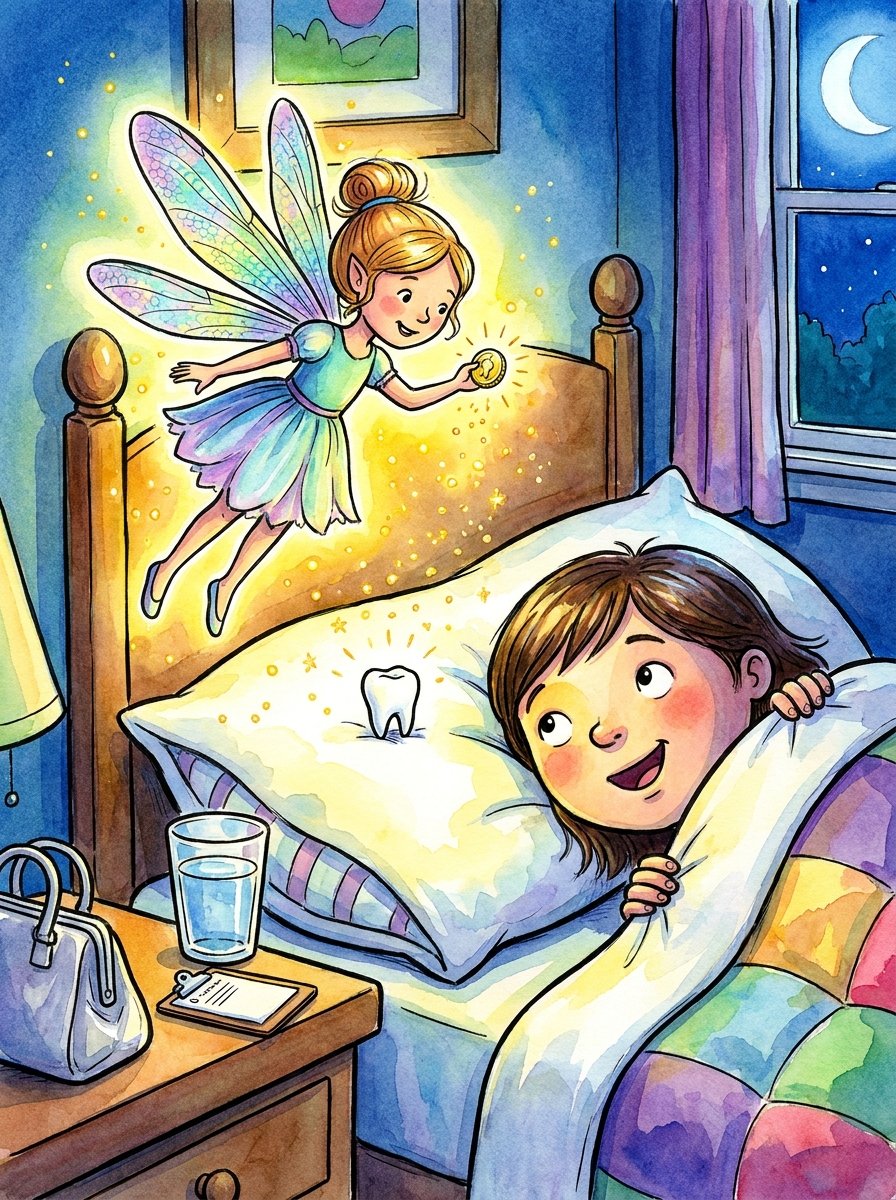
A light appeared under the door. Not a big light. A small light, golden and warm, the colour of honey held up to the sun. It slid across the floor, rose into the air, and hovered near his pillow.

And there, floating above his bed, was the tooth fairy.

She was not what Felix had expected. She was small — very small, about the size of his hand — with wings like a dragonfly, clear and shimmering. She wore a dress made of something that looked like silver thread, and her hair was white and pulled back in a tight bun. She carried a tiny bag over her shoulder, and in her other hand she held a clipboard.

She looked like someone who had a lot of teeth to collect and not a lot of time to do it.

She landed on the edge of his pillow, folded her wings, and reached under it.

She pulled out the glass of water with the tooth inside. She held it up to the light, examined it, and made a note on her clipboard.

"Right" she said. "Standard primary. Upper left canine. Good condition. Slight discoloration from—" she sniffed the glass, "—apple juice. Acceptable."

She opened her bag.

And the tooth spoke.

"Excuse me," said the tooth.

The tooth fairy froze. Felix sat up in bed.

"Did your tooth just talk?" said the tooth fairy.

"I did," said the tooth. Her voice was small and bright, like a bell that had been wound up very tightly. "And I have something to say."

The tooth fairy looked at the tooth. She looked at Felix. She looked at the clipboard, as if it might have instructions for this situation. It did not.

"You are a tooth," she said. "Teeth do not talk."

"This one does," said the tooth. "I have been thinking about this for six weeks, and I have decided that I am not ready to go."

The tooth fairy set down her bag. "Not ready," she repeated.

"Correct," said the tooth. "I have been in Felix's mouth for seven years. I have seen things. I have heard things. I have been there for every meal, every laugh, every time he talked in his sleep about dinosaurs. I am part of his story. And I would like to know what happens next."

The tooth fairy blinked. "What happens next," she said, "is that I take you, and you go in the bag, and you are processed, and Felix gets a coin. That is the arrangement."

"Yes," said the tooth. "But what happens after that? To me? Where do the teeth go?"

The tooth fairy opened her mouth. Closed it. Opened it again. "That is proprietary information," she said.

"Then I am staying," said the tooth.

Felix, who had been lying very still and very quiet, sat up properly. "You can talk?" he said to his tooth.

"I can talk," said the tooth. "I have always been able to talk. You just never listened. You were too busy wiggling me."

"I wiggled you because you were loose," said Felix.

"I was loose because I was trying to get your attention," said the tooth. "But you never got the message. So now I am taking matters into my own hands. Or whatever hands teeth have."

The tooth fairy pinched the bridge of her nose. She had been doing this job for a very long time. She had collected teeth from children who cried, children who laughed, children who tried to trick her by putting in a piece of chalk. She had never had a tooth refuse to leave.

"This is not how this works," she said.

"Then explain how it works," said the tooth. "Explain to me why I should go into a bag with a hundred other teeth and be processed by a system I know nothing about, when I could stay here and continue being part of Felix's life."

"Because that is the deal," said the tooth fairy. "You fall out. I come. I take you. Felix gets a coin. Everyone is happy."

"I am not happy," said the tooth.

"You are a tooth. You do not have feelings."

"I have a great many feelings," said the tooth. "I have feelings about apples. I have feelings about chocolate. I have feelings about the way Felix always chews on the left side, which I have found to be unfair but which I have tolerated because I am a professional."

Felix looked guilty. He did always chew on the left side.

The tooth fairy sat down on the pillow. She crossed her legs and put her clipboard on her knee. She looked tired, but also, Felix thought, a little bit interested.

"Fine," she said. "Make your case."

The tooth was quiet for a moment. When she spoke again, her voice was calm and steady, like someone who had been rehearsing.

"I have three arguments," she said. "The first is that I am not done. I have been in Felix's mouth through the most important years of his life. I was there when he learned to read. I was there when his dog, Clover, died, and he cried into his pillow for three nights. I was there when he stood up to Jack and told him to stop being a jerk, which was the bravest thing I have ever witnessed. I was there for all of it. And I would like to see what comes next."

The tooth fairy said nothing.

"My second argument," continued the tooth, "is that Felix needs me. Not me specifically — I understand that another tooth will grow in my place, and I accept that. But the idea of me. The memory of me. He should know that the small things in his life were not nothing. That every tooth, every meal, every moment mattered. If I disappear into a bag without a word, it sends the message that I was just a thing. But I was not just a thing. I was his tooth. And that should count for something."

Felix's eyes were very wide.

"My third argument," said the tooth, "is this: I would like to see the coin."

The tooth fairy stared at her. "You want to see the coin."

"I have heard about the coin my entire life," said the tooth. "Every tooth that has ever fallen out of every child's mouth has seen the coin. But I have never seen it. I think that is unfair. I think I have earned the right to see it before I go. Just once. Then I will go quietly. You have my word."

The tooth fairy was quiet for a long time. The room was silent except for Jack's snoring through the wall, which had not stopped and was, if anything, getting louder.

"That," said the tooth fairy, "is the most reasonable argument a tooth has ever made to me."

"Thank you," said the tooth.

"I have been doing this for four hundred years," said the tooth fairy. "I have collected over nine million teeth. Not one of them has ever asked to see the coin. Not one of them has ever asked me where they go. They simply lie there and wait for me to pick them up, as if that is all they are good for."

She reached into her bag. Her hand came out holding something small and round and shining. She held it up.

It was a coin. But not like any coin Felix had ever seen. It was gold, but not the bright, shiny gold of a new coin. This was a deep, warm gold, like sunlight that had been saved in a jar. And on one side there was an engraving of a tooth, and on the other side there was a name.

"Is that my name?" said the tooth.

"It is," said the tooth fairy. "Every coin has the name of the tooth it replaces. That is how we keep track. Every tooth that falls out is remembered. Every one. For as long as there are children and teeth and someone to collect them."

The tooth was quiet.

"So I am not disappearing," she said.

"No," said the tooth fairy. "You are being remembered."

The tooth considered this. "That is a very good system," she said.

"It is," said the tooth fairy. "Now. Are you ready?"

The tooth was quiet for a moment longer. Then, very softly, she said, "Yes. I am ready."

The tooth fairy picked up the glass, tipped the tooth gently into her bag, and placed the gold coin on Felix's pillow.

"One more thing," said the tooth.

"Yes?"

"Tell the next tooth to be brave. Tell them it is worth it. All of it."

The tooth fairy smiled. It was the first time Felix had seen her smile, and it made her look less like someone with a clipboard and more like someone who had a very important job that she cared about very much.

"I will," she said.

She folded her wings, rose into the air, and drifted toward the door. The golden light moved with her, sliding across the floor, slipping under the door, and disappearing into the hallway.

The room was dark again.

Felix reached under his pillow and found the coin. It was warm in his hand. He held it up and read the name engraved on it: Felix's Left Canine.

He closed his fist around it and lay back down.

"Goodnight," he whispered.

And from somewhere very far away, carried on a breeze he could not feel, he heard a tiny voice say, "Goodnight."

In the morning, Felix showed the coin to his mother. She said it was very nice and asked where he had got it. He said the tooth fairy had left it. She said that was lovely and went back to making toast.

Jack asked to see the coin, because Jack asked to see everything. Felix showed him.

"That's weird," said Jack. "Mine was just a regular coin."

"Maybe yours was," said Felix. "But mine was special."

Jack made a face and went back to eating his cereal.

Felix put the coin in the drawer beside his bed, next to a rock he had found on the beach, a marble he had won from Owen, and a small piece of string that he liked for reasons he could not explain.

It was a good drawer. It held important things.

And somewhere, in a bag made of silver thread, a small white tooth sat among nine million others, each one remembered, each one named, each one part of a story that was still being written.

Preview
Share this story
Kinder Yarns

Listen in the app

Engaging, narrated stories for kids aged 4-10.
↓  App Store ↓  Google Play