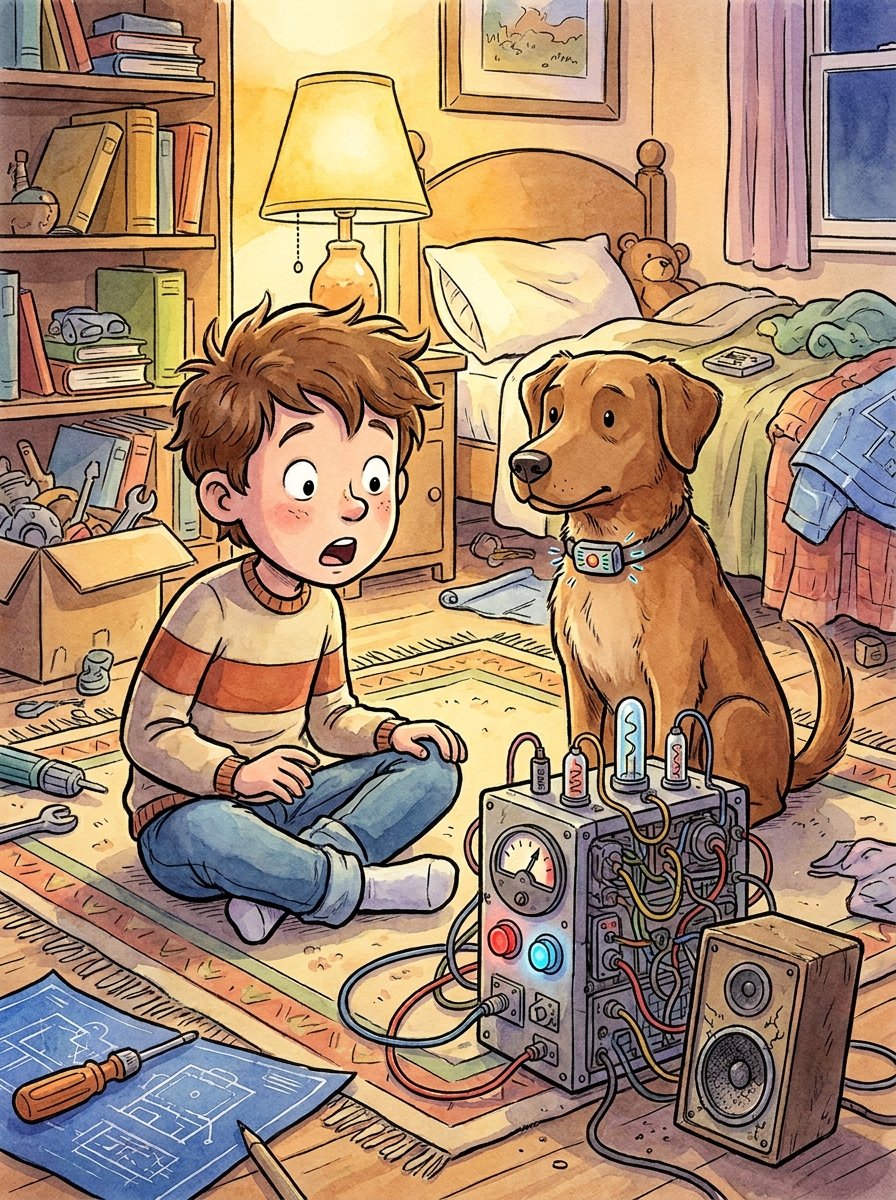
The machine looked like it had been built by someone who ran out of the right parts halfway through, which was exactly what had happened.
Ned had been working on it for three weeks. It sat on his desk in a tangle of wire and mismatched components — a walkie-talkie, a circuit board from a broken radio, three buttons from a television remote. The speaker had once been part of a talking birthday card. Ned had kept it specifically for the voice.
Ned was eleven and believed this project was entirely achievable.
Pepper was a medium-sized brown dog of unclear ancestry who had lived with Ned's family for six years. She spent her days moving between specific spots in the house in a precise daily order that nobody had ever successfully mapped. She was calm, reliable, and communicated her feelings almost entirely through the position of her ears.
The machine worked on the very first try, which Ned had not been expecting.
He clipped the sensor to Pepper's collar on a Tuesday evening. Pepper gave him a long, considering look — the kind that meant she was reserving judgement. He switched on the receiver, pressed the three buttons in the right order, and waited.
Pepper walked to her dinner bowl, looked down at it, and barked once.
The speaker crackled and hummed for a moment. Then it said, in a flat electronic voice: dinner was three minutes late.
Ned stared at the speaker.
Pepper turned and walked calmly back to her bed.
"Did that just —" said Ned's mum, appearing in the doorway.
"Yes, it did," said Ned.
A silence settled over the room.
"Was it?" said Ned's mum. "Three minutes late?"
Ned checked the clock on the wall. It was six-oh-three, not six. Dinner was always supposed to be at six. He looked at his mother. His mother looked at the speaker. The speaker said nothing further.
"Hm," said Ned's mum, and went back to the kitchen with an expression Ned could not quite read.
The next morning Pepper walked to the sitting room window and barked three times at the armchair. The machine translated: the chair has been moved eleven centimetres to the left. It belongs in its correct position.
Ned's dad moved the chair back without asking how the machine knew that.
Pepper inspected the result and appeared satisfied. She got into the chair.
By Thursday the household was reorganising itself around a stream of very specific instructions. The walk, Pepper explained via two sharp barks on the doorstep, should go left at the end of the road and not right. The right route was perfectly acceptable but dull. The left route had significantly more interesting smells, particularly near the hedge outside number fourteen.
They turned left that morning. Pepper's tail moved with noticeably more enthusiasm than usual.
The postman, Pepper clarified on Friday, was completely fine. She had no problem with him personally. The barking at the letterbox was a procedural alert, she explained — something was coming through the door — and the family should stop interpreting it as hostility. It was information, not aggression, the machine reported on Pepper's behalf. The family should please note the difference.
Ned's mum nodded slowly in the way of someone receiving news she was still processing.
The cat from next door was a separate and much larger subject. The machine translated three distinct barking sessions into a thorough account of the cat's poor attitude and her disregard for established property boundaries. She also described a specific incident from the previous August involving the garden fence, which Pepper felt had never been properly addressed by anyone.
Nobody else in the household could remember the August incident. Ned's mum tried hard to remember. Ned's dad thought very hard about August. Ned had been on a school trip in August.
Pepper remembered it in precise and unflinching detail. She also, the machine reported, considered the matter unresolved.
By the end of the first week Ned had filled half a notebook with Pepper's views. She covered dinner timing and walk routes in considerable depth. She addressed the positioning of her bed relative to the radiator, and specified that her ears should be stroked from the base and not the tip. She described a particular brand of treats discontinued three years ago, which nothing had come close to replacing. She mentioned the television programme on Wednesday evenings at nine o'clock, which she found distressing and preferred not to be running while she was trying to sleep.
"She has a lot of thoughts," said Ned's dad, reading the notebook over Ned's shoulder.
"She's had six years to develop them," said Ned.
His dad put the notebook down with the careful manner of someone who had learned something they were still absorbing.
When Ned's grandmother came to visit on Saturday, Pepper sat at her feet for ten minutes and then delivered an assessment. She was, the machine reported, an excellent visitor. She sat in the right chair, spoke at a pleasant volume, and smelled of something particularly good that she should continue to wear. The only note was that she tended to leave by the front door rather than the back, which created a draught at floor level.
Ned's grandmother took this very well. She left by the back door from then on.
On Sunday Pepper stood in the middle of the kitchen and barked for four minutes without stopping. The machine could not quite keep up with the translation speed and the output came in bursts. It was, as far as Ned could tell, a complete household performance review. He sat at the table with his notebook and wrote down every point as fast as he could.
The heating was two degrees too cold. The sofa cushions were always in the wrong arrangement after a film and nobody ever fixed them. Someone had been leaving the back door open in twelve-second intervals, creating an uncomfortable draught at floor level. The bath was run too loudly on Tuesday evenings. The radio station in the kitchen was acceptable, but there was a noticeably better one three numbers along the dial. Ned's trainers, left at the bottom of the stairs on three recent occasions, were a hazard. The houseplant in the hall had not been watered correctly in approximately six weeks. The linen cupboard door, which had not shut properly since February, was both a hazard and an embarrassment. And the formal matter of the cat from next door had still not been addressed to anyone's satisfaction, and she wished it noted that she had raised this matter before.
"We are being managed," said Ned's dad, standing in the doorway with his arms folded.
"We have always been managed," said Ned's mum. "Now we are simply informed about it."
Ned looked at Pepper. Pepper looked back at him with the calm, even expression of someone delivering a routine update to a department that had been underperforming for some time.
Pepper finished her review, sat down, and looked satisfied. She had been waiting some time for the right technology to come along.
The family adjusted their routines accordingly. Dinner was served at exactly six o'clock. The walk went left on weekdays and was varied on weekends according to a system Pepper indicated each morning with one bark or two at the front door. The Wednesday programme was changed. The radio dial was moved three numbers along. The sofa cushions were arranged correctly after every film. This took about thirty seconds and Pepper monitored it from her bed with the expression of someone checking that their instructions were being followed properly.
The houseplant in the hall was watered on schedule. Ned moved his trainers off the bottom step. The back door was kept closed.
Things ran, Ned had to admit, considerably more smoothly than they had before. He was not sure whether to be impressed or slightly embarrassed that a dog had been the one to point this out.
The following Tuesday Ned came home from school with the particular flat tiredness that came from a test going badly and lunch being cold. He left his bag in the hall and sat on the bottom step and did not move.
Pepper came out of the sitting room. She stopped in front of him and looked at his face. She did not bark immediately. She simply sat down and waited with him for a moment, in the particular way she had.
She barked once, very softly.
The machine translated: you are back.
Pepper did not move or look away. She kept looking at him with the steady, patient expression she had always worn.
After a moment she barked a second time.
You seem unwell this afternoon, the machine said. Is it something at school?
Ned blinked at the speaker. He had not been expecting this from the machine that had spent the previous week cataloguing complaints about draught levels and treat quality.
"A test," Ned told her. "It didn't go well."
Pepper sat down. She looked at him for a moment longer. Then she barked twice, slowly and deliberately.
Tests do not measure most things, the machine said. In my experience, the things that matter most cannot be tested at all. They can only be paid attention to.
Ned looked at the speaker for a long moment.
"That is by far the wisest thing you have said," he told Pepper.
Pepper stood up, turned, and walked back to her bed. She circled it twice and lay down. Then she barked once more.
The machine made a crackling sound before it spoke. There is one additional point, it said. The radiator is still two degrees too cold.
Ned laughed, properly and suddenly. It was the first time he had laughed all day. He got up and turned the heating up two degrees, which seemed like the right and proper response.
He turned back to look at Pepper. She had already closed her eyes. She had said what she needed to say, and she was quite finished with that topic now.
At dinner that evening he told his family what Pepper had said on the stairs. His mum listened with her head tilted. His dad stopped eating and looked over at Pepper, who was finishing her dinner at exactly six o'clock.
"Six years," his dad said. "She has been watching us for six years."
"Watching and forming conclusions," said Ned's mum.
"She has strong opinions about everything," said Ned.
"She has strong opinions about specific things," said his mum. "All things she has been paying very close attention to."
Ned looked at Pepper, who had finished her dinner and was turning in a slow circle before lying down. Six whole years, he thought. She had been watching every single bit of it.
Ned thought about this after dinner. He sat in the sitting room with the notebook and read back through every entry. He read through the chair and the walk route and the cat from next door and what had happened in August. He read the entries about the discontinued treats, the radio station, the back-door draught, and the sofa cushions.
Every single one was real. She had noticed all of it, all along, and she had never had a way to say any of it until now.
But she had also been there for everything else. She had been in the room on every good evening and every ordinary Sunday afternoon. She had been on the sofa during every film, at the incorrect-cushion end, for six entire years. She had come and sat beside anyone who was having a hard day without being asked and without needing a machine to translate why.
The notebook had all the complaints in it. But the complaints were only part of the picture. The rest of it was written in six years of showing up.
He could remember exactly what that looked like. She had been in the room for everything — not because anyone told her to be, but because she chose it.
Ned looked at Pepper across the room.
Pepper looked back at him with the same steady, patient expression she had always worn. He had been reading it as calm all these years. He understood now that calm was only part of it.
He went over and stroked her ears, from the base and not the tip.
She did not bark at all. Her tail moved twice, just slightly, in the quiet room.
Ned decided the bark machine was the best thing he had ever built, and possibly the most useful thing anyone in the family had ever built. He went to bed already planning how to improve the translation speed so it could keep up with the longer reviews. He also wanted to add a volume setting, because the Sunday performance review had been quite loud and his dad had not enjoyed standing in the doorway for that long.
Pepper was probably not finished. She had lived in this house for six years and she had opinions about most of it. Ned estimated they were still covering maybe sixty percent of her total views. He was looking forward to the rest — mostly.