← Story Library
Kinder Yarns

What the River Knows

What the River Knows

Mira had been at her grandparents' house for two days when she ran out of things to do indoors.

She had finished both books she'd brought and completed the sitting room puzzle. She had also confirmed, after checking every room including the attic, that there was no internet signal anywhere in the building. Her grandmother suggested she go outside. Her grandfather suggested the river specifically. Neither of them explained what she was supposed to do at a river, which she found unhelpful.

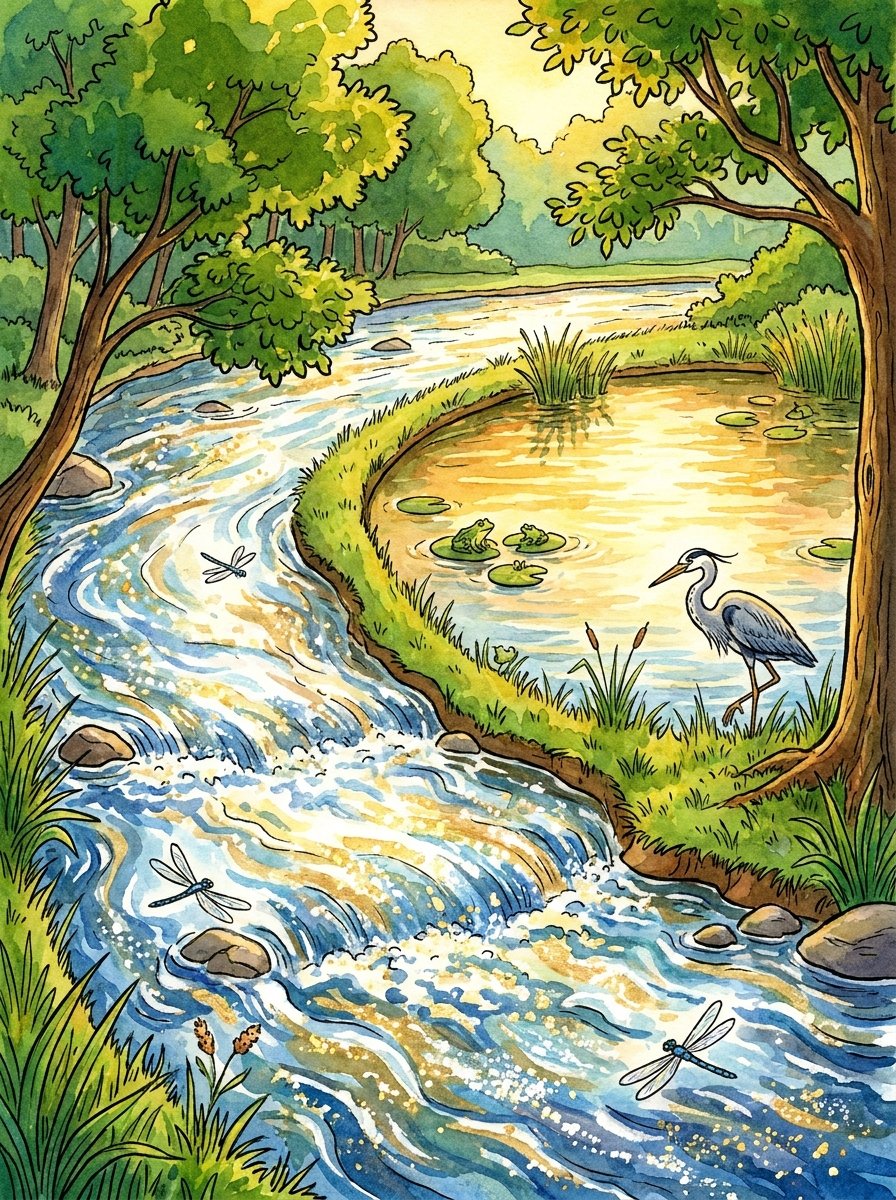
The river ran along the bottom of the garden through a gap in the old stone wall. It was narrower than she'd expected — maybe ten or twelve steps across at the widest point. It was louder too, with a constant rushing sound she had been hearing from her bedroom window all night and had assumed was the road.

She stood on the bank and looked at it.

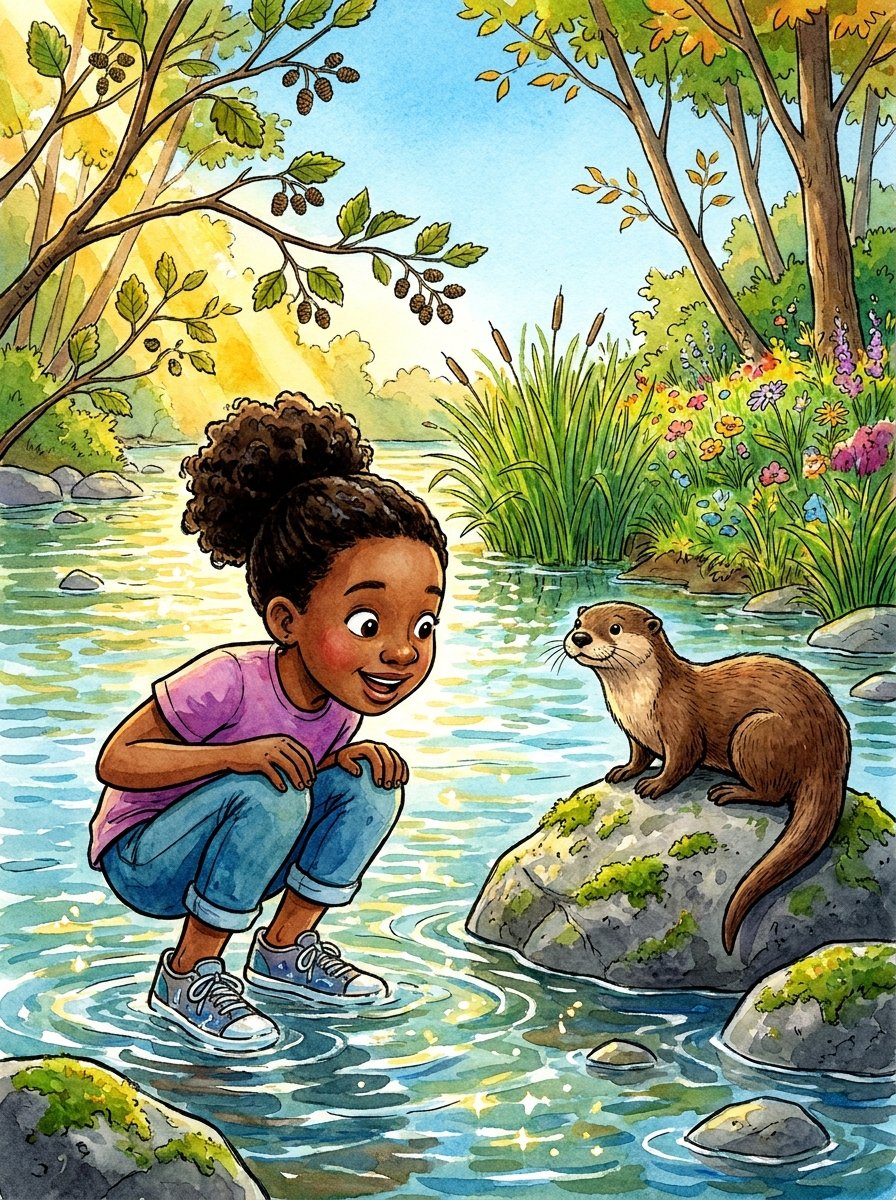
An otter was sitting on a grey boulder in the middle of the water. It was looking back at her with the expression of something that had been waiting for her to arrive and found her arrival entirely unsurprising.

Mira had seen otters in documentaries. She had not expected one to look quite so deliberately at her. Its expression was patient and considering, the expression of an animal that had a fairly clear idea of what was going to happen next.

"Hello," said Mira, because it seemed polite.

"Watch where you step," said the otter.

Mira looked down at her feet. The bank edge was not where she'd thought it was. She was standing on a patch of ground that looked solid and wasn't, and the mud was already coming up around her left shoe.

She stepped back quickly onto firm grass. "Thank you," she said sincerely.

"Move further along," said the otter. "The ground holds better there."

She walked further along the bank to where the grass was short and the earth was firm underfoot. The otter watched her go, then watched her stop.

"Can all otters talk?" said Mira.

"All animals talk," said the otter. "You've been in places where nobody talked to you. That's all." It looked upstream for a moment, then back at her. "Come in when you're ready. Walk on the rocks — not the pale ones. The grey ones with the rough surface."

Mira looked at the river. Several rocks were visible near the bank, some pale and smooth and some dark and rough-textured. She took off her shoes.

"Leave them on," said the otter. "They'll dry."

She put them back on and stepped carefully into the water. The cold came through immediately. The current pressed against her ankles with considerably more force than she'd expected.

She put her foot on a pale, smooth rock and it slid sideways. She shifted quickly to a rough grey one and steadied herself.

"Why does the colour matter?" said Mira, once she had her balance.

"Run your hand along the pale one," said the otter. "Then the grey one."

She crouched and reached down. The pale rock was smooth and slick, almost like wet glass. The grey one was rough and textured beneath her fingers, like coarse sandpaper. She straightened up and looked at the otter.

"The pale rocks are worn smooth by the current," said the otter. "That means the current runs fast over them. Fast water over smooth stone gives your foot nothing to catch on. The grey ones are sheltered — the current is slower there, and the texture grips your sole. Now you know why."

Mira looked at the rocks with a different kind of attention than she'd had a minute ago. The river was the same river. The rocks were the same rocks. She was reading them differently now.

"Is it true in every river?" she said.

"Every river," said the otter. "The shapes change, but the rule holds everywhere."

It slid off its boulder and moved upstream through the water with the specific ease of something built entirely for this purpose. Mira followed, stepping rock to rock, reading the grey from the pale, and getting it right. She missed once — felt her foot slide on a pale rock she'd misjudged — and corrected quickly onto a grey one without going down.

The otter glanced back at her. "You're reading them now," it said. "Keep going and trust what your feet tell you."

She could feel the difference now with her feet as much as her eyes. The rough rocks held her and the pale ones offered nothing, and she knew which was which before she stepped. By the time they stopped at the bend, she had crossed a dozen rocks without slipping once.

They stopped where a large boulder broke the current and threw a long shadow of still water behind it. The otter settled on a flat rock and looked at Mira.

"Where are the fish?" it said.

Mira looked at the water. The current ran fast past the boulder, white and choppy on both sides. She looked downstream where the water smoothed and quieted. She looked at the deep still patch behind the boulder. She looked at the cut bank on the far side, where years of water had eaten under the earth and left a dark overhang above a slow pool.

"Behind the boulder," she said slowly. "And under the bank on the far side."

"Why there?" said the otter.

"Because the water is slow there," said Mira. "Fish wouldn't sit in fast water."

"Fish would spend all their energy fighting the current and have nothing left for anything else," said the otter. "They find the slow water and wait in it. The food comes to them. Everything comes to them if they know where to be still."

Mira looked at the river with new categories now — fast water and slow water, sheltered and exposed. She could see the fish habitat everywhere once she had the idea of it. She found another spot downstream where two currents met and the water flattened and slowed.

"There's another pocket," she said. "Where those two currents meet."

"That's right," said the otter. "You've got the principle."

It slid under the surface without announcing its intention. Three or four seconds later it came up under the cut bank, exactly where it had indicated. It had a small fish, which it ate quickly before climbing back onto its rock. The whole thing took about eight seconds.

"You could see them before you dove," said Mira. "From up here."

"I could see them and smell them," said the otter. "The river here is clear enough to read the bottom through the surface. Look at the water not as something moving but as a window. Try to see what's underneath it."

Mira crouched on a grey rock and looked at the water this way. It was strange at first — she kept catching the surface, the ripples, the reflection of the pale sky. But she kept looking, and gradually the surface seemed to become transparent. She could see through it to the riverbed: dark patches of depth, lighter sandy stretches, waving green fronds of weed. And there in the calm behind the boulder, she saw a shape holding very still. A second shape held still just beside it. She kept looking and found a third, tucked under the edge of the weed.

She straightened up and looked at the otter. "Three," she said, "behind the boulder."

"Four," said the otter. "There's one under the weed on the far side. You'll find it."

She crouched back down and looked. After a moment she found it — further back in the shadow than she'd expected, barely visible.

The otter watched her from its rock without comment, which she was beginning to understand was its way of saying she was doing well.

"The third thing," said the otter. "How to know when the current is about to change."

"The current changes?" said Mira.

"The speed changes, the direction shifts at each bend. The volume increases when rain falls upstream — sometimes hours before you feel it here." The otter moved to a rock closer to midstream and looked upstream. "Watch the surface and tell me what you notice."

Mira looked upstream. The water was moving fast and choppy, breaking white over the scattered rocks above the bend. She watched it for a while, the way she had watched the otter before she understood what to look for. Then she tried watching it the way she had looked at the riverbed — as something to be read, not just observed.

Slowly she noticed that the surface was not uniform. There was a section maybe thirty feet upstream where the water went smoother. A long lens of calm moved through the chop, as if the river there was thinking about something different from the rest of it.

"Something's different up there," she said. "Where the surface goes smooth."

"That means the main current underneath is separating from the surface flow," said the otter. "You'll feel it in about thirty seconds. The direction of the water shifts."

"The birds are flying lower," she said, looking up. The swallows that had been cutting back and forth over the river were closer to the surface now than they had been when she arrived.

"When swallows fly low over water, the surface insects are rising," said the otter. "Insects rise when the water temperature changes. Current shifts come with temperature changes, often."

The smooth lens upstream stretched and widened. The surface went still for a moment — a held breath of water — and then the current shifted. She felt it first in her legs, a change in the pressure against her shins, before she could see anything different on the surface.

"There it goes," said Mira.

"You felt it before you saw it," said the otter.

"In my legs first," said Mira. "Then in the surface."

"The body learns faster than the eyes," said the otter. "That is what the river teaches, in the end."

She stood in the water and thought about this. The river was cold and clear and the sky above it was a thin autumn blue. Rooks went over in long, loose lines. She thought about all the times she had walked past water in the city — the fountains in the square, the canal behind the market, the river near school. She had walked past all of it as if it were a wall. She had never once looked at it as something to be read.

"Does the same thinking apply in other rivers?" she said.

"Same principles everywhere," said the otter. "Different rivers have different characters. This one is quick-tempered — it changes fast, responds fast. The river on the other side of the hill is slower and more considered. You have to learn each one, but what this river teaches you, you take to the next."

They stayed in the water a while longer. Mira stood in the current and read it — found the slow pockets, tracked the surface changes, named the rocks before she stepped on them. She felt the current shift twice more and both times felt it in her legs before she saw it in the surface.

When the light on the far bank went golden, the otter slid toward the deep channel.

"Will you be here tomorrow?" said Mira.

"Come back tomorrow and read it without me," said the otter. "The river will be different tomorrow — it is always different. Pay attention to it and it will always have something new to show you. Come back as often as you like."

It dove cleanly, without a splash, and the water closed over it without a trace.

Mira stood alone in the river. The current pressed against her shins with steady, familiar weight. She read it: the current was moving at a moderate pace, pressing slightly to the right. It was holding steady for now, but with that particular surface quality upstream that meant it would change within the minute.

She waded back to the bank and sat on the grass. Her shoes were soaked through and the sun was going off the water and she was in no particular hurry.

She went back the next morning. The otter was not there, or was somewhere she could not see it. She waded in on the grey rough rocks and stood in the middle of the river and read it. She found the fish behind the boulder. She found the slow pocket under the cut bank. She tracked the surface upstream and felt the current shift in her legs a full thirty seconds before it happened.

She stayed for a long time.

On her way back up the garden she passed her grandfather coming down to check on her.

"Learning anything out there?" he asked.

"Which rocks to stand on," said Mira. "Where the fish wait, and why. How to know when the current is going to change."

He looked at her for a moment. He looked at the river. He looked back at her.

"That'll do you for a lifetime," he said quietly. "Maybe a good deal longer than that."

Preview
Share this story
Kinder Yarns

Listen in the app

Engaging, narrated stories for kids aged 4-10.
↓  App Store ↓  Google Play