← Story Library
Kinder Yarns

What the Shadow Wanted

What the Shadow Wanted

Iris first noticed it on a Wednesday afternoon in October, on the walk home from school.

She was passing the row of silver birches at the edge of the park when a single leaf dropped from the branch above her. She did not reach for it — it was behind her before she thought to try. But her shadow, cast long and thin by the low autumn sun, raised one arm and caught it. When she looked at her hand, it was empty. The leaf lay on the path at her feet.

She stood and looked at it for a long moment. Then she looked at her shadow, and her shadow was quite still, perfectly ordinary, doing nothing at all. She told herself she had imagined it and walked on.

But she kept thinking about it for the rest of the walk, and she could not quite make it sound right inside her head. Her shadow had moved on its own. She had seen it happen. She knew the difference between imagining something and seeing it, and she had seen it.

That evening, trying to remember the walk home, she found a gap. She could remember the school gate and she could remember her own front door, but very little of what came in between.

It happened again on Thursday.

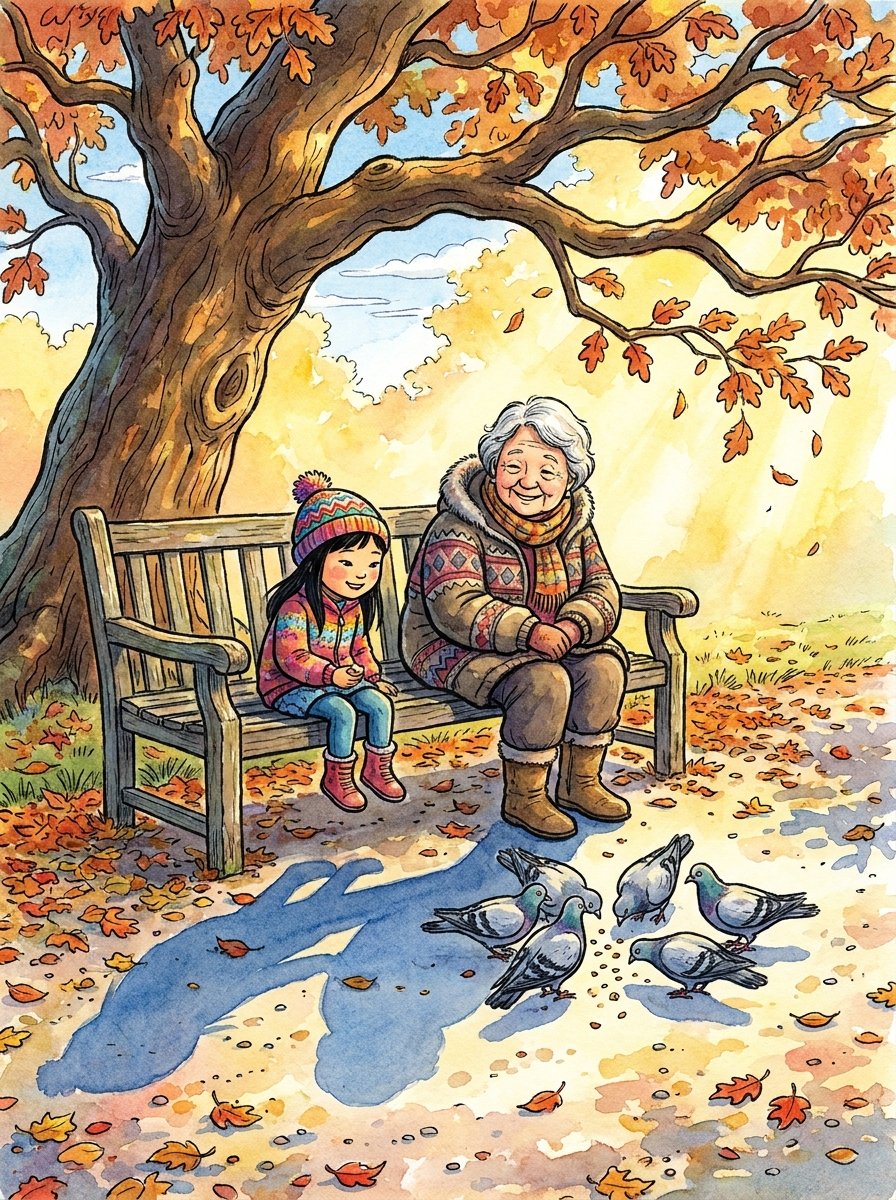
She was walking through the middle of the park, past the old stone bench near the oak tree, when her own feet lost their rhythm for a moment and slowed. Her shadow, she caught in a glance at the path, had stopped completely. It was turned toward the bench. An old woman sat there with her hands folded in her lap, watching the pigeons walk along the gravel path. Iris was already slightly late, so she kept going. The shadow hesitated, and then caught her up.

That evening she could not remember the park at all.

She sat at her desk and tried to piece the walk together from what she had. She had the school gate and the road beside the newsagent and the corner shop and her front door. The park — the path through it, the oak tree, the old stone bench — was simply gone. She knew she had walked through it, the way you know a dream was a dream, but she could not find the details anywhere.

She got out a notebook. She wrote down what she had: school gate, newsagent, corner shop, front door. Then she drew a line between the newsagent and the corner shop and wrote PARK — GONE in the space.

She stared at it for a long time. Then she wrote one word: shadow. She drew an arrow from "shadow" to the gap and looked at the arrow. She did not know what it meant yet, but she had the feeling it was important.

On Friday she walked the same route very slowly, paying attention to everything. She watched the pavement ahead and her shadow beside her and she did not let herself think about anything except the walk itself.

She was almost past the bench when her shadow did it again.

She caught it this time. Her shadow turned — just the head, a slight tilt toward the bench — and paused. She counted two or three seconds before her own feet carried her past and the shadow came after. In those seconds she looked at the bench. The old woman was there again, same coat, same folded hands, watching the sky now instead of the pigeons. Then Iris was past, and the moment was over.

That evening the park was gone again, and this time the corner shop had gone with it.

She spent the weekend with the notebook. She wrote down every walk of the past week in as much detail as she could recover, and she marked the gaps in red. There were five of them, all inside the park, all clustered around the same bench. She drew a circle around the bench on a rough map she made. She looked at the circle for a while. Then she wrote next to it: the shadow stops here every time.

She underlined it twice, firmly.

The shadow was trying to show her something. She was as certain of this as she had been of anything, in the way you are certain of things that make no logical sense but feel unmistakably true.

On Monday she walked past the bench again, this time slowly and deliberately. The old woman was there, same as before — folded hands, patient expression, something unhurried about the way she sat that Iris could not quite account for. She wanted to stop but stopping felt strange when she had no particular reason to give for it, so she kept walking. The shadow paused for a count of four and then came after her.

That evening she forgot the whole second half of school. Two lessons, a conversation at her locker, the walk to the bus stop — all of it simply not there.

"Right," said Iris, aloud, to no one in particular. She felt like someone who had been told the same thing four times and had only just decided to hear it.

On Tuesday she went to the park before walking home. She had no errand there and no reason to hurry anywhere, and she walked straight to the bench and sat down on it.

The old woman was there. She looked at Iris with the patient expression of someone who had not been expecting her but was not especially surprised.

"You've walked past me every day this week," the old woman said.

"I know," said Iris quietly. "I'm sorry I kept going."

"I was exactly the same when I was young," said the old woman. "Always somewhere to be."

They sat without speaking for a moment. Pigeons moved along the path in front of the bench with the deliberate manner of pigeons who had been doing this for years and expected nothing from it. The light through the oak tree was thin and pale and autumn-coloured.

"I've been coming to this bench for forty years," the old woman said. "My husband built it — donated it to the park when our daughter was born, so she'd always have somewhere to sit and watch the pigeons. She loved them — pigeons specifically, not birds in general, just pigeons." She paused for a moment. "She lives in Edinburgh now. I expect she still loves them."

"Do you come every day?" said Iris.

"Most days," said the old woman. "Fewer in winter when the cold gets into my knees. But most days."

They sat in comfortable quiet for a while. A pigeon walked toward the bench with the purposeful air of one that had tried this before.

"What do you feed them?" said Iris.

"I don't feed them anything at all. I just sit here quietly, and the pigeons don't seem to mind that. They have no strong expectations of me. I appreciate that about them."

Iris asked about the bench, and the old woman said her husband had built it from cedar because cedar holds up in all weathers. She ran her hand along the armrest as she said this, in a way that made it clear she had thought about that quite a lot over forty years.

She asked Iris about school, and Iris told her about the history project on the Tudor period. The old woman said she had a history teacher who made the whole class memorise every English monarch from William the Conqueror in strict chronological order. She had done it so thoroughly that she still knew them all now.

"Can you still say them?" said Iris.

The old woman said them. She went all the way through without once stopping, in the comfortable rhythm of something learned long ago and never quite let go. Iris counted along in her notebook and confirmed all forty were there and in the right order.

"There are a lot of them," Iris said.

"There are," said the old woman cheerfully. "And some of them were genuinely very mediocre indeed."

Iris laughed. The pigeons, startled, moved a short distance along the path and then resumed their investigations.

Dorothy — for that was her name, as Iris had learned when she asked — had been a teacher herself for thirty-two years, mostly small children, mostly maths. She asked about Iris's family, and Iris told her about her parents and her younger brother. He was seven and had recently become interested in rocks for reasons nobody in the family could entirely explain. Dorothy said that was a perfectly sensible interest. She had a friend who had been interested in rocks at exactly the same age and was now a geologist, which seemed like a reasonable outcome.

"What about you?" Dorothy asked. "What are you interested in?"

Iris thought about it. "Noticing things," she said, which surprised her a little because she hadn't planned to say it.

Dorothy looked at her with an expression that was not quite a smile. "That's a good one," she said. "That's a useful one to have."

The light changed as they talked. A cloud crossed the sun and the park went grey for a moment, then warm again as it passed through. Iris realised she had been sitting on the bench for almost half an hour.

"Come back whenever you like," said Dorothy. "The bench will always be here, and most days I will be too."

"I will come back," said Iris. "Definitely."

Dorothy nodded and looked up at the oak tree. Its branches were almost bare now, only a few copper leaves still holding on. "It will look different in winter," she said. "The bench is better then, actually — you can see all the way to the far end of the park."

She walked home by the usual route. And as she went, things came back.

She remembered the leaf dropping from the silver birch and her shadow raising one arm to catch it. She remembered the newsagent's window with its arrangement of magazines she had looked at without meaning to. She remembered the smell of bread from the corner shop on the three days she had passed it. Then the park came back — all the parks of the past week together. She got the oak tree and the gravel path and the particular quality of the light in the afternoons. She got the old woman on the bench with her folded hands, and the pigeons walking toward her without expectation.

She also got back a Tuesday afternoon from the week before. It was a moment on the bus — she had been looking out the window at the river and had felt, briefly, that everything was going to be fine. She had forgotten that feeling entirely and was very glad to have it back. She wondered, as she walked, how many other small things she had let pass by in the ordinary rush of days. There must be many — moments and feelings that had slipped between the cracks because she had not been paying attention.

She remembered all of it, and it was a whole week's worth of afternoons, and it came back fast.

By the time she reached her own front door, she had all of it.

She stood on the step and thought about Dorothy. Dorothy had been coming to that bench every day for forty years, in the cold and in the warmth and in all the ordinary weather in between. She thought about how many times she had walked through the park without once stopping. She thought about how many other people walked past that bench every day and kept going, and she thought it was probably quite a lot of people.

Then she looked down at her shadow on the front step.

It was doing nothing unusual. It stood beside her in the late afternoon light, the shape of a girl, quite still, quite ordinary. She had the sense that it was finished. Whatever it had been trying to show her, it had shown her, and this was the end of the lesson.

She thought it had been a patient teacher, for a shadow.

She went back to the bench on Thursday. Dorothy was there, in the same coat, with the pigeons making their usual investigations along the path. They talked for a while about the history project and the best methods for memorising things under pressure. Dorothy also recommended a film she had seen in 1974 that she described as difficult to summarise but involving light and a great deal of patience.

"How do you know I'd like it?" said Iris.

"You're the sort of person who notices things," said Dorothy. "That kind of film rewards noticing. You should try to find it."

Iris thought about this for the rest of the walk home. She thought about it in the quiet and particular way she had started to think about things recently — slowly, paying attention to all of it.

She thought that her shadow had told her she was that kind of person before Dorothy said it. She had just not been paying quite close enough attention to hear it.

Preview
Share this story
Kinder Yarns

Listen in the app

Engaging, narrated stories for kids aged 4-10.

↓  App Store ↓  Google Play